Feral Hogs in North America: Origins, Biology and Range
Feral hogs in North America are nonnative Sus scrofa that come from escaped domestic pigs, introduced Eurasian wild boar, and hybrids. They reproduce quickly, eat many foods, damage farms and habitat, and can carry diseases that matter to hunters, landowners, pets, livestock, and wildlife.
By RaiS. Reviewed by RaiS. Published . 8 min read.
Research and drafting were assisted by AI. RaiS checked the facts against the sources below and approved this page.
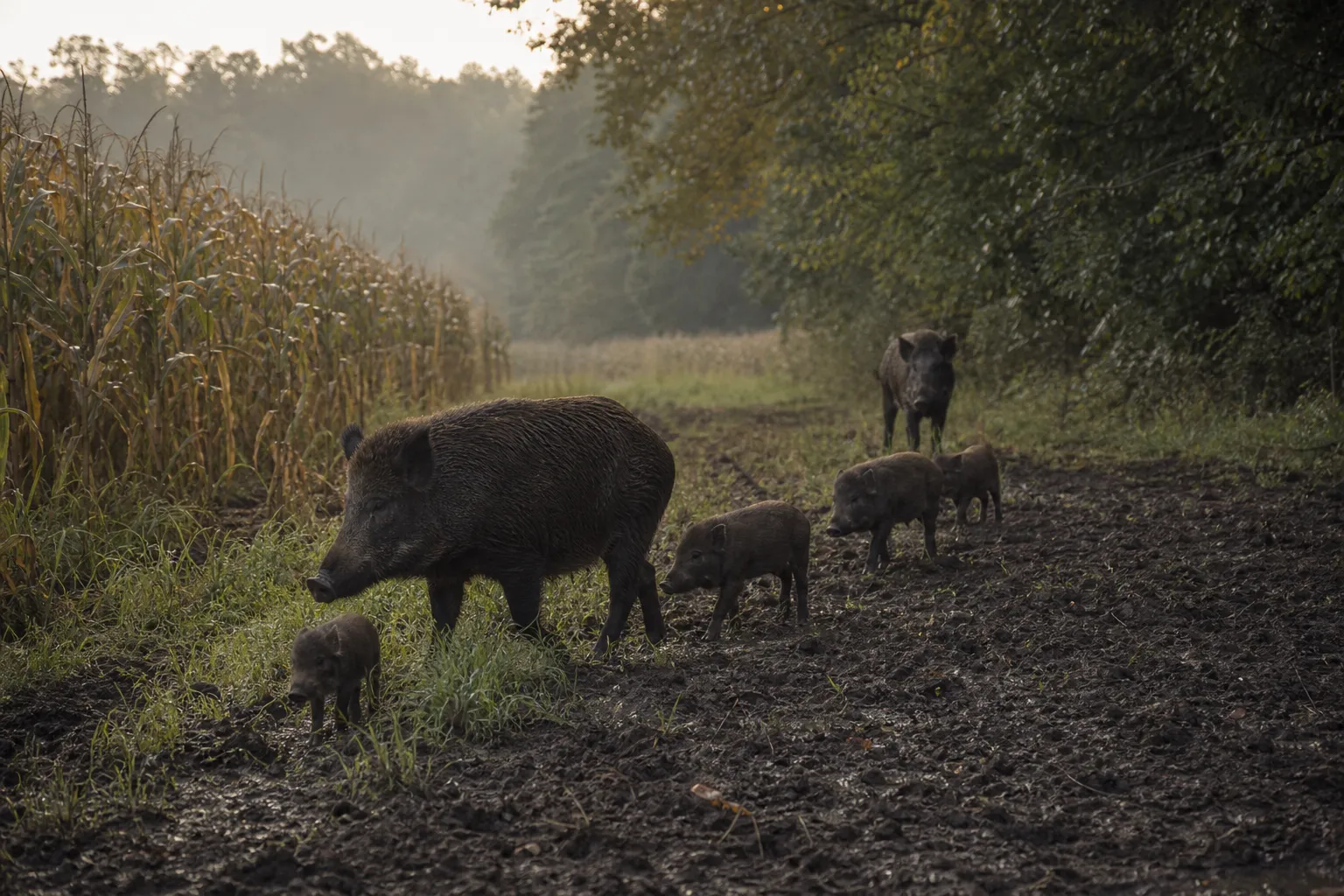
Feral hogs are nonnative wild living pigs in the species Sus scrofa. In North America, they come mainly from escaped or released domestic pigs, Eurasian or Russian wild boar brought in for livestock or sport hunting, and hybrids of the two. They matter because they reproduce quickly, adapt to many habitats, damage crops and natural areas, and can carry diseases that affect people, pets, livestock, and wildlife.
Names, origins and what “feral hog” means
USDA APHIS states that feral swine are not native to North America. The same animal may be called a feral hog, feral swine, wild pig, wild hog, razorback, Eurasian wild boar, Russian wild boar, or a hybrid, depending on local usage and ancestry.
Ontario’s invasive wild pig strategy states that Eurasian wild boar and domesticated pigs belong to the same species, Sus scrofa. That is why domestic pigs, Eurasian wild boar, and their hybrids can all be discussed together when agencies talk about wild pigs or feral swine.
USDA APHIS says early explorers and settlers brought swine into what is now the United States in the 1500s as a food source. APHIS also says free range livestock practices and escapes from enclosures led to the first establishment of feral swine populations in the United States.
A second pathway came later. USDA APHIS says Eurasian or Russian wild boar were introduced into parts of the United States in the 1900s for sport hunting. APHIS describes present day feral swine in the United States as a mix of escaped domestic pigs, Eurasian wild boars, and hybrids.
Canada has a similar domestic livestock connection in several provinces. Alberta says wild boar were brought to Alberta as livestock in the 1980s and 1990s, and some escaped and established feral populations. Saskatchewan says wild boar were imported to the province in the late 1970s as domestic livestock, escaped from farms, and created reproducing wild populations. Manitoba says current free ranging wild boar are escaped farm animals or their descendants, often with mixed wild boar and domestic pig genetics. Ontario says Eurasian wild boar were first introduced to Canada from Europe beginning in the 1980s as exotic livestock for meat.
Identification: body, coat, tracks and field sign
USDA APHIS says adult feral swine average 75 to 250 pounds, can reach 3 feet tall and 5 feet long, and males are larger than females. Their appearance varies because many populations include domestic pig, wild boar, and hybrid ancestry.
| Feature | What official sources describe |
|---|---|
| Build | USDA APHIS says feral swine often resemble domestic hogs but are generally thinner. |
| Hair and hide | USDA APHIS describes coarse, bristly hair and thicker hides. |
| Tusks | USDA APHIS says feral swine have longer tusks than domestic hogs. |
| Color | USDA APHIS says color and coat patterns vary, including white, black, brown, and red. |
| Piglets | USDA APHIS says piglets are often striped or spotted. |
| Tracks | USDA APHIS says tracks can resemble deer tracks but have blunter tipped toes and a square track shape. |
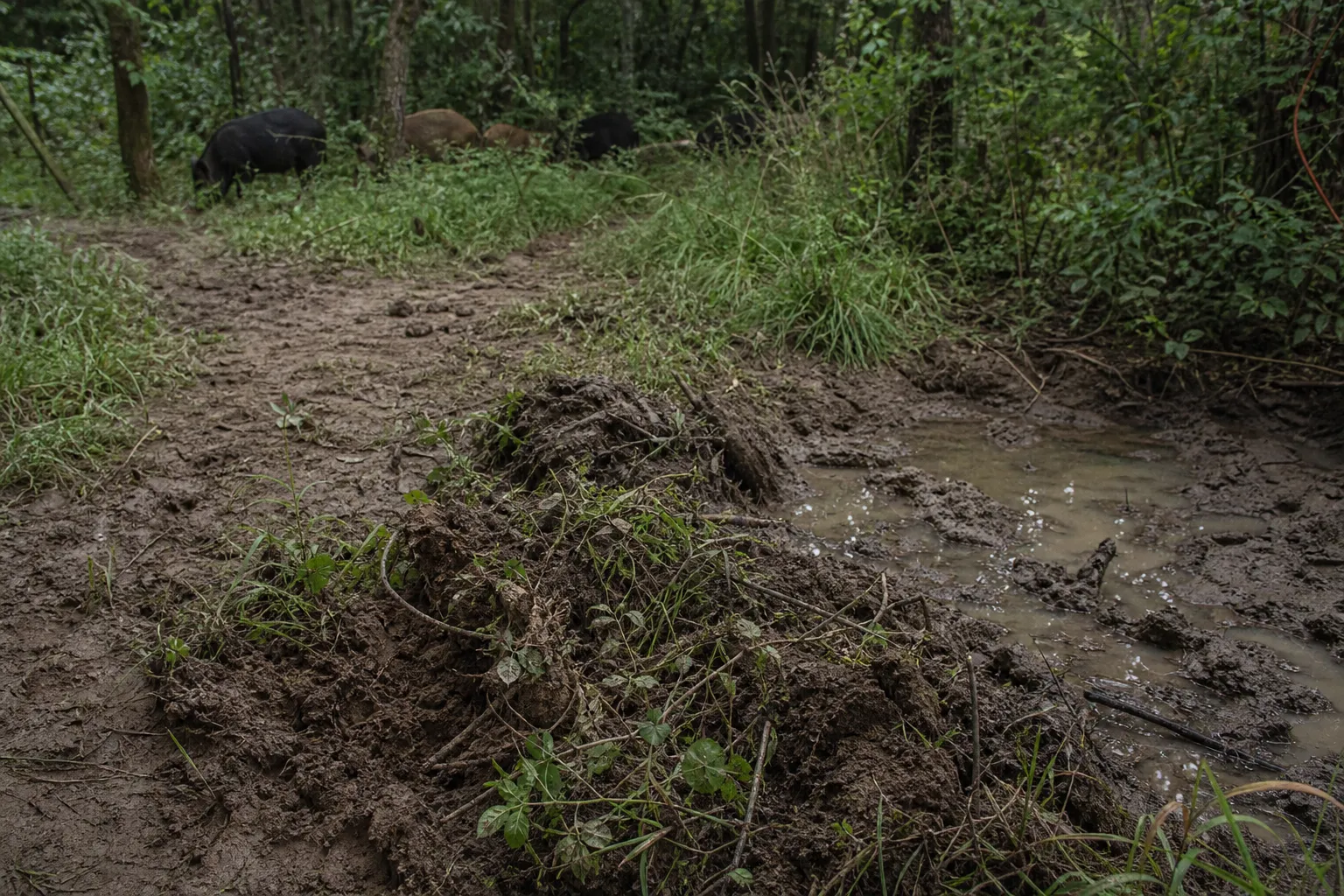
Sign is often easier to find than the animals themselves. USDA APHIS lists common signs of feral swine presence as rooting, wallows, tree rubbing, trails through thick vegetation, hoof tracks near water, and scat.
Rooting is the turned over soil left when pigs use their snouts to dig. Alberta says wild boar use their snouts to dig and root for insects and roots. Wallows are muddy areas used by hogs, and rubs are places where mud and hair may be left on trees or other objects after hogs rub against them.
Behavior: sounders, boars and nighttime movement
USDA APHIS says feral swine travel in family groups called sounders, made up of two or more adult sows and their young. Alberta also describes wild boar as living in matriarchal groups called sounders.
Adult males are different. Texas A&M AgriLife Extension says boars are generally solitary and join family groups only to breed. That means a single large hog seen alone may not represent the whole local group using an area.
USDA APHIS says feral swine are usually active at night, so they are less often seen in daylight, especially in hot, humid climates. For hunters and landowners, that explains why fresh sign may appear even when few animals are seen during the day.
Texas A&M AgriLife Extension says feral hogs prefer dense brush for cover but may also be found in open range and grassy areas. Manitoba says invasive swine can survive harsh weather, varied habitats, and the presence of people.
Reproduction: why populations can grow quickly
Feral hog numbers can grow rapidly because breeding can happen throughout the year. USDA APHIS says feral swine can breed year round, have up to two litters of 4 to 12 piglets per year, and mature at 6 to 8 months.
Alberta gives a similar warning about early maturity, saying females can mature as early as 6 months and litters average 6 piglets. These reproductive traits are one reason agencies treat wild pigs as a serious invasive animal concern.
Diet: what feral hogs eat
Alberta says wild boar are omnivores that eat plants, insects, and other animals. This description helps explain why hog sign can show up in crop fields, pastures, wetlands, brushy cover, and around water.
USDA APHIS says feral swine damage crops by consuming them and through rooting, trampling, and wallowing. APHIS lists field crops targeted by feral swine as sugar cane, corn, grain sorghum, soybeans, wheat, oats, peanuts, and rice.
Range in the United States and Canada
For the United States, USDA APHIS is the best starting point for current distribution. APHIS describes the history of feral swine establishment and expansion, and its county distribution map is the current visual reference readers should use for United States range.
Because feral hog distribution can change, avoid relying on old maps, rumors, or a single sighting. Hunters and landowners should confirm current local information with USDA APHIS and with the state wildlife or agriculture agency before planning any hunting or control work.
In Canada, official provincial sources point to a prairie core. Ontario’s invasive wild pig strategy says wild pigs in Alberta, Saskatchewan, and Manitoba are growing in number. Alberta, Saskatchewan, and Manitoba each describe escaped or formerly farmed wild boar as part of the origin of free ranging populations in those provinces.
Saskatchewan reported in a June 28, 2016 release that free ranging wild boar had been reported in more than 60 rural municipalities across southern Saskatchewan. Manitoba says invasive swine can survive harsh weather, varied habitats, and the presence of people. Alberta says wild boar in the province were brought in as livestock in the 1980s and 1990s, and some escaped and established feral populations.
Ontario’s 2021 invasive wild pig strategy says established populations of wild pigs are not known in the Canadian territories or Atlantic Canada. For any Canadian province or territory, readers should check the current provincial or territorial agency page before assuming presence, rules, or reporting procedures.
Crop, pasture and habitat damage
USDA APHIS says feral swine damage crops by consuming them and through rooting, trampling, and wallowing. For landowners, that damage can show up as missing crop, broken plants, rutted soil, wallowed wet spots, and turned sod.
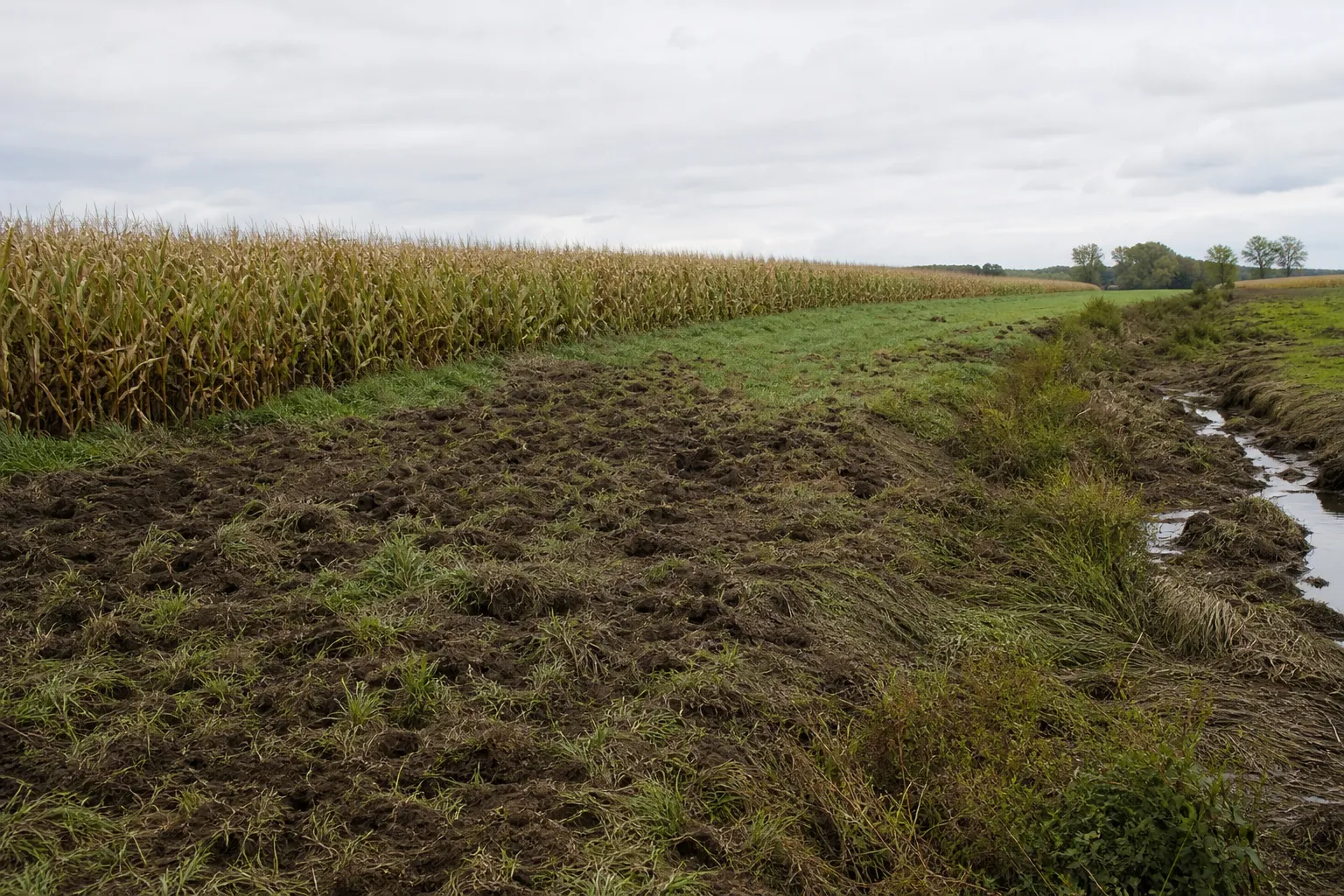
USDA APHIS says feral swine damage pasture by turning over sod and pasture while rooting for roots, grubs, and invertebrates. APHIS also says feral swine may eat or contaminate livestock feed, mineral supplements, and water sources.
Natural areas can be affected too. USDA APHIS says feral swine pollute and degrade water quality, reduce forest regeneration, and kill or displace native wildlife. APHIS also says rooting and wallowing increase erosion, especially along waterways and in wetlands.
Manitoba describes similar impacts, saying invasive swine feeding behavior, especially rooting, can reduce water quality, increase erosion, damage native plants and crops, and harm wildlife populations.
Disease risks for people, pets, livestock and wildlife
USDA APHIS says feral swine can carry at least 30 viral and bacterial diseases and nearly 40 parasites transmissible to humans, pets, livestock, and wildlife. APHIS lists leptospirosis, toxoplasmosis, brucellosis, tularemia, trichinellosis, swine influenza, salmonella, hepatitis, and pathogenic E. coli as organisms or pathogens carried by feral swine that can infect people.
USDA APHIS says the most common human transmission routes are handling or butchering feral swine, or eating meat that is not cooked thoroughly. CDC says hunters can get brucellosis if blood, body fluid, or tissues from an infected feral swine contact the eyes, nose, mouth, or cuts in the skin.
Brucellosis deserves special attention. USDA APHIS says swine brucellosis is caused by Brucella suis and is still present in wild swine in the United States. APHIS also says swine brucellosis can infect people and anyone exposed to infected pigs should contact a health provider immediately.
Basic precautions are simple and important. USDA APHIS says gloves should be worn when handling feral swine carcasses. CDC says game meat from feral swine should be cooked to an internal temperature of 160°F measured with a food thermometer, and APHIS gives the same 160°F internal temperature for meat.
CDC also advises hunters not to feed dogs raw feral swine meat or let dogs play with feral swine carcasses. If a person becomes ill after exposure to feral swine, APHIS says anyone exposed to infected pigs should contact a health provider immediately. If a dog has contact with a carcass or raw meat and becomes ill, contact a veterinarian.
What to check before hunting or control work
Feral hog rules are not the same everywhere. This guide explains origins, biology, range, damage, and health risk, but it does not replace current regulations.
Before hunting, reporting, trapping, transporting, or doing any control work, check the official agency for the exact state, province, or territory. In the United States, that may include the state wildlife agency, state agriculture agency, and USDA APHIS. In Canada, check the provincial or territorial wildlife, agriculture, or invasive species agency. Confirm current range information, seasons or permissions, reporting requirements, disease guidance, and any restrictions that apply where you are.
Frequently asked questions
Are feral hogs native to North America?
No. USDA APHIS states that feral swine are not native to North America.
Where did North American feral hogs come from?
USDA APHIS says early explorers and settlers brought swine into the United States in the 1500s, and free range livestock practices and escapes helped establish feral populations. APHIS also says Eurasian or Russian wild boar were introduced into parts of the United States in the 1900s for sport hunting.
How can I identify feral hog sign?
USDA APHIS lists common signs as rooting, wallows, tree rubbing, trails through thick vegetation, hoof tracks near water, and scat. APHIS says their tracks can resemble deer tracks but have blunter tipped toes and a square shape.
How fast do feral hogs reproduce?
USDA APHIS says feral swine can breed year round, have up to two litters of 4 to 12 piglets per year, and mature at 6 to 8 months.
What diseases are associated with feral hogs?
USDA APHIS says feral swine can carry diseases and parasites transmissible to people, pets, livestock, and wildlife. APHIS lists leptospirosis, toxoplasmosis, brucellosis, tularemia, trichinellosis, swine influenza, salmonella, hepatitis, and pathogenic E. coli among organisms or pathogens that can infect people.
What precautions should hunters take with feral hog meat?
USDA APHIS says gloves should be worn when handling feral swine carcasses. CDC says game meat from feral swine should be cooked to an internal temperature of 160°F measured with a food thermometer, and CDC advises hunters not to feed dogs raw feral swine meat or let dogs play with carcasses.
Sources
- Feral Swine: Damages, Disease Threats, and Other Risks, USDA Animal and Plant Health Inspection ServiceOfficial source. Accessed October 25, 2026.
- Feral Swine Population Distribution, USDA Animal and Plant Health Inspection ServiceOfficial source. Accessed October 25, 2026.
- Identifying Feral Swine, USDA Animal and Plant Health Inspection ServiceOfficial source. Accessed October 25, 2026.
- Feral Swine Damage: Agriculture, USDA Animal and Plant Health Inspection ServiceOfficial source. Accessed October 25, 2026.
- Feral Swine Damage: Natural Resources, USDA Animal and Plant Health Inspection ServiceOfficial source. Accessed October 25, 2026.
- Feral Swine Damage: Pets and People, USDA Animal and Plant Health Inspection ServiceOfficial source. Accessed October 25, 2026.
- Swine Brucellosis, USDA Animal and Plant Health Inspection ServiceOfficial source. Accessed October 25, 2026.
- Feral Swine Hunters: Protect Yourself and Your Family from Brucellosis, Centers for Disease Control and PreventionOfficial source. Accessed October 25, 2026.
- Managing Feral Hog Damage, Texas A&M AgriLife ExtensionOfficial source. Accessed October 25, 2026.
- About wild boar, Government of AlbertaOfficial source. Accessed October 25, 2026.
- Invasive Swine, Government of ManitobaOfficial source. Accessed October 25, 2026.
- Government Amends Feral Wild Boar Regulations, Government of SaskatchewanOfficial source. Accessed October 25, 2026.
- Wild Pig Fact Sheet, Government of OntarioOfficial source. Accessed October 25, 2026.
- Ontario’s Strategy to Address the Threat of Invasive Wild Pigs, Government of OntarioOfficial source. Accessed October 25, 2026.