How Laser Rangefinders Work
Laser rangefinders measure distance by timing reflected laser light, then display either line of sight distance or a mode specific adjusted value. For hunters, the useful reading depends on target reflectivity, beam placement, angle, mode selection, and staying inside practiced shooting limits.
By RaiS. Reviewed by RaiS. Published . 6 min read.
Research and drafting were assisted by AI. RaiS checked the facts against the sources below and approved this page.
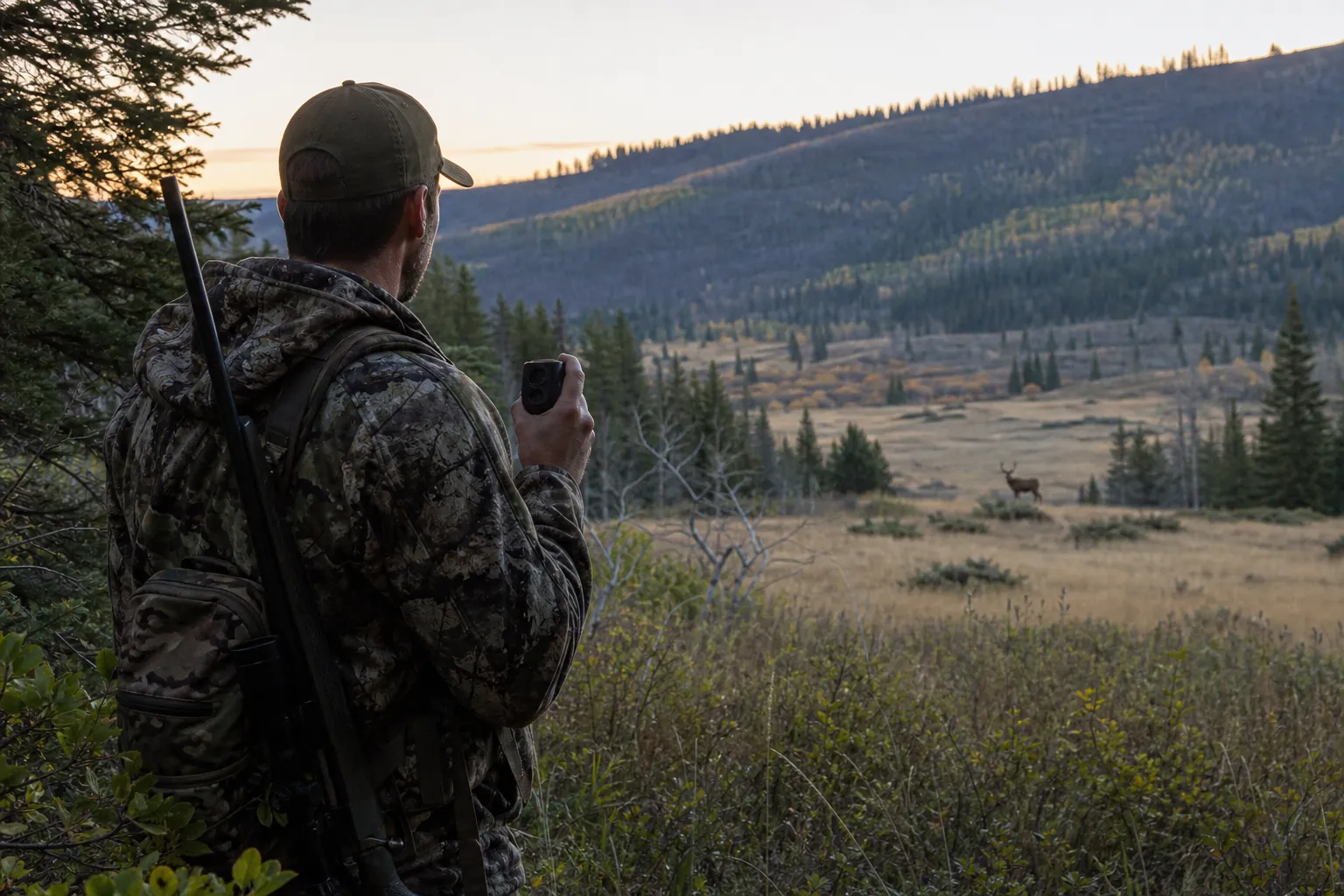
A laser rangefinder measures distance by sending timed laser light toward a target, detecting reflected light, and converting the return time into range. The USGS defines lidar as measuring distance by emitting timed light pulses and measuring the time between emission and the received reflection. For bow and rifle hunters, the important question is not just how far the target is, but what the rangefinder actually ranged, which mode it used, and whether that number matches the shot you are preparing to take.
The basic measurement: timed light out and back
A laser rangefinder is a time-of-flight instrument. In plain terms, it sends laser light out, receives a reflection, and uses the return time to calculate distance. Infiniti Electro-Optics describes a rangefinder receiver detecting reflected laser light and calculating distance from the time it took the light to return.
Field performance is more complicated than simply pressing a button. The instrument needs enough reflected signal from the intended object, and that signal can be affected by the target, the background, the angle, and the conditions between you and the target.
Why rangefinder readings vary in the field
Manufacturers describe several reasons why two range readings may differ, or why a rangefinder may read one object more easily than another. Leupold says lighting, fog, and rain may reduce the effective maximum range of a laser rangefinder.
Reflectivity, color, size, and angle
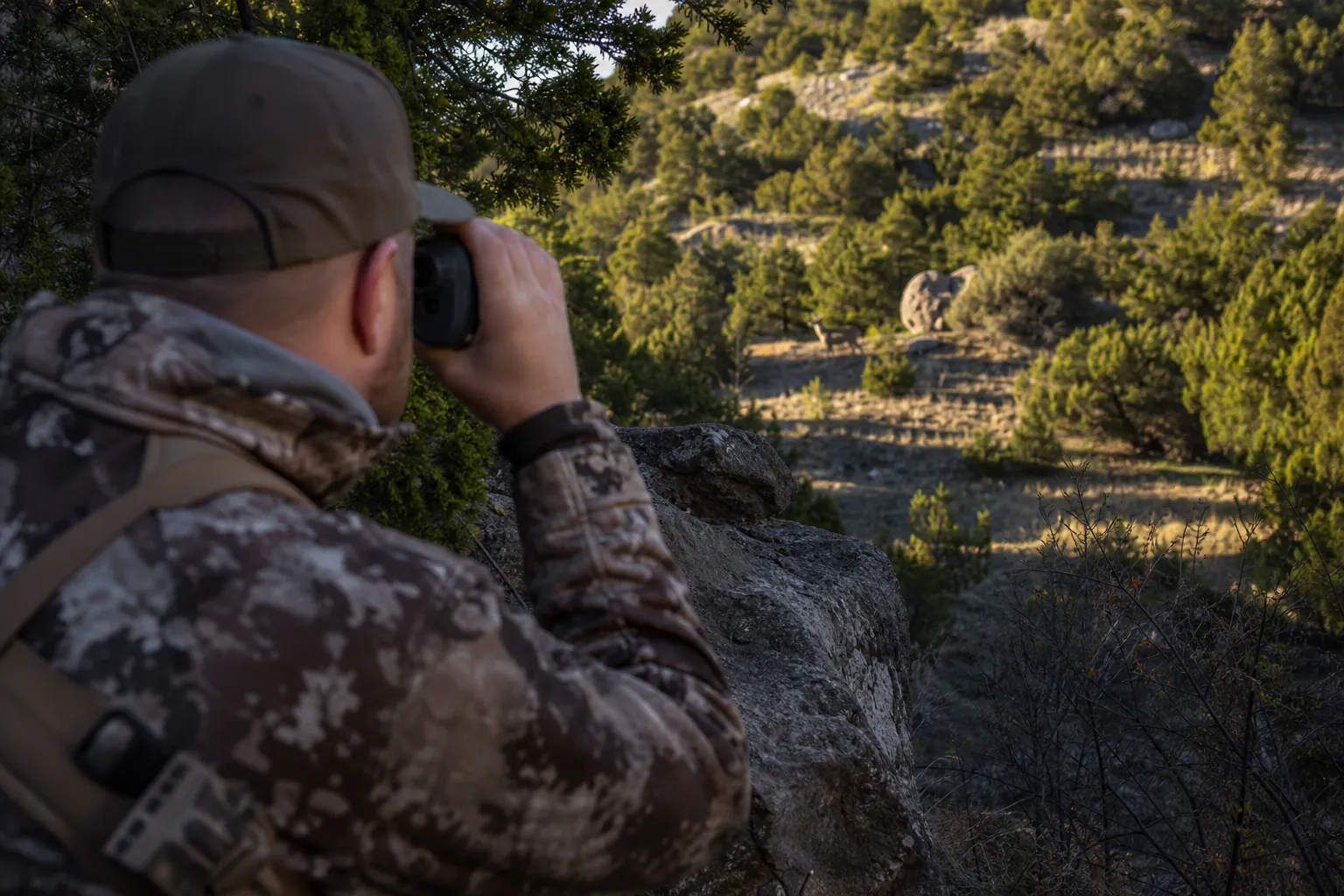
Target reflectivity matters. Infiniti Electro-Optics states that a shiny surface reflects laser light better than a dull surface, and that brightly colored or glossy objects tend to reflect better than dark colored or matte finish objects.
Target size also matters. Infiniti Electro-Optics explains that a target larger than the projected beam can reflect far more light than a target smaller than the beam. The same company also notes that the projected beam size expands as it gets farther from the rangefinder.
The angle of the target surface matters too. Infiniti Electro-Optics states that the most effective reflected light occurs when the beam impacts at 90 degrees, or perpendicular, to the object’s surface. A slanted surface may return less useful signal than a flat surface facing the rangefinder.
Beam divergence
Beam divergence describes how the laser beam spreads with distance.
Beam divergence is also a real specification on rangefinder data sheets. Leica lists laser beam divergence as a technical specification for its Rangemaster CRF Max, with a listed value of 1.2 x 0.96 mrad.
For hunters, the takeaway is simple: the laser beam covers an area, not a perfect dot. At longer distances, or in cluttered cover, part of the beam may contact brush, grass, rocks, a background object, or another surface near the intended target. The rangefinder’s target mode helps decide which return it displays.
Line-of-sight range and angle-compensated range
Vortex defines line-of-sight mode as the actual line-of-sight range from the rangefinder to the target, along with the slope angle. This is the direct distance along the viewing line.
Vortex defines HCD mode as the slope-angle-compensated distance to the target.
The Alaska Department of Fish and Game bowhunter teaching guide lists steep uphill or downhill shots as a factor that affects distance judgment. Angle-compensated modes exist for this type of situation, but the exact labels and outputs vary by manufacturer.
SIG Sauer also states that line-of-sight distance is preferred for long-range shooters and hunters using an external ballistic calculator. That distinction matters: one mode may be meant to show the direct measured distance, while another may be meant to show a horizontal or slope-adjusted value.
First target, last target, and best target modes
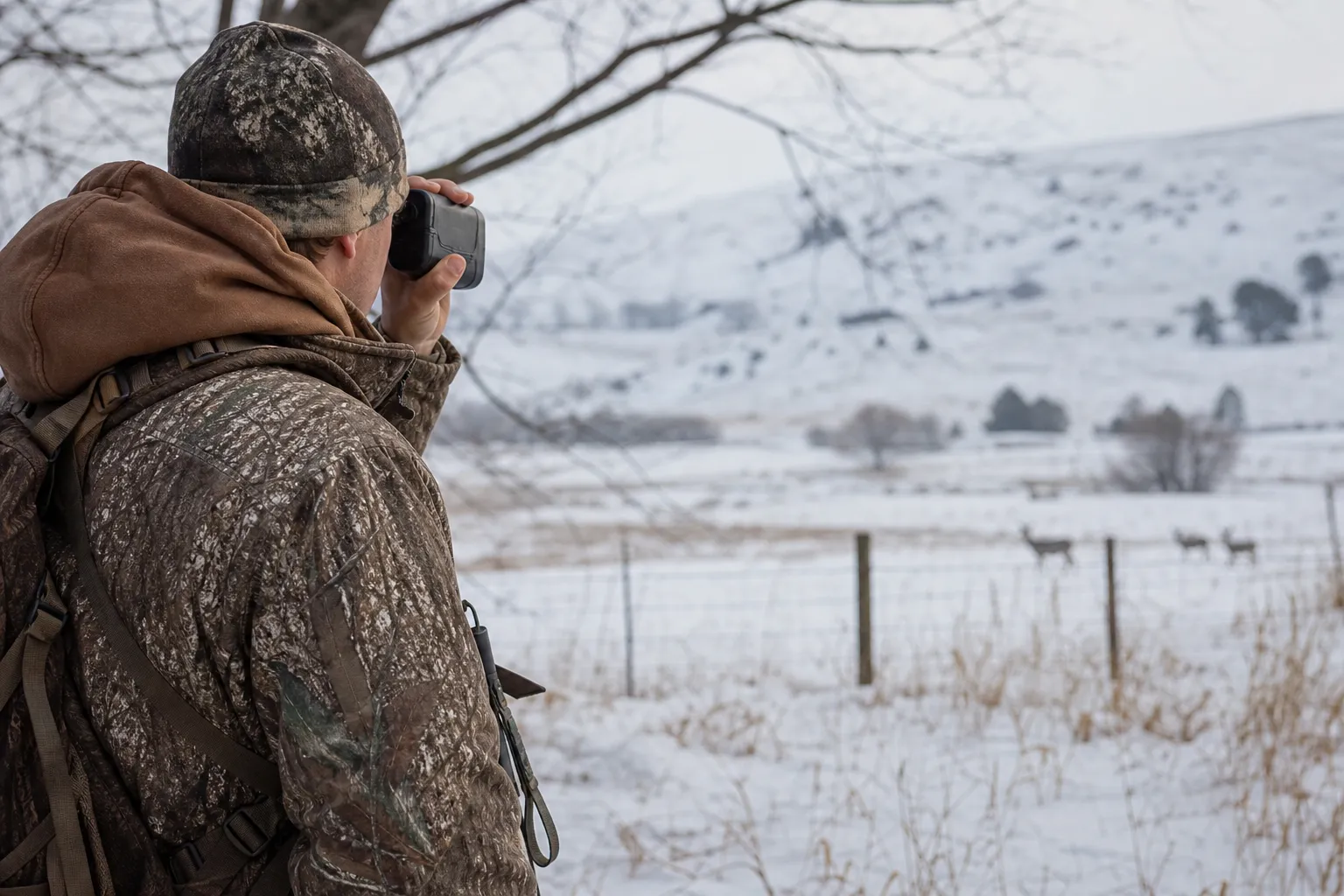
Target priority modes tell the rangefinder which return to display when more than one object may be inside the beam or along the line of sight. Nikon defines First Target Priority as displaying the closest overlapping subject and Distant Target Priority as displaying the farthest overlapping subject.
| Mode name | What manufacturers say it displays | Field use described by manufacturers |
|---|---|---|
| First Target Priority or First Mode | Nikon says First Target Priority displays the closest overlapping subject. Vortex says First Mode displays the closest distance when ranging. | Vortex says First Mode is useful for a smaller target in front of larger or more reflective objects. |
| Distant Target Priority or Last Mode | Nikon says Distant Target Priority displays the farthest overlapping subject. Vortex says Last Mode displays the farthest distance when ranging. | Vortex says Last Mode is useful for a target behind brush, trees, or rocks. SIG Sauer says Last Target is ideal for ranging through foliage. |
| Best Target | SIG Sauer says Best Target displays the range of the target with the strongest received signal. | This mode is based on strongest received signal, according to SIG Sauer. |
Mode names differ by brand and model. The same field scene can produce different displayed ranges if one mode prioritizes the nearest return, another prioritizes the farthest return, and another prioritizes the strongest return.
Angle compensation is not the same as a ballistic solver
Simple angle compensation and full ballistic solving are related, but they are not the same thing. Vortex describes HCD as a slope-angle-compensated distance. Ballistic-solving models can go farther by outputting holds or corrections tied to ballistic data.
SIG Sauer’s KILO CANYON manual says its ballistic groups can provide AMR range along with holdover in either MOA or MRAD. Leica lists ballistic functions for the Rangemaster CRF Max that include Equivalent Horizontal Range, holdover, click correction, and windage and elevation unit correction. Leica also lists Applied Ballistics Elite as onboard for that model.
Some systems use stored profiles and environmental or ballistic inputs. SIG Sauer’s KILO6KHD manual says its BDX App can create and modify up to 25 profiles, with one active profile at a time. The same manual says the display can show range, environmental, and ballistic information, including wind, ambient temperature, ballistic coefficient, bullet weight, altitude, and muzzle velocity calibration.
SIG Sauer also states that the rangefinder must be in ABU mode to calculate real-time ballistic solutions and send them to a SIG BDX riflescope by Bluetooth. For archery, SIG Sauer says its archery mode requires arrow speed in feet per second and produces an equivalent flat-range shoot-to distance.
The practical difference is this: an angle-compensated number may be a horizontal or slope-adjusted distance, while a ballistic solver may produce a holdover, click correction, or other shooting solution based on the model’s inputs and settings.
Laser safety basics
Nikon gives a rangefinder-specific warning in its manual: do not look toward the objective-lens side while the laser irradiation mark is shown. That warning matters because the objective side is the side from which the laser is emitted.
Use the safety label and manual for the exact device in your hand. Do not point any laser rangefinder at a person, and do not look into the beam path through optics.
Why accurate range matters for ethical shots
Accurate distance is part of ethical shot preparation. The Alaska Department of Fish and Game bowhunter teaching guide says accurate distance judgment is critical in bowhunting because arrows have a short trajectory and because distance is critical for shot placement.
Texas Parks and Wildlife Department says a hunter’s goal should be a well-placed shot to the vital organs for a quick, clean kill, minimizing suffering and maximizing recovery. Kentucky Department of Fish and Wildlife Resources warns that misjudging 30, 35, and 40 yard archery distances may result in a wounded elk or a complete miss.
A rangefinder can help remove guesswork, but it does not replace practice. Kentucky Department of Fish and Wildlife Resources says practice helps hunters learn how far they can comfortably shoot and that they should not exceed that limit in the field.
What to check before relying on a rangefinder
Before using a rangefinder for hunting, read the manual for the exact model’s target modes, line-of-sight mode, angle-compensated mode, ballistic functions, and laser warnings. If a rangefinder provides ballistic or archery solutions, confirm which inputs it uses, such as profiles, environmental information, bullet data, or arrow speed.
Also check current hunter education and wildlife-agency materials where you hunt for shot-placement and distance-judgment guidance. A good range reading is only useful when it supports a shot you have practiced and can make within your own effective range.
Frequently asked questions
How does a laser rangefinder measure distance?
It sends timed laser light toward a target, detects reflected light, and converts return timing into range. The USGS describes lidar as measuring distance with timed light pulses and received reflections.
Why does a rangefinder read some targets better than others?
Manufacturers identify several factors: target reflectivity, color, size, surface angle, beam size at distance, lighting, fog, rain, and whether the beam reaches the intended target.
What is beam divergence?
Beam divergence describes how the laser beam spreads with distance.
What is the difference between first and last target modes?
Nikon says First Target Priority displays the closest overlapping subject, while Distant Target Priority displays the farthest overlapping subject. Vortex says Last Mode can be useful for a target behind brush, trees, or rocks.
Is angle-compensated range the same as a ballistic solution?
No. Vortex describes HCD as a slope-angle-compensated distance. Ballistic-solving models can add outputs such as MOA or MRAD holdover, click correction, or profile-based solutions.
Are laser rangefinders safe for eyes?
Follow the safety label and manual for the exact device in use. Nikon warns users not to look toward the objective-lens side while the laser irradiation mark is shown.
Sources
- FAQs, SIG SauerOfficial source. Accessed October 23, 2026.
- Lidar Base Specification: Glossary, U.S. Geological SurveyOfficial source. Accessed October 23, 2026.
- EM 1110-1-2910, Remote Sensing, U.S. Army Corps of EngineersOfficial source. Accessed October 23, 2026.
- LRF Performance: Ranging Limitations of Laser Range Finders, Infiniti Electro-Optics. Accessed October 23, 2026.
- FAQ, Safran Vectronix UltisenseOfficial source. Accessed October 23, 2026.
- Leica Rangemaster CRF Max Technical Specification, Leica CameraOfficial source. Accessed October 23, 2026.
- Rangefinder Troubleshooting, LeupoldOfficial source. Accessed October 23, 2026.
- How Laser Rangefinder Modes Work, Vortex OpticsOfficial source. Accessed October 23, 2026.
- KILO CANYON Operator’s Manual, SIG SauerOfficial source. Accessed October 23, 2026.
- Nikon PROSTAFF 7i Laser Rangefinder Instruction Manual, NikonOfficial source. Accessed October 23, 2026.
- KILO6KHD Manual, SIG SauerOfficial source. Accessed October 23, 2026.
- Frequently Asked Questions About Lasers, U.S. Food and Drug AdministrationOfficial source. Accessed October 23, 2026.
- Today’s Bowhunter Teaching Guide, Alaska Department of Fish and GameOfficial source. Accessed October 23, 2026.
- Shots to the Vital Areas, Texas Parks and Wildlife DepartmentOfficial source. Accessed October 23, 2026.
- ELK 101, Personal Limitations, Kentucky Department of Fish and Wildlife ResourcesOfficial source. Accessed October 23, 2026.
- Lidar Base Specification: Glossary | U.S. Geological Survey. Accessed October 23, 2026.