How to Pattern a Shotgun: Paper Targets, Chokes and Pellet Distribution
Shotgun patterning shows how a specific shotgun, choke and shotshell load spread pellets at a chosen distance. It helps hunters and clay shooters compare point of impact, pellet density and evenness before relying on that combination in the field or on the range.
By RaiS. Reviewed by RaiS. Published . 8 min read.
Research and drafting were assisted by AI. RaiS checked the facts against the sources below and approved this page.
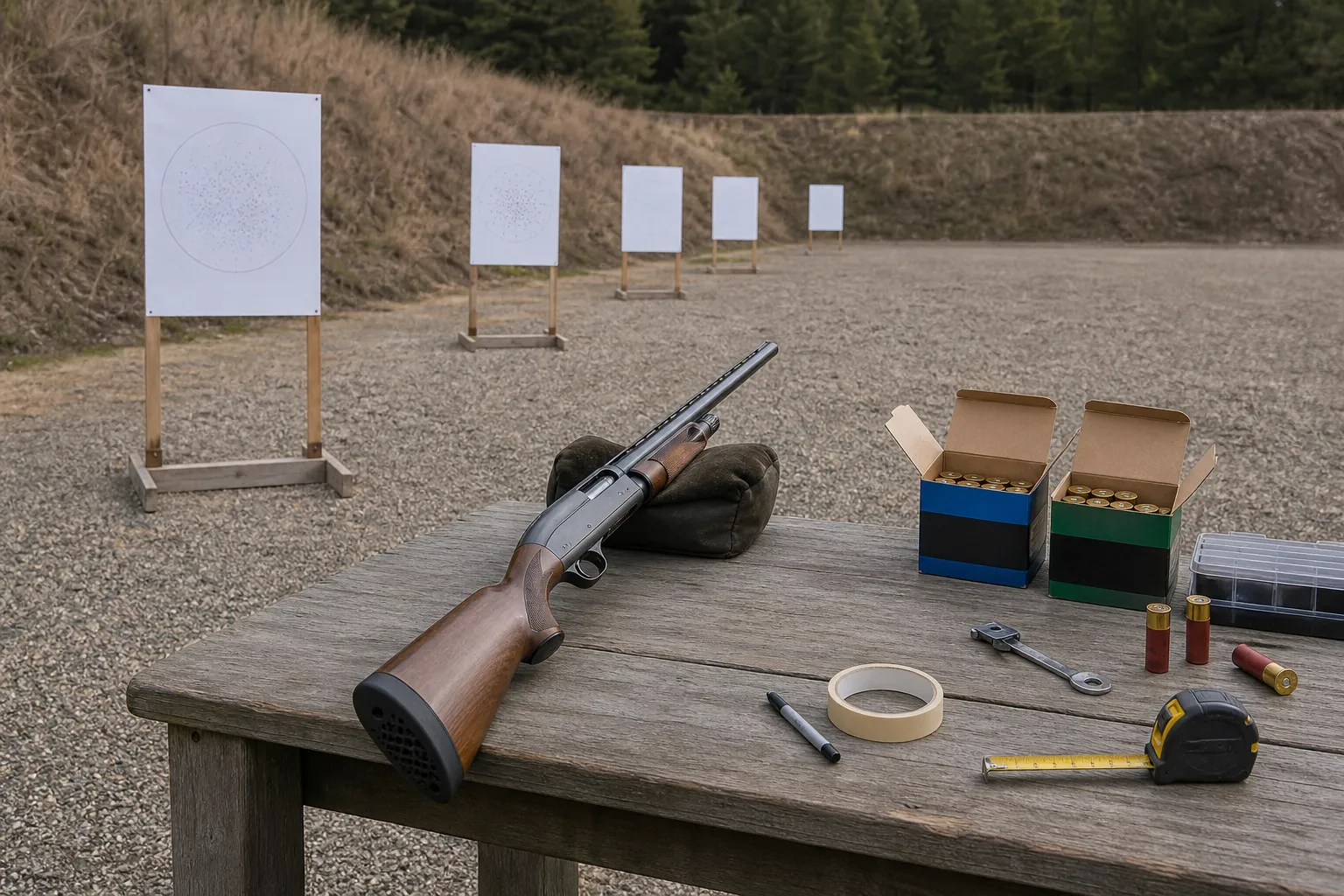
Shotgun patterning is the process of shooting a specific shotgun, choke and shotshell load at paper to see where the pellets actually go at a chosen distance. Texas Parks and Wildlife describes it as finding out how a shotgun performs with various loads and chokes at specific distances, and Hunter-ed defines a shot pattern as the spread of pellets after they hit a non-moving target.
Why patterning matters
A shotgun does not place one single bullet on the target. It sends a group of pellets, and that group can be wide, tight, centered, high, low or uneven depending on the gun and load.
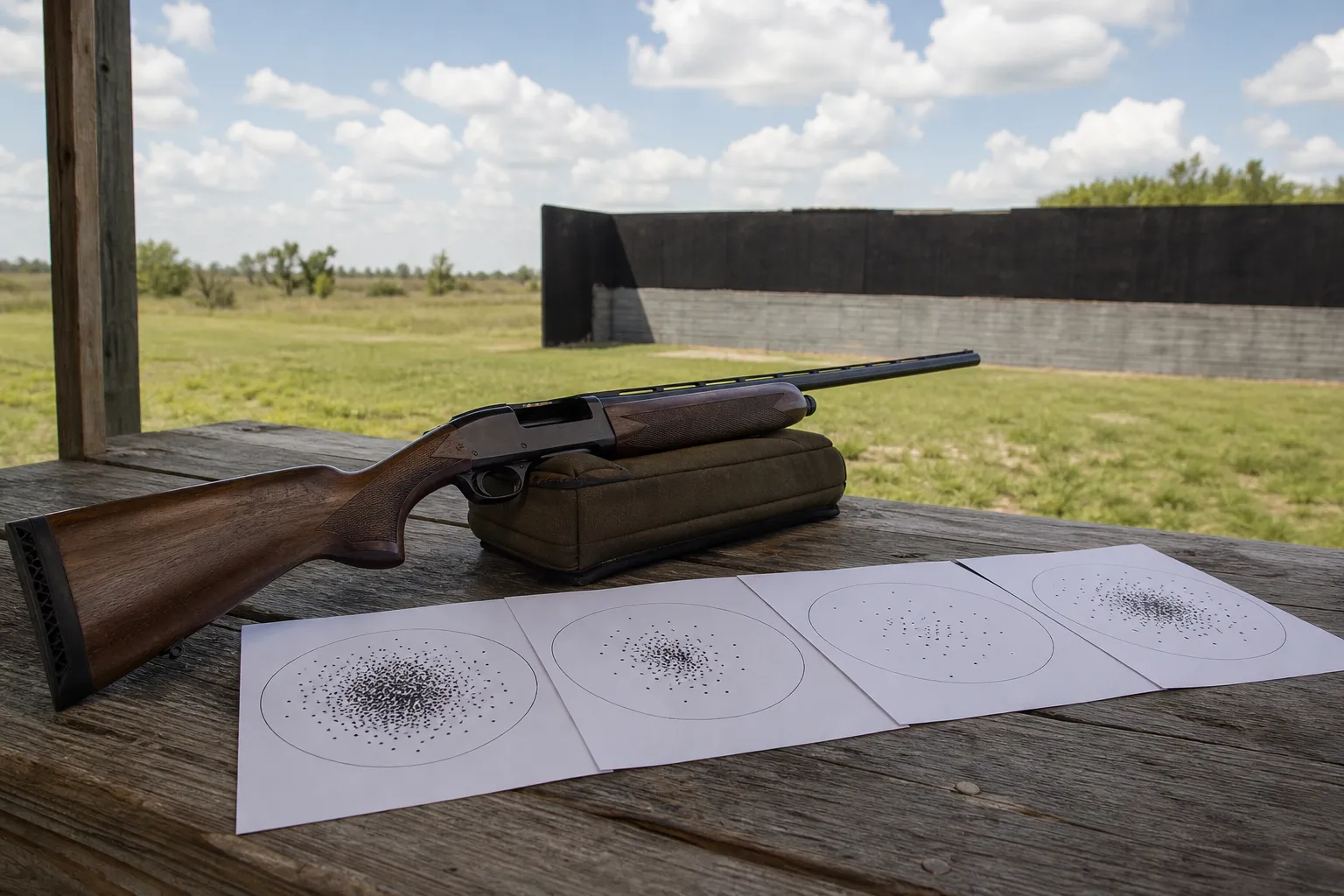
Texas Parks and Wildlife notes that two 12 gauge shotguns with full chokes and the same type of shotshell can still produce different patterns at the same distance. That is the main reason patterning is a test, not a guess.
For hunters, patterning is tied to clean shot selection. Hunter-ed connects maximum effective range to the distance at which a hunter can hit consistently, and warns that shooting beyond that distance increases wounded and lost birds. Texas Parks and Wildlife recommends patterning before hunting to find the shotshell and choke combination that gives an effective pattern at the expected distance.
For clay shooters, the same process helps show whether the center of the pattern is where the shooter expects it to be. Browning says patterning can show pattern percentage, pattern density and point of impact, which it describes as the center of the pattern.
Patterning also gives a practical way to compare combinations. Hunter-ed states that a shotgun pattern can be affected by the gun’s firing characteristics, choke, shotshell brand, shot size and shot type. Federal Premium adds that lead, steel, bismuth and tungsten can pattern differently in chokes.
Set up a safe patterning session
Start with safety. Federal Premium says to select an area with a safe backdrop and to wear shooting glasses and hearing protection. Use a safe range or another safe area where shooting is allowed, and follow the rules for that place.
Use a large target. Federal Premium recommends patterning paper at least 40 inches square with an aiming point near the center. Browning describes using paper attached to a large pattern board, probably 40 to 50 inches.
Mark one clear aiming point near the middle of the paper. The mark does not have to be large, but it should be easy to see from the firing position.
Use a separate sheet for each test shot. Hunter-ed says to fire at the center of the target from the expected quarry distance and repeat twice more with new target paper. Federal Premium recommends at least five test patterns, each on a separate pattern sheet. Ducks Unlimited also says more than one pattern should be fired for each gun, choke and load combination because patterns vary from shot to shot.
Label each target before or after shooting. Texas Parks and Wildlife says to write the shell load, choke type and firing distance on the target so patterns can be compared later. Because patterning is specific to a particular shotgun, it is also useful to keep each target with the shotgun and test session it came from.
A simple target label can include:
| Record on the target | Why it matters |
|---|---|
| Shotgun | Patterning is specific to the individual gun |
| Shotshell load | Texas Parks and Wildlife says to record the shell load |
| Choke | Texas Parks and Wildlife says to record the choke type |
| Distance | Texas Parks and Wildlife says to record the firing distance |
| Shot number | Multiple patterns help show normal variation |
Choose the distance
Pattern at a distance that matches the use you are checking. Texas Parks and Wildlife describes patterning as shooting single shots at individual targets at the distance you anticipate shooting at game. Browning says the final test distance should be the distance where the shooter most often shoots game.
There is no need to rely only on one generic distance. Browning notes that 40 yards is commonly used by firearms companies, while Texas Parks and Wildlife gives examples of 20 to 25 yards for quail and 40 yards for turkey.
The key is to test the distance you want to understand. A close pattern may look very different from a longer pattern. Federal Premium recommends patterning a variety of loads at different distances to determine which load gives the best pattern density and the most even pellet distribution.
Shoot the targets
Set the paper on the board, confirm the safe backdrop, and aim at the marked aiming point. Fire one shot at one sheet of paper. Then replace it with a fresh sheet before firing the next shot.
Keep each test as consistent as you can. Browning warns that rib alignment and cant can affect where the pattern appears on the target. Browning specifically notes that seeing rib other than a single flat surface can affect results, and that canting the shotgun can affect pattern position on the target.
Do not combine multiple shots on one sheet if you are trying to read a pattern. Separate targets make it possible to see the pellet distribution, the densest part of the pattern and the center of that single shot.
Read the pattern on paper
After the target is safe to inspect, find the densest part of the pellet pattern. Hunter-ed says to draw a 30 inch circle around the densest part of the shot pattern, and notes that this is not necessarily the center of the paper.
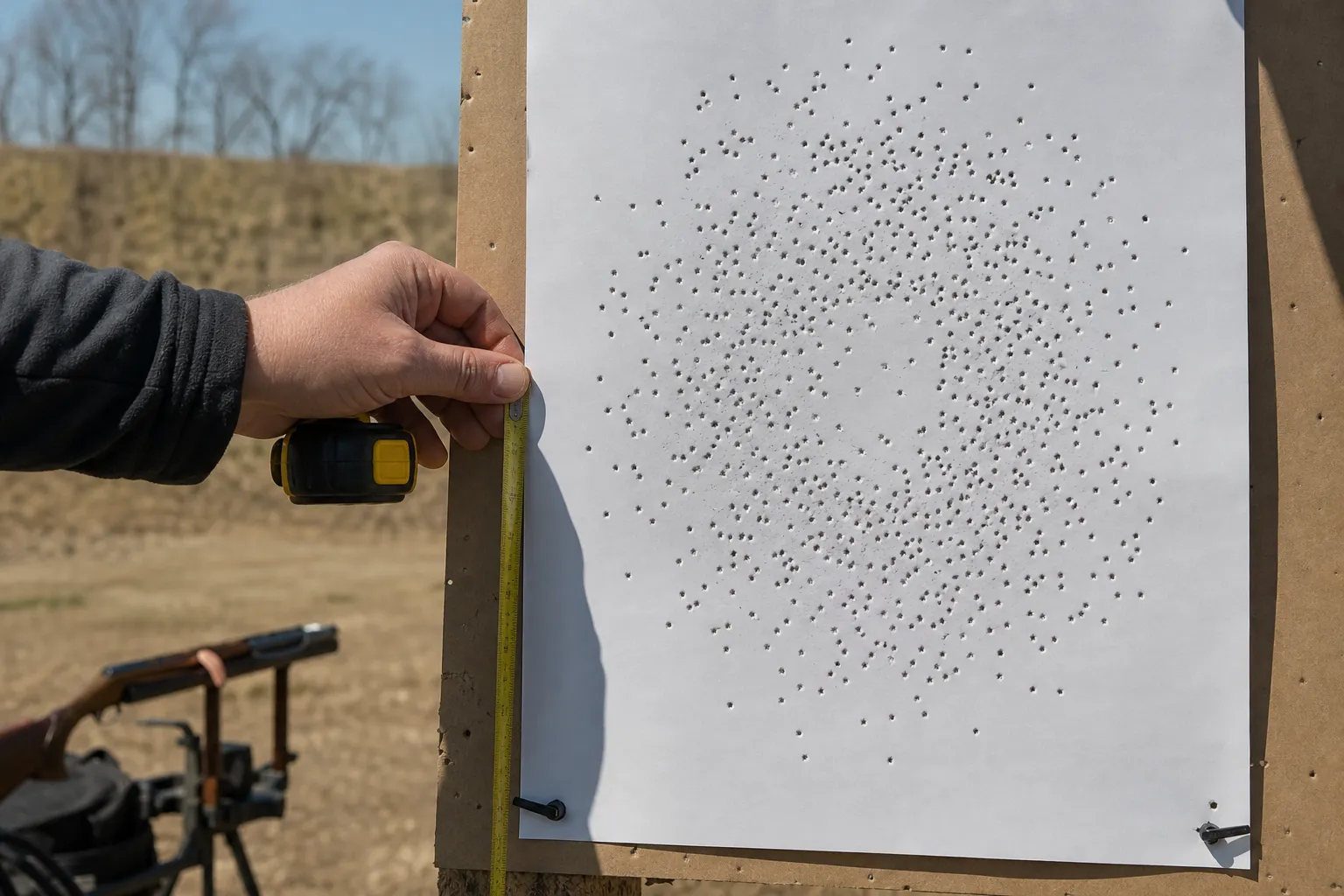
That detail matters. The aiming point shows where you held. The densest part of the pellet holes shows where the pattern actually centered for that shot. If the densest area is consistently above, below, left or right of the aiming point, that is point of impact information.
Next, count the pellet holes inside the 30 inch circle. Hunter-ed says to count the pellet holes that fall within the circle and mark each hole while counting. Marking each hole helps avoid counting the same hole twice.
Then repeat the same process on the other targets from the same gun, choke, load and distance. Hunter-ed’s method is to average the pellet counts, divide the average pellet count by the number of pellets in the load, and multiply by 100. That gives the pattern percentage for that combination.
The basic formula is:
average pellet holes inside 30 inch circle ÷ pellet count in the load × 100 = pattern percentage
Pattern percentage is only one part of the picture. Hunter-ed states that the goal is an even pellet density and a sufficient percentage of the load within a 30 inch circle. Federal Premium also emphasizes pattern density and even pellet distribution.
When looking at the paper, compare:
- How many pellet holes are inside the 30 inch circle
- Whether the pellet holes are evenly spread or clumped
- Whether there are large gaps in the pattern
- Where the densest part of the pattern is compared with the aiming point
- Whether repeated targets look similar enough to trust the result
Compare chokes and loads
A choke slightly narrows the muzzle to influence the shot stream and produce a desired pattern, according to Texas Parks and Wildlife. Texas Parks and Wildlife also says chokes do not make shot travel farther. Their purpose is to deliver effective shot density at a particular distance.
Many shotguns use interchangeable choke tubes, which Texas Parks and Wildlife says allow shooters to adjust the choke to the situation. SAAMI states that shotgun choke names historically relate to pattern density, but choke dimensions are not standardized and manufacturers vary. SAAMI also states that interchangeable choke tube thread patterns and locations are not standardized by SAAMI, so users should consult the shotgun manufacturer for information about choke tubes for a specific shotgun.
Because names and dimensions can vary, the paper target is the real comparison. Test the choke and load combinations you want to evaluate at the distances that matter to you.
Federal Premium says lead, steel, bismuth and tungsten pattern differently in chokes. Hunter-ed also lists shotshell brand, shot size and shot type among the factors that affect pattern. That is why a patterning session should compare the actual combinations you plan to use rather than assuming that two loads, two shot sizes or two choke markings will behave the same.
A practical comparison should look at three things together:
- Pattern percentage: the average percentage of the load inside the 30 inch circle.
- Pellet distribution: whether the pellet holes are even enough for the use being tested.
- Point of impact: whether the center of the pattern matches the aiming point closely enough for the shooter’s needs.
Avoid choosing by choke name alone. A marked choke can be a starting point, but Texas Parks and Wildlife, Hunter-ed, Federal Premium, Browning, SAAMI and Ducks Unlimited all point back to the same idea: the shotgun, choke, load and distance need to be tested as a combination.
Point of impact, gun fit and technique
Point of impact is where the center of the pattern lands. Browning describes point of impact as the center of the pattern, and patterning can show whether that center is above, below, left or right of the aiming point.
If the pattern center is not where expected, do not assume the shotshell is the only reason. Browning warns that rib alignment and cant can affect pattern position on the target. A shotgun that consistently patterns away from the point of aim may involve the shooter’s mount, the way the gun is aligned, the sighting system, gun fit or professional adjustment.
Patterning from several separate sheets helps separate a one shot result from a repeated trend. Ducks Unlimited says more than one pattern should be fired for each gun, choke and load combination because patterns vary shot to shot.
Keep good records
Good patterning records turn paper targets into useful information. At minimum, follow the Texas Parks and Wildlife guidance to record the shell load, choke type and firing distance on the target.
Keep targets grouped by combination. If you compare two chokes, use fresh sheets for each choke. If you compare two loads, use fresh sheets for each load. If you change the distance, mark that distance clearly.
A clear record helps you look back later and see which combination gave the most useful balance of pattern percentage, pellet density, distribution and point of impact.
What to check before you rely on a pattern
Before using a shotgun, choke and load combination for hunting or shooting, confirm the pattern on paper at the distance you expect to use it. Confirm safe range rules, use eye and hearing protection, and follow the shotgun and choke manufacturer’s instructions. For hunting, also check the current rules from the wildlife agency for the place and season you plan to hunt, including any requirements that affect shotshells or shot material.
Frequently asked questions
What is shotgun patterning?
Shotgun patterning is testing how a specific shotgun performs with specific loads and chokes at specific distances. Hunter-ed defines a shot pattern as the spread of pellets after they hit a non-moving target.
What size paper should I use to pattern a shotgun?
Federal Premium recommends patterning paper at least 40 inches square with an aiming point near the center.
Should the 30 inch circle be centered on the aiming point?
Not automatically. Hunter-ed says to draw the 30 inch circle around the densest part of the shot pattern, and notes that this is not necessarily the center of the paper.
How many patterns should I shoot?
Hunter-ed describes firing one shot and repeating twice more on new target paper. Federal Premium recommends at least five test patterns, each on a separate sheet, and Ducks Unlimited says more than one pattern is needed because patterns vary from shot to shot.
Do choke names tell me exactly how my shotgun will pattern?
No. SAAMI states that choke names historically relate to pattern density, but choke dimensions are not standardized and vary by manufacturer. The actual shotgun, choke, load and distance should be tested on paper.
Do chokes make shot travel farther?
Texas Parks and Wildlife says chokes do not make shot travel farther. Their purpose is to deliver effective shot density at a particular distance.
Sources
- Chokes and Patterns, Texas Parks and Wildlife DepartmentOfficial source. Accessed October 23, 2026.
- Shooting Shotguns, Texas Parks and Wildlife DepartmentOfficial source. Accessed October 23, 2026.
- The Patterning Procedure, Hunter-ed.com, Virginia Hunter Safety Course. Accessed October 23, 2026.
- What You Learned, Shotguns, Hunter-ed.com, Pennsylvania Hunter Safety Course. Accessed October 23, 2026.
- Shotgun Choke and Shot String, Hunter-ed.com, Oregon Hunter Safety Course. Accessed October 23, 2026.
- Patterning Your Shotgun, Hunter-ed.com, Louisiana Hunter Safety Course. Accessed October 23, 2026.
- How do I check for POI and pattern my shotgun?, Browning. Accessed October 23, 2026.
- Ammo Basics, Shotshell, Federal Premium. Accessed October 23, 2026.
- FAQs, Sporting Arms and Ammunition Manufacturers' InstituteOfficial source. Accessed October 23, 2026.
- Shotgunning: Patterning Makes Perfect, Ducks Unlimited. Accessed October 23, 2026.