Knife Steel Types Explained: Carbon, Stainless and Powder Steels
Knife steel is a balance of hardness, toughness, edge retention and corrosion resistance. Steel names help, but heat treatment, edge geometry and the field task matter too.
By RaiS. Reviewed by RaiS. Published . 7 min read.
Research and drafting were assisted by AI. RaiS checked the facts against the sources below and approved this page.
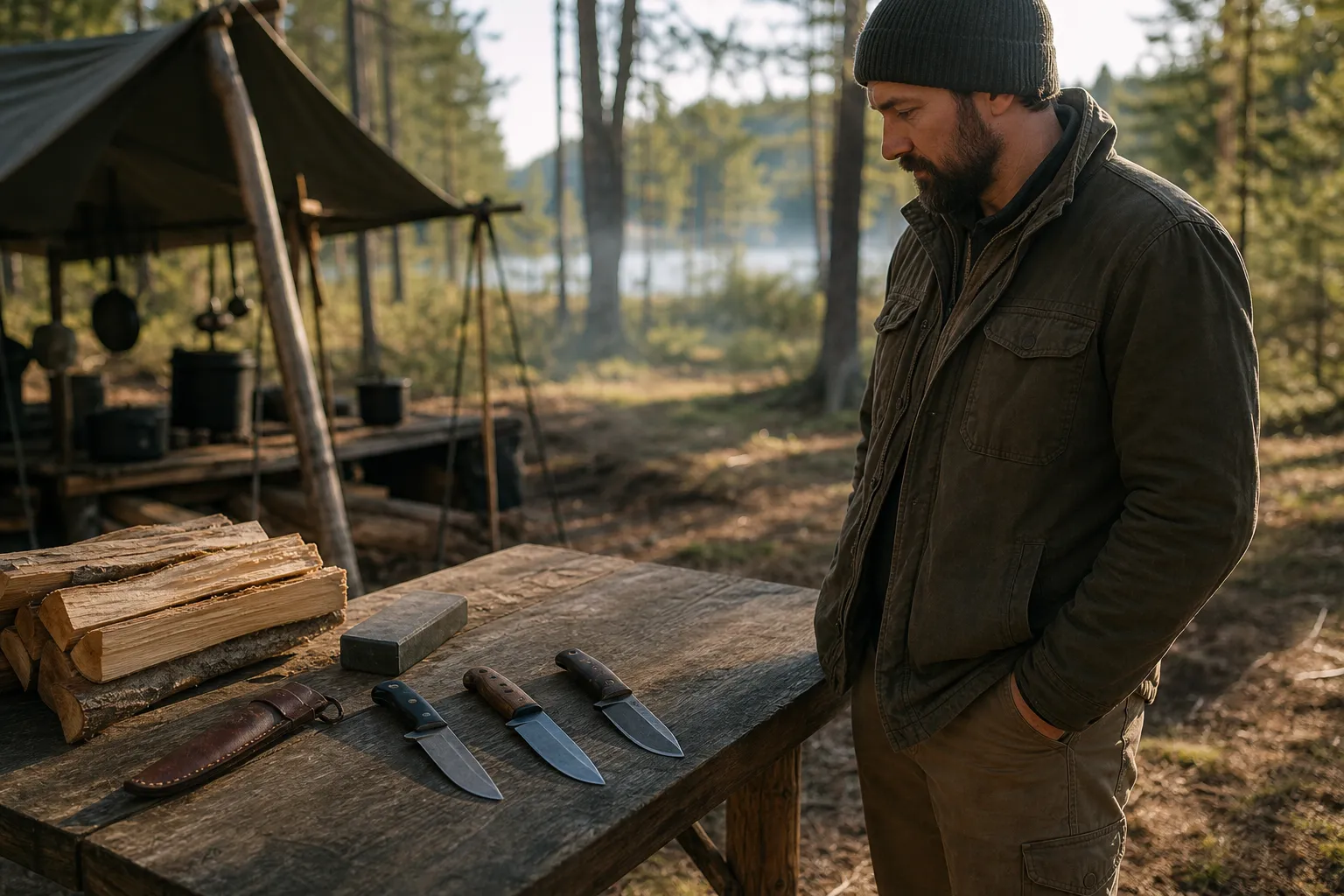
Knife steel is not a single ranking from bad to good. For hunting and outdoor knives, the steel name is a clue to four linked traits: hardness, toughness, edge retention and corrosion resistance. Knife Steel Nerds summarizes the big tradeoff plainly: toughness and edge retention are generally opposing properties, and heat treatment and edge geometry can matter more than the steel name alone.
If you are also choosing blade shape and knife style, start with our Hunting Knife Types guide, which frames hunting knife choice around the field task first.
The four performance terms that matter
Hardness, usually listed as HRC
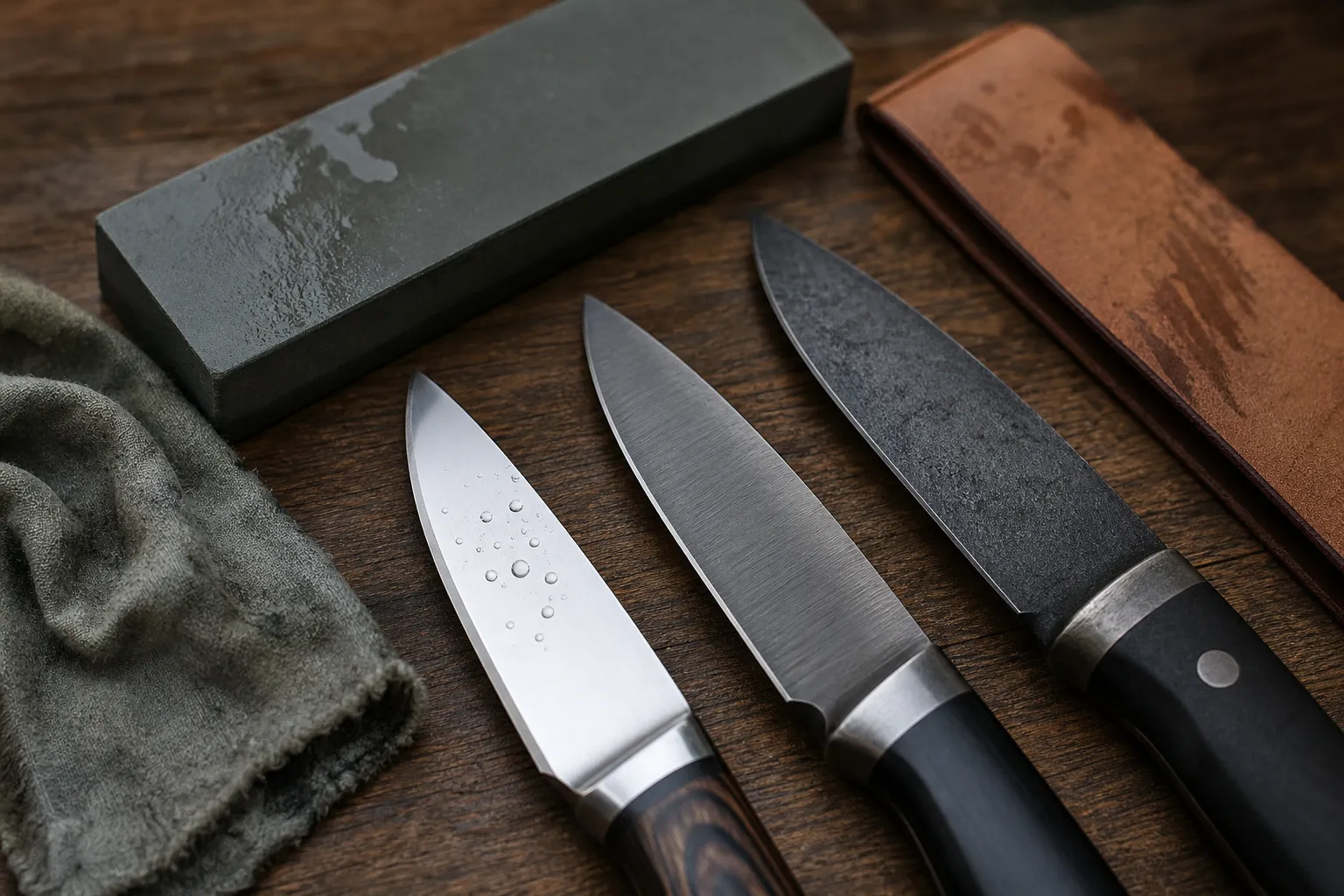
HRC means Rockwell C hardness. NIST describes the Rockwell C scale as using a spheroconical diamond indenter and a 150 kgf total force. In knife catalogs and steel data sheets, HRC is usually shown as a finished or target hardness range.
Hardness is useful, but it is not the whole story. A steel at one hardness can behave differently from the same steel at another hardness, and Knife Steel Nerds notes that heat treatment and edge geometry can matter more than the specific steel used.
Toughness
Knife Steel Nerds defines toughness for knives as resistance to fractures, such as chipped edges or broken knives. This matters for outdoor knives because a thin edge that cuts well still has to survive field use.
Do not read toughness as the same thing as softness. Steel data sheets often report toughness through impact testing, such as Charpy C-notch values. Those numbers are most useful when comparing steels tested in the same published context.
Edge retention
Knife Steel Nerds defines edge retention as the ability of a knife to maintain cutting ability during cutting. It also notes that CATRA testing focuses on abrasive wear.
Some steel maker data sheets publish CATRA edge retention relative to 440C ESR. Those comparisons are helpful, but they do not replace the importance of edge geometry. Knife Steel Nerds gives an example where a 10 degree per side edge had about five times the edge retention of a 25 degree per side edge.
Corrosion resistance
Corrosion resistance is often simplified to chromium content, but Knife Steel Nerds warns that chromium percentage alone does not determine corrosion resistance, using D2 as an example. The reason is that alloy content does not tell the whole story of what is available in the steel’s structure.
Knife Steel Nerds also points to CPM MagnaCut as an unusual case: it has effective corrosion resistance for its chromium level because its chromium is in solution rather than tied up in chromium carbide.
Common knife steel families
1095 and other simple carbon steels
1095 is a high-carbon steel name many hunters see on traditional fixed blades. A steel handbook lists SAE and ASTM 1095 at about 0.90 to 1.03 percent carbon and 0.30 to 0.50 percent manganese. Boker’s steel table lists 1095 as a USA steel with 0.9 to 1.03 percent carbon and a 56 to 59 HRC range.
The useful takeaway is that the 1095 name tells you the knife is built around a simple carbon steel composition rather than the higher chromium stainless compositions shown below. Its performance still depends on heat treatment and edge geometry.
Conventional stainless steels: 440C, AUS-8, 154CM and VG10
440C is one of the long-running stainless cutlery steels. Carpenter says heat-treated 440C reaches about Rockwell C 60. Niagara says 440C ESR is particularly designed for cutlery needing high hardness and excellent cutting edge retention.
AUS-8 is another stainless knife steel name often seen on production knives.
154CM is a stainless steel closely tied to 440C in published knife-steel data. Niagara lists typical 154CM composition as 1.05 percent carbon, 14.00 percent chromium and 4.00 percent molybdenum. Niagara describes 154CM as a 440C ESR modification with added molybdenum and says it offers better edge retention than 440C ESR for knife makers.
VG10 is a Japanese stainless cutlery steel. Takefu lists VG10 standard representative composition as 1.00 percent carbon, 15.00 percent chromium, 1.00 percent molybdenum, 0.25 percent vanadium and 1.55 percent cobalt. Takefu lists VG10 hardness as at least HRC 60.
D2, a high-carbon, high-chromium tool steel
Crucible describes Airdi 150, AISI D2, as an air-hardening, high-carbon, high-chromium tool steel heat treatable to HRC 60 to 62. Crucible lists D2 composition as 1.55 percent carbon, 11.5 percent chromium, 0.8 percent vanadium and 0.9 percent molybdenum.
D2 is a good example of why the label can be confusing. It has substantial chromium, but Knife Steel Nerds warns that chromium percentage alone does not determine corrosion resistance, using D2 as the example.
Powder metallurgy steels: CPM S30V, S35VN and MagnaCut
Crucible describes the CPM process as gas atomization of a prealloyed melt into fine powder particles. Crucible says CPM processing produces fine-grained steel with homogeneous composition and a uniform microstructure. Crucible also lists improved edge retention and improved toughness as user-facing advantages of CPM knife steels.
CPM S30V was designed for a combination of toughness, wear resistance and corrosion resistance, according to Niagara. Niagara lists typical CPM S30V composition as 1.45 percent carbon, 14.00 percent chromium, 2.00 percent molybdenum and 4.00 percent vanadium.
CPM S35VN is closely related to S30V. Crucible says S35VN was designed for improved toughness over CPM S30V. Crucible also says substituting niobium carbides for some vanadium carbides makes CPM S35VN about 15 to 20 percent tougher than CPM S30V without loss of wear resistance.
CPM MagnaCut is another powder metallurgy stainless knife steel. Niagara lists MagnaCut toughness at 38 ft-lbs at 62.5 HRC and 30 ft-lbs at 64 HRC, and CATRA edge retention at 135 percent of 440C ESR at 62.5 HRC. Niagara also notes that tempering above 750°F reduces corrosion resistance.
Published comparison table
The table below uses published composition, hardness and performance values where they are available from the organizations named in each row. Do not compare every number as if it came from the same test. The toughness and CATRA figures are most useful when the same publisher lists the comparison set.
| Steel | Family | Published composition highlights | Published hardness | Published toughness | Published edge retention and notes |
|---|---|---|---|---|---|
| 1095 | Simple carbon steel | A steel handbook lists SAE and ASTM 1095 at 0.90 to 1.03% carbon and 0.30 to 0.50% manganese. | Boker lists 56 to 59 HRC. | Not listed in the gathered published data. | Performance depends strongly on heat treatment and edge geometry, as Knife Steel Nerds notes for knife steels generally. |
| VG10 | Conventional stainless | Takefu lists 1.00% carbon, 15.00% chromium, 1.00% molybdenum, 0.25% vanadium and 1.55% cobalt. | Takefu lists VG10 hardness as at least HRC 60. | Not listed in the gathered published data. | No CATRA value listed in the gathered published data. |
| D2 | High-carbon, high-chromium tool steel | Crucible lists 1.55% carbon, 11.5% chromium, 0.8% vanadium and 0.9% molybdenum. | Crucible says D2 is heat treatable to HRC 60 to 62. | Not listed in the gathered published data. | Knife Steel Nerds uses D2 to warn that chromium percentage alone does not determine corrosion resistance. |
| CPM S35VN | Powder metallurgy stainless | Crucible describes niobium carbides replacing some vanadium carbides in the S35VN design. | Not listed in the gathered published data. | Crucible lists 12.0 ft-lbs transverse Charpy C-notch, compared with 10.0 ft-lbs for CPM S30V. | Crucible says S35VN is about 15 to 20% tougher than S30V without loss of wear resistance. |
How to read a steel name on a hunting knife
First, treat the steel name as a starting point, not a verdict. A knife marked 440C, D2 or CPM S35VN tells you something about the alloy family, but it does not tell you the exact heat treatment, edge angle or blade geometry.
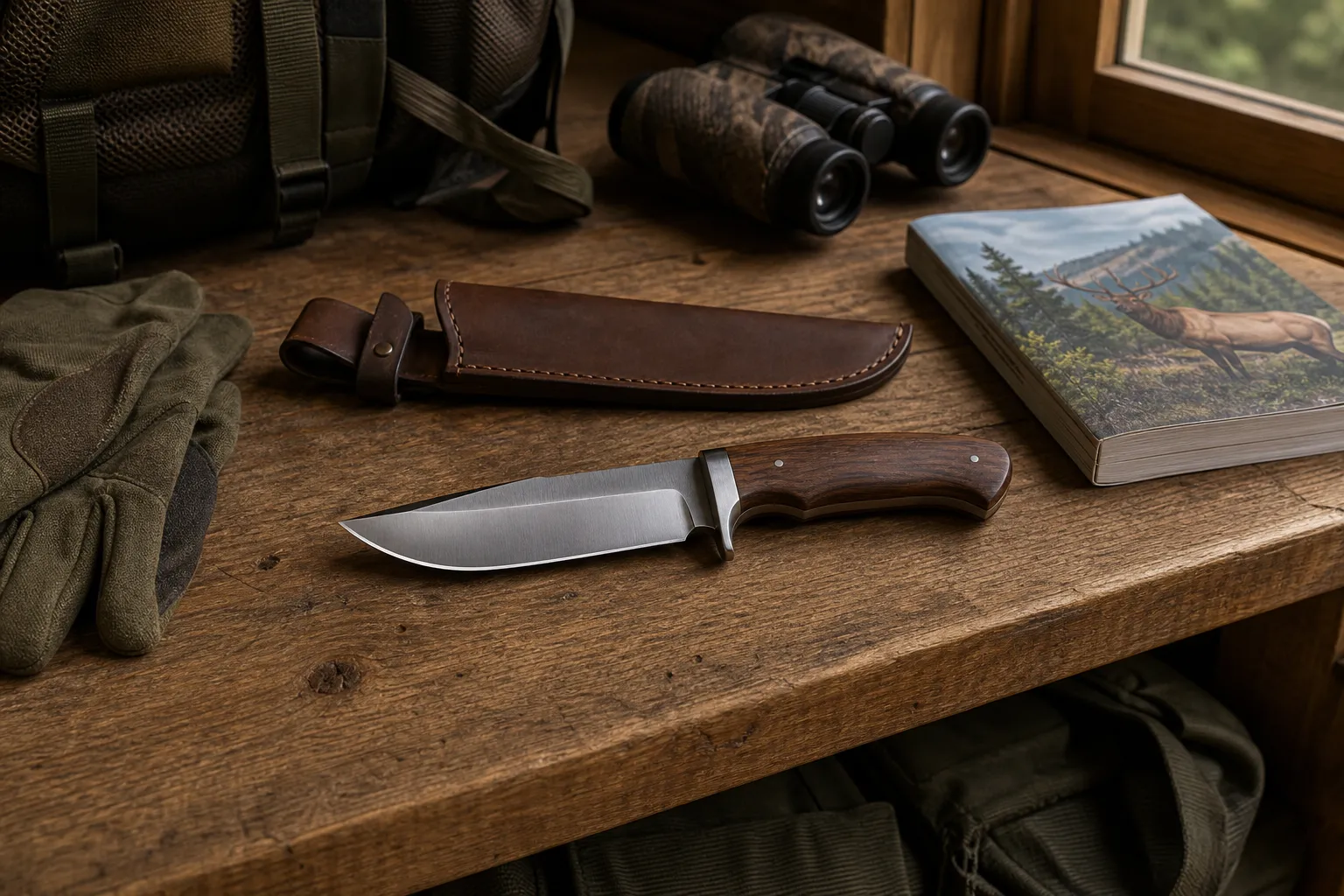
Second, match the trait to the field task. If you care most about resisting chips and fractures, pay attention to published toughness data. If you care most about how long an edge keeps cutting in abrasive media, CATRA-style edge retention data is relevant. If you use a knife where corrosion is a concern, look beyond chromium percentage alone.
Third, compare numbers within the same published test whenever possible. Niagara’s S30V data sheet gives one useful toughness set: CPM S30V at 10.0 ft-lbs transverse Charpy C-notch, with 154CM and 440C ESR at 2.5 ft-lbs. Crucible’s S35VN data gives another direct comparison: 12.0 ft-lbs for S35VN and 10.0 ft-lbs for S30V.
Finally, remember the practical warning from Knife Steel Nerds: heat treatment and edge geometry can matter more than the specific steel used. That is why two knives with the same steel name can still feel different in use.
What to check before you buy or sharpen
Check the maker’s published steel, HRC range and heat-treatment information when it is available. If a knife is advertised only by a steel name, you still do not know the finished hardness or edge geometry.
For technical comparisons, look for steel maker data sheets from organizations such as Crucible, Niagara, Carpenter and Takefu, and remember that test numbers are clearest when compared inside the same published data set.
Frequently asked questions
What does HRC mean on a knife?
HRC means Rockwell C hardness. NIST describes the Rockwell C scale as using a spheroconical diamond indenter with a 150 kgf total force.
Is harder knife steel always better?
No. Hardness is only one trait. Knife Steel Nerds notes that toughness and edge retention generally trade off, and that heat treatment and edge geometry can matter more than the steel name.
What is toughness in knife steel?
Knife Steel Nerds defines toughness as resistance to fractures, such as chipped edges or broken knives.
What is CATRA edge retention?
Knife Steel Nerds describes edge retention as maintaining cutting ability during cutting, and notes that CATRA testing focuses on abrasive wear.
Why is D2 confusing when people talk about stainless steel?
Crucible lists D2 with 11.5 percent chromium, but Knife Steel Nerds uses D2 as an example that chromium percentage alone does not determine corrosion resistance.
What is different about powder metallurgy knife steels?
Crucible describes the CPM process as gas atomization of a prealloyed melt into fine powder particles, producing fine-grained steel with homogeneous composition and a uniform microstructure.
Sources
- Airdi 150 (AISI D2) Data Sheet, Crucible, hosted by Burgess Knives. Accessed October 26, 2026.
- CPM S30V Data Sheet, Niagara Specialty MetalsOfficial source. Accessed October 26, 2026.
- Hunting Knife Types and Blade Shapes, ProjectGunsOfficial source. Accessed October 26, 2026.
- Rockwell Hardness Measurement of Metallic Materials, National Institute of Standards and TechnologyOfficial source. Accessed October 26, 2026.
- Knife Steels Rated by a Metallurgist, Knife Steel Nerds. Accessed October 26, 2026.
- Crucible Steels for Knifemaking, Crucible, hosted by Burgess Knives. Accessed October 26, 2026.
- Handbook of Comparative World Steel Standards, ASTM reference copy, hosted by ASREMAVAD. Accessed October 26, 2026.
- Steel Guide, Boker USAOfficial source. Accessed October 26, 2026.
- CarTech 440C Stainless Technical Datasheet, Carpenter TechnologyOfficial source. Accessed October 26, 2026.
- 440C ESR Data Sheet, Niagara Specialty MetalsOfficial source. Accessed October 26, 2026.
- 154-CM Data Sheet, Niagara Specialty MetalsOfficial source. Accessed October 26, 2026.
- VG10, Takefu Special Steel Co., Ltd.Official source. Accessed October 26, 2026.
- CPM S35VN Data Sheet, Crucible, hosted by Doble O Knives. Accessed October 26, 2026.
- CPM MagnaCut Data Sheet, Niagara Specialty MetalsOfficial source. Accessed October 26, 2026.