Tree Stand Types: Ladder, Climber, Hang-On and Saddles
Ladder stands are less mobile once installed, hang-on stands are lightweight, saddles are mobile, and climbers work only on suitable straight trees. Whatever system you use, hunter education guidance is consistent: wear a full-body fall-arrest system, stay attached from the ground up and back down, use a haul line, and keep three points of contact while climbing.
By RaiS. Reviewed by RaiS. Published . 9 min read.
Research and drafting were assisted by AI. RaiS checked the facts against the sources below and approved this page.
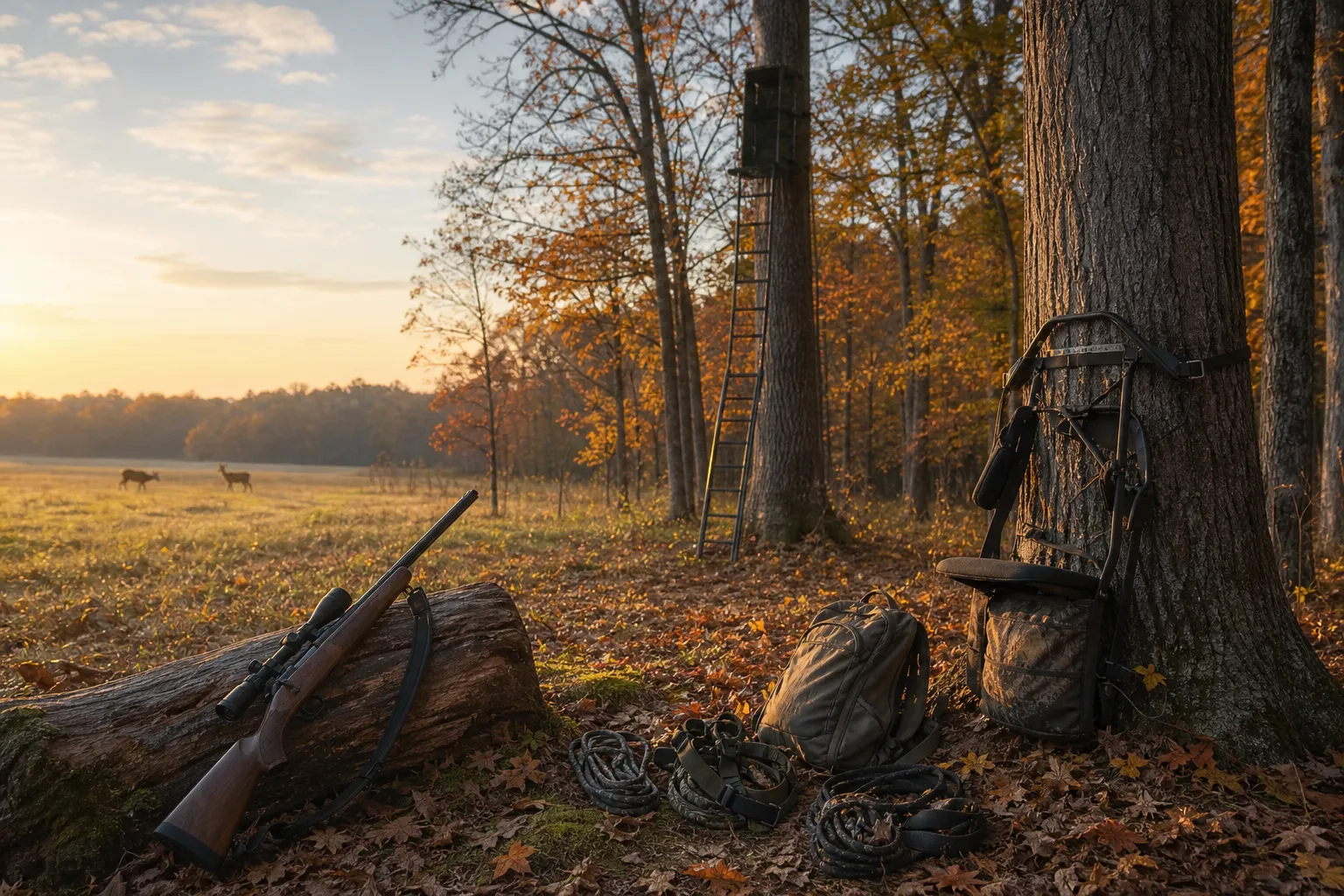
A first-season deer hunter should choose a tree stand by balancing setup, mobility, tree choice and safety. Ladder stands use an attached ladder and are often heavy. Hang-on stands strap or chain to a tree and are lightweight, but need a climbing aid. Climbing stands move up the trunk with the hunter and need straight trees with no lower branches. Saddles are lightweight, mobile elevated systems built around a saddle, ropes, a platform and a climbing method. For every elevated option, the most important rule is the same: use a full-body fall-arrest system and stay attached from the time you leave the ground until you return.
What elevated hunting systems are
Elevated hunting systems come with a serious fall risk, so safety comes before stand style.
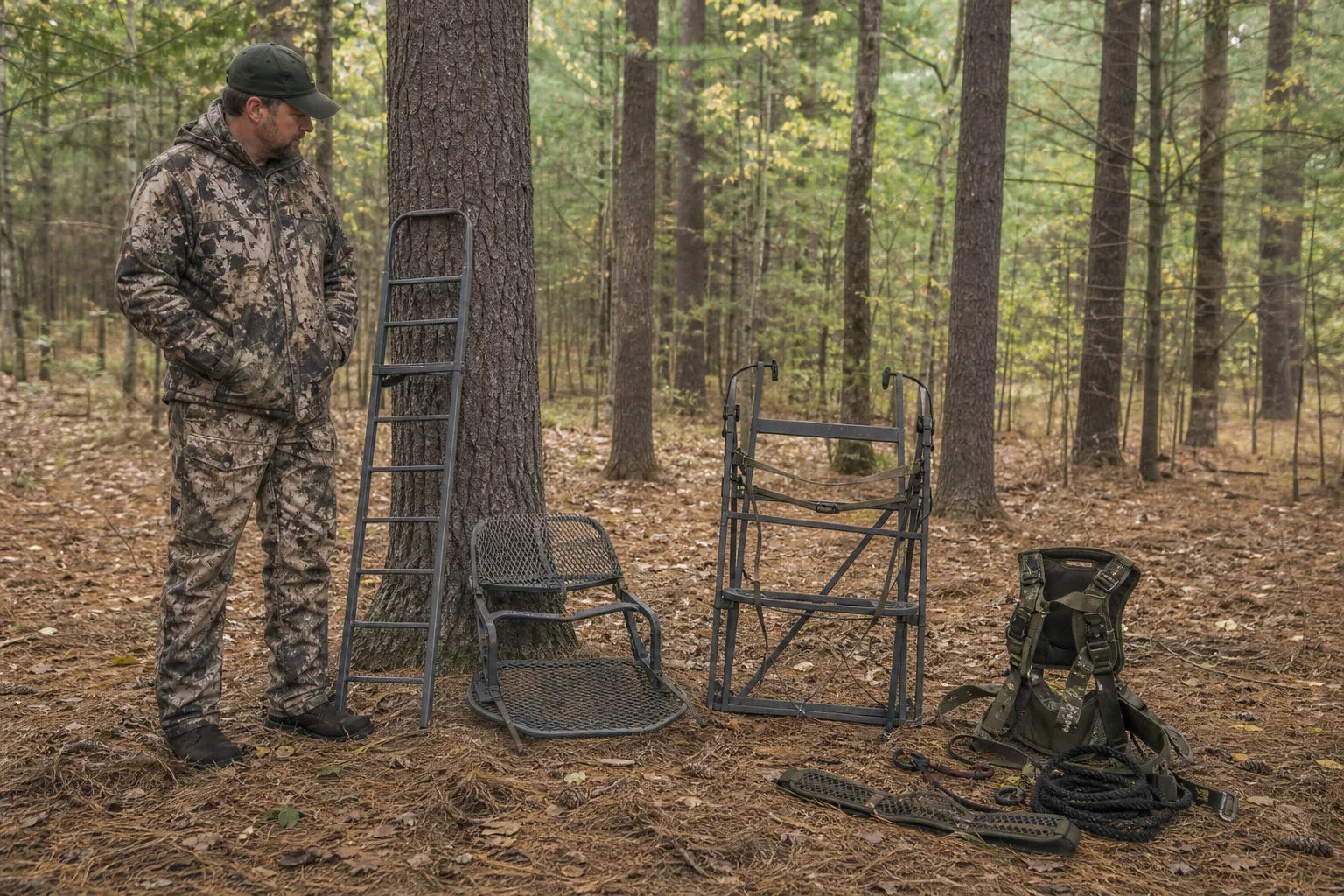
Minnesota DNR describes fixed-position stands as stands placed on a tree trunk and secured in that spot. Oklahoma Hunter Education describes hang-on stands as stands chained or strapped to trees, and ladder stands as stands that use a ladder to reach the perch. Minnesota DNR describes a vertical ladder stand as a ladder that supports the shooting platform, usually in short sections assembled on site.
Oklahoma Hunter Education describes climbing stands as stands that move up and down the tree with a series of stand-up and sit-down motions. Minnesota DNR similarly says a climbing stand is designed to “walk” up a tree trunk with the hunter to the desired height.
Hunter-ed saddle hunting material treats saddle hunting as a form of elevated hunting that is lightweight, mobile and dynamic. Its basic components include a tree saddle, tree tether, lineman belt, platform and climbing sticks. Hunter-ed also lists saddle equipment as a saddle, climbing sticks or another ascending system, a platform, a lineman belt, a tree tether and a haul line.
Quick comparison for first-season deer hunters
Use this table as a plain-English starting point. It does not replace the manufacturer’s instructions for a specific stand, saddle, harness or climbing system.
| System | Setup | Mobility | Weight class | Tree fit and limits |
|---|---|---|---|---|
| Ladder stand | Oklahoma Hunter Education says it uses a ladder to reach the perch. Minnesota DNR says the ladder supports the shooting platform and is usually assembled in short sections on site. | Less mobile once assembled and secured. Oklahoma Hunter Education says ladder stands often require at least two to three people to install or remove. | Often heavy, according to Oklahoma Hunter Education. | TMA says to select a live, healthy, straight tree within the manufacturer’s size limits and never select a leaning tree. |
| Hang-on stand | Oklahoma Hunter Education says it is chained or strapped to a tree. Georgia DNR says non-climbing portable stands should be securely fastened to the tree and ladders or steps installed according to manufacturer directions. | Lightweight, but it still needs a climbing aid. | Lightweight, according to Oklahoma Hunter Education. | May be difficult to place, according to Oklahoma Hunter Education, and may require a ladder. |
| Climbing stand | Oklahoma Hunter Education says it moves up and down the tree with stand-up and sit-down motions. Minnesota DNR says it walks up the trunk with the hunter. | Designed to move up and down the tree with the hunter. | Hunter-ed saddle material says tree stands range from 10 to 45 pounds depending on type. | Oklahoma Hunter Education says climbing stands can only be used on straight trees with no lower branches. |
| Saddle | Hunter-ed describes saddle hunting as using a saddle, tree tether, lineman belt, platform and climbing sticks. | Lightweight, mobile and compact compared with many stand systems, according to Hunter-ed. | Hunter-ed says saddles are typically under five pounds, and a complete saddle setup is usually 10 to 15 pounds. | Requires a saddle-specific system, including the saddle, tether, lineman belt, platform, climbing method and haul line listed by Hunter-ed. |
Ladder stands: simple layout, heavier setup
A ladder stand is easy to understand visually: ladder below, platform and seat above. Oklahoma Hunter Education says ladder stands use a ladder to reach the perch, and Minnesota DNR says the ladder supports the shooting platform.
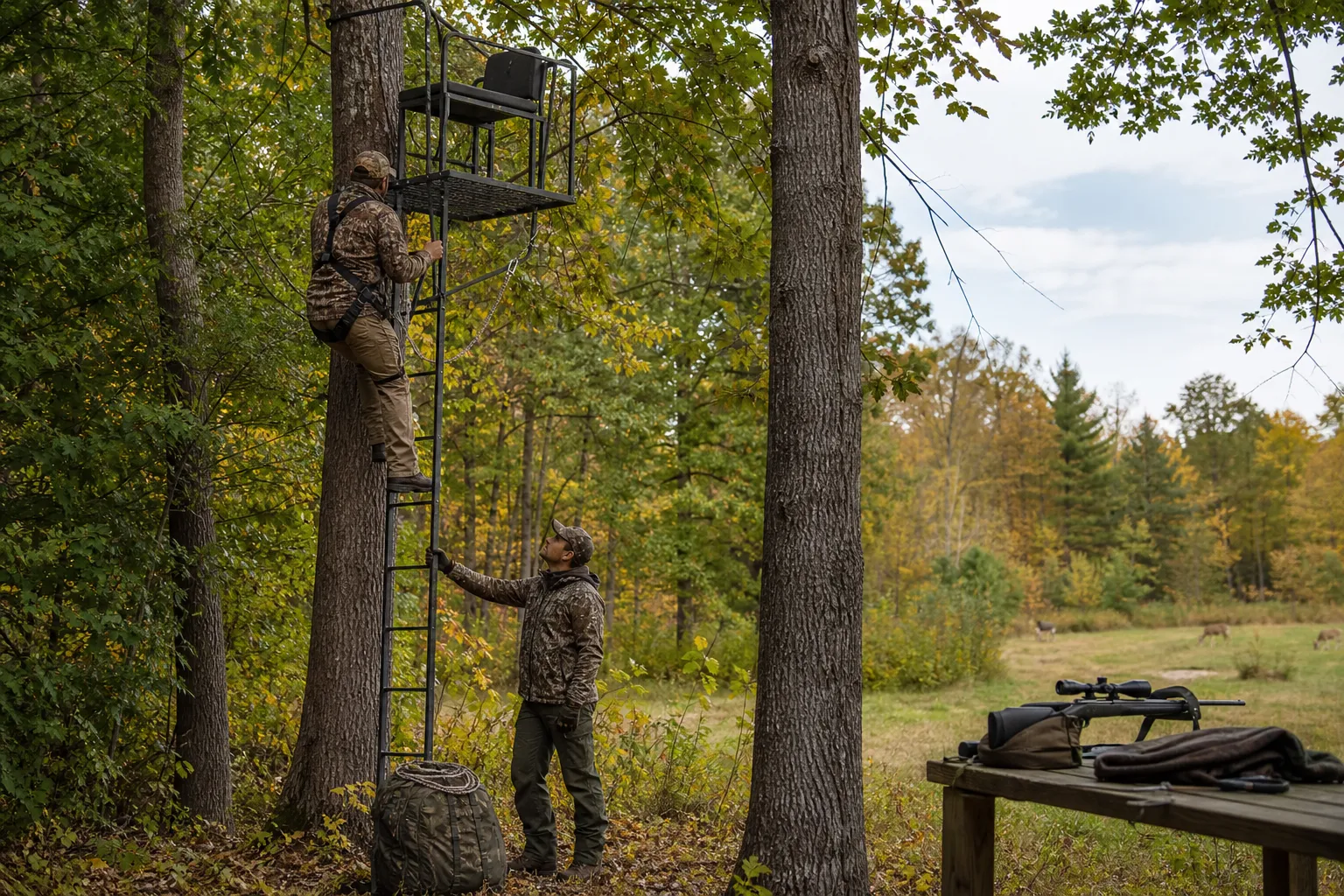
The main tradeoff is setup. Oklahoma Hunter Education says ladder stands are often heavy and require at least two to three people to install or remove. That makes them a poor choice for a hunter who expects to move stand sites often. Once a ladder stand is installed, it is better understood as a fixed elevated location that must be inspected and used according to the manufacturer’s instructions.
Georgia DNR says ladder stands should be securely fastened to the tree and that ladders or steps should be installed according to the manufacturer’s directions. TMA also says to use a live, healthy, straight tree that fits the manufacturer’s size limits, and not to use a leaning tree.
Hang-on stands: portable, but more setup detail
A hang-on stand is a platform and seat that attaches directly to the tree. Oklahoma Hunter Education describes hang-on stands as chained or strapped to trees, lightweight, and possibly difficult to place.
That combination can make hang-on stands attractive for hunters who want a lightweight option, but setup still needs care.
A hang-on stand needs a safe way to climb. Oklahoma Hunter Education says climbing sticks are portable ladders, and that all climbing aids should be used with extreme care. It also says a full-body safety harness with climbing belt should always be used when installing and climbing any type of ladder.
Climbing stands: mobile, but tree-limited
A climbing stand is meant to travel up the tree with the hunter. Oklahoma Hunter Education describes the movement as a series of stand-up and sit-down motions, while Minnesota DNR says the climber is designed to walk up the tree trunk with the hunter.
The key limitation is the tree. Oklahoma Hunter Education says climbing stands can only be used on straight trees with no lower branches.
That tree requirement matters during scouting. A location with good deer sign is not automatically a climbing-stand location. The tree must fit the stand and the manufacturer’s limits, and TMA says the tree should be live, healthy and straight.
Saddles: compact elevated hunting systems
Hunter-ed describes saddle hunting as lightweight, mobile and dynamic. Instead of a conventional stand seat and platform, the hunter uses a saddle system with ropes and a small platform.
Hunter-ed lists required saddle equipment as a hunting saddle, climbing sticks or another ascending system, a hunting platform, a lineman belt, a tree tether and a haul line. Hunter-ed also says saddles are typically under five pounds, while complete saddle setups are usually 10 to 15 pounds.
A saddle is not just a lighter tree stand. It is its own system. A first-season hunter should learn the saddle, tether, lineman belt, platform, climbing method and haul line as one connected safety system, and should follow the manufacturer’s instructions for each component.
Safety essentials that answer hunter education questions
IHEA-USA bowhunter education standards say being properly secured from the ground to the stand and back to the ground is the most important part of hunting from tree stands. IHEA-USA also says most injuries and fatalities occur while climbing into and out of a tree stand.
TMA says to wear and properly use a full-body fall-arrest harness system every time you leave the ground, including while ascending or descending. Oklahoma Hunter Education gives the same exam-style answer: use a full-body harness from the time you leave the ground until you are back down.
Texas Parks and Wildlife says a fall-arrest system has three components: a full-body harness worn by the hunter, a tether and a tree belt. TMA says single-strap belts and chest harnesses are no longer allowed and shall not be used. TMA also says the harness tether should have no slack when the hunter is sitting.
TMA says to practice using the full-body fall-arrest harness system at ground level, with a responsible adult present, before using it in an elevated hunting environment. TMA also says to practice installing and using the treestand at ground level before hunting.
Use a haul line, not your hands or back
The common hunter education answer for getting a bow or firearm into and out of a treestand is: use a haul line. Oklahoma Hunter Education states that answer directly.
TMA says to use a haul line to raise a backpack, gear, unloaded firearm or bow after reaching the desired hunting height. TMA also says never to climb with anything in your hands or on your back. Texas Parks and Wildlife says to completely unload a firearm before climbing into an elevated stand.
The safe sequence is simple to remember: climb with both hands free, stay attached, then raise or lower your unloaded firearm, bow, pack and other gear with the haul line.
Keep three points of contact
TMA says that when using any treestand with a ladder or steps, maintain three points of contact with each step. TMA defines that as two hands and one foot, or one hand and two feet, in contact at all times.
Texas Parks and Wildlife describes the same rule as two feet and one hand, or two hands and one foot, always in contact with the ladder or climbing device. IHEA-USA also includes ascending with three points of contact in its bowhunter education standards.
For a new hunter, this is one of the easiest safety rules to remember and one of the most likely to appear in hunter education material: never climb as if you are carrying gear in your hands.
Inspect every time and plan for rescue
Oklahoma Hunter Education says that no matter what type of stand you use, you need to check it for wear and tear every time before getting into it, including broken welds, cracked boards, weak spots in expanded metal and frayed cables. TMA says to inspect the treestand and full-body fall-arrest harness system before each use, and to replace the harness after a fall.
TMA also says not to use homemade or permanent elevated stands, not to modify a purchased treestand without the manufacturer’s written permission, and to use treestands and fall-arrest harness systems that meet or exceed industry standards recognized by TMA.
TMA advises hunters to know what to do after a fall before hunting from a treestand. That includes understanding the manufacturer’s safety and rescue procedures for your fall-arrest system. Tell someone where you are hunting, carry a reachable communication or signaling device, and do not assume you can solve a fall while suspended unless you have practiced the procedure described for your equipment.
Bottom line
For a first-season deer hunter, a ladder stand is the heavier, less mobile choice. A hang-on stand is lighter, but it requires careful climbing setup. A climbing stand is mobile, but only works on suitable straight trees. A saddle is the most compact elevated system described here, but it requires saddle-specific equipment and skills.
Before using any elevated system, check the current instructions from the manufacturer of your stand, saddle, harness, climbing aid and haul line. Also review your state or provincial hunter education and wildlife agency guidance before the season, especially if you are taking a hunter education exam or hunting from public land.
Frequently asked questions
What is the safest type of tree stand for a beginner?
The sources here do not rank one stand type as safest. TMA, IHEA-USA and hunter education materials emphasize the same safety rules for all elevated systems: use a full-body fall-arrest system, stay attached from the ground up and back down, inspect equipment and follow the manufacturer’s instructions.
What should you wear when installing, removing or using a treestand?
Oklahoma Hunter Education says to use a full-body harness from the time you leave the ground until you are back down. TMA says to wear a full-body fall-arrest harness system every time you leave the ground, including while ascending or descending.
How do you raise a firearm or bow into a tree stand?
Use a haul line. TMA says to raise a backpack, gear, unloaded firearm or bow with a haul line after reaching hunting height, and Texas Parks and Wildlife says to completely unload a firearm before climbing into an elevated stand.
What does three points of contact mean?
TMA defines three points of contact as two hands and one foot, or one hand and two feet, in contact at all times when using ladders or steps. Texas Parks and Wildlife and IHEA-USA describe the same rule for ladders or climbing devices.
What trees work for climbing stands?
Oklahoma Hunter Education says climbing stands can only be used on straight trees with no lower branches.
Are saddles lighter than tree stands?
Hunter-ed saddle hunting material says saddles are typically under five pounds, while tree stands range from 10 to 45 pounds depending on type. It also says a complete saddle setup is usually 10 to 15 pounds.
Sources
- Treestand Safety Guidelines, Treestand Manufacturers AssociationOfficial source. Accessed October 22, 2026.
- Elevated Stands, Texas Parks and Wildlife DepartmentOfficial source. Accessed October 22, 2026.
- Oklahoma Hunter Education Manual, Chapter 5 Safety, Oklahoma Department of Wildlife ConservationOfficial source. Accessed October 22, 2026.
- Tree stand safety, Minnesota Department of Natural ResourcesOfficial source. Accessed October 22, 2026.
- Stand Locations, Missouri Department of ConservationOfficial source. Accessed October 22, 2026.
- IHEA-USA Bow Hunter Education Standards, Addendum to approved Hunter Education Standard, International Hunter Education Association USA. Accessed October 22, 2026.
- Hunting From A Tree Stand? Review Safety Tips, Georgia Department of Natural Resources Wildlife Resources DivisionOfficial source. Accessed October 22, 2026.
- What Is Saddle Hunting?, Hunter-ed.com, Kalkomey Enterprises, Tethrd Hunter Safety Course. Accessed October 22, 2026.
- Equipment Overview, Hunter-ed.com, Kalkomey Enterprises, Tethrd Hunter Safety Course. Accessed October 22, 2026.
- Benefits of Saddle Hunting vs. Tree Stand Hunting, Hunter-ed.com, Kalkomey Enterprises, Tethrd Hunter Safety Course. Accessed October 22, 2026.
- Retrieving Your Sporting Arm With a Haul Line, Hunter-ed.com, Kalkomey Enterprises, Tethrd Hunter Safety Course. Accessed October 22, 2026.
- Fall-Arrest Systems (FASs), Hunter-ed.com, Kalkomey Enterprises, Tethrd Hunter Safety Course. Accessed October 22, 2026.
- Elevated Hunting Safety Guidelines, Hunter-ed.com, Kalkomey Enterprises, Tethrd Hunter Safety Course. Accessed October 22, 2026.