The Mauser 98 Rifle: History, Action Design and Global Influence
The Mauser 98 was the 1898 German service rifle and became one of the most influential bolt-action designs. Its controlled-round feed, dual front locking lugs, rear safety lug and three-position safety shaped later military and sporting rifles.
By RaiS. Reviewed by RaiS. Published . 7 min read.
Research and drafting were assisted by AI. RaiS checked the facts against the sources below and approved this page.
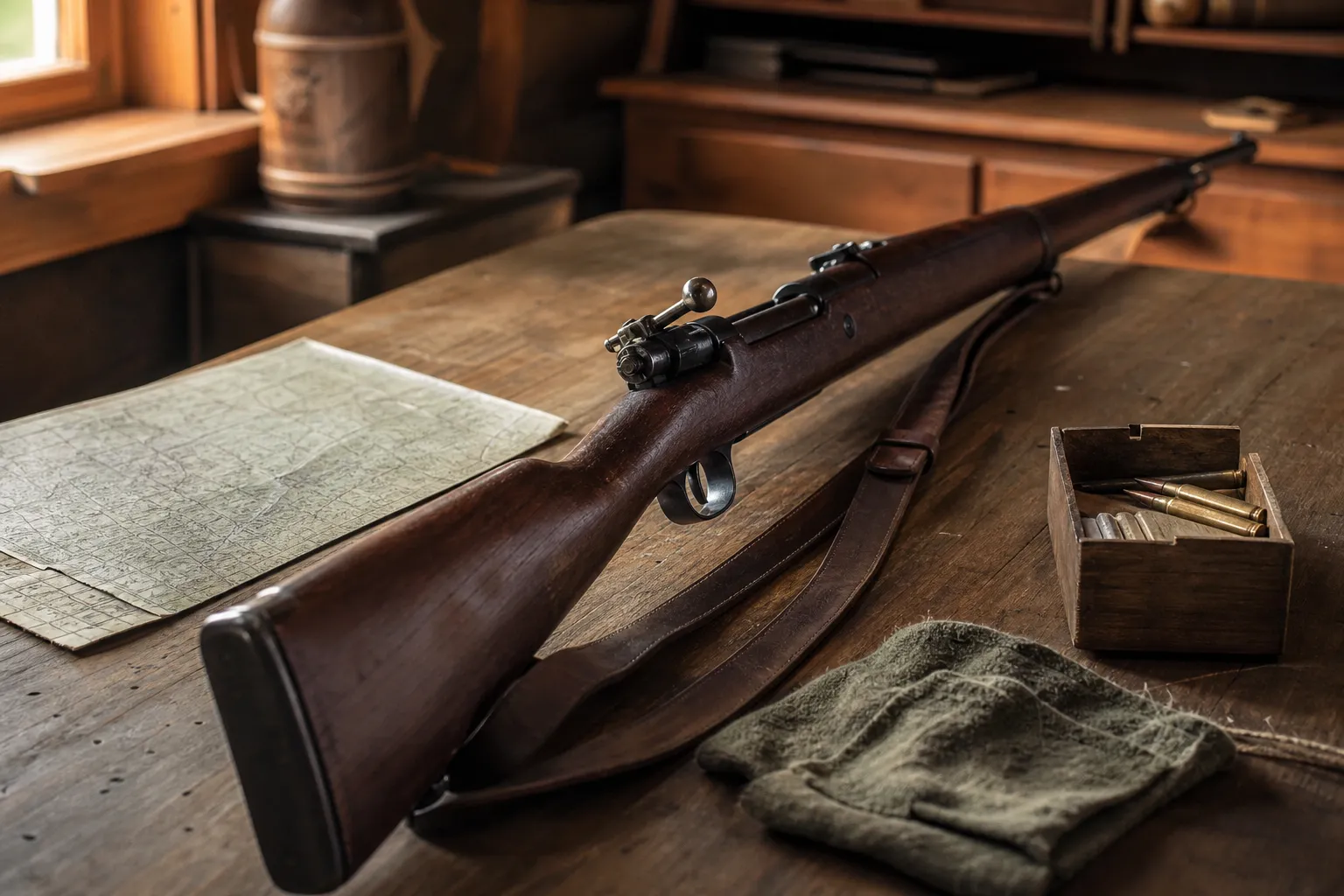
The Mauser 98 matters because it was both a specific German service rifle, the Gewehr 98, and a pattern for later bolt-action rifle design. Royal Armouries describes the Gewehr 98 as the ultimate variant of a Mauser rifle line that included earlier commercially successful models, while the National Institute of Justice says the Model 1898 Mauser influenced most modern bolt-action sporting rifles.
Why the Mauser 98 matters
When rifle readers say “Mauser 98,” they may mean the German Gewehr 98 military rifle, the broader Model 1898 action, or a later sporting rifle built around Mauser 98 ideas. The term appears often because the action became a reference point for bolt-action rifles, especially where controlled feeding and large claw extractors are discussed.
The National Institute of Justice describes the Model 1898 as a design with two forward locking lugs, a large nonbearing safety lug at the rear of the bolt body, gas venting in the bolt body and a feed mechanism that controlled cartridge movement from magazine to chamber. Those features help explain why “Mauser action” became a shorthand phrase in rifle history and hunting writing.
Mauser’s own modern catalog also treats the action as important to the brand. Mauser’s 2023 catalog says the Mauser 98 action is regarded by the company as the forefather of modern bolt-action rifles.
Development path to the Gewehr 98
The Gewehr 98 did not appear in isolation. American Rifleman states that Paul Mauser developed a series of smokeless-powder magazine rifles introduced from 1889 to 1897, and that many improvements in those rifles were carried into the Rifle 98.
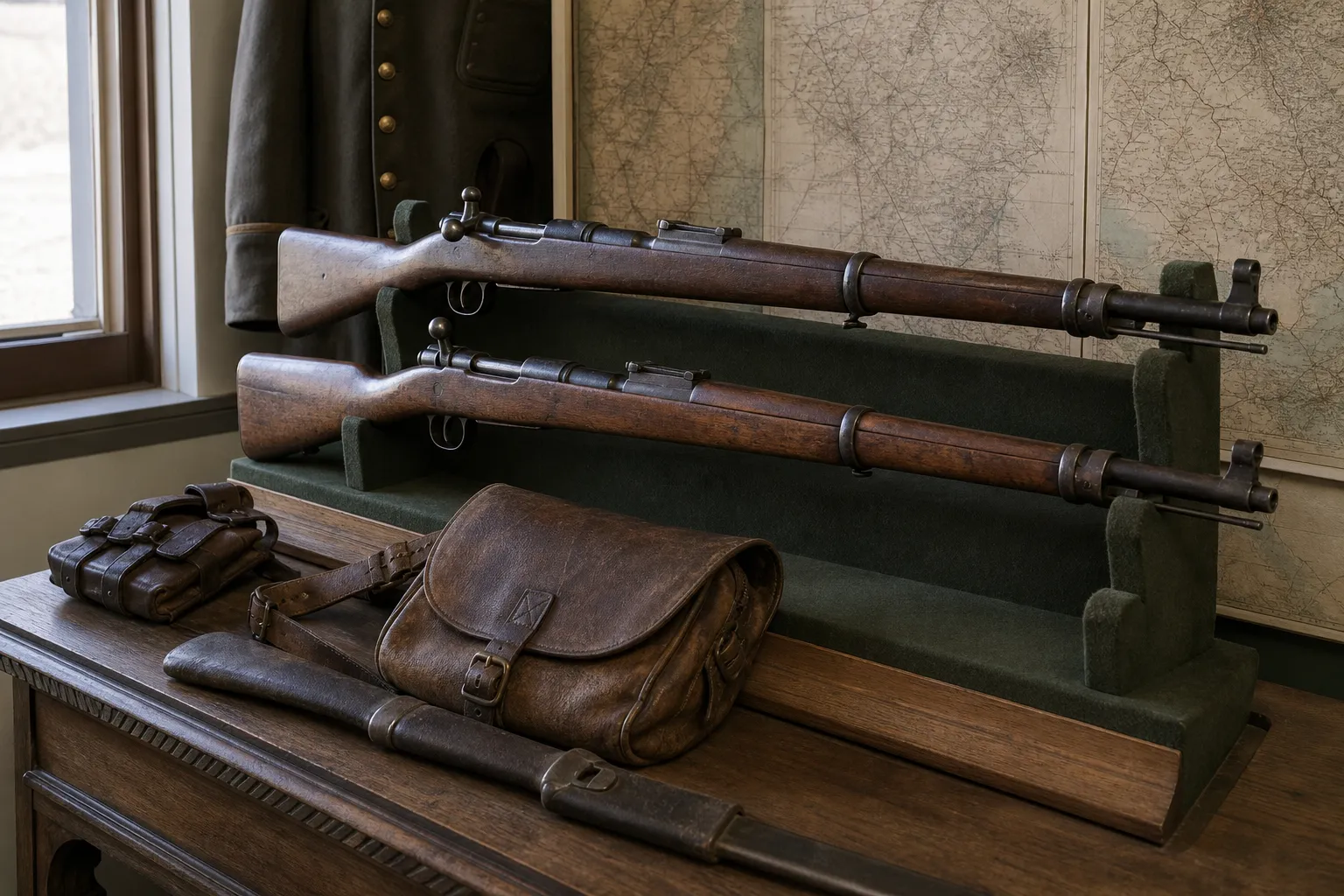
Royal Armouries describes the Gewehr 98 as the culmination of a series of commercially successful rifles that began with the Model 93 sold to Spain in 1893. American Rifleman also says German authorities were favorably impressed by the 7 mm Mauser Model 93 adopted by Spain, which helped lead to German Mauser testing and adoption of the Rifle 98 in 7.9 mm.
The National Institute of Justice training material points to two important steps before 1898. It states that by 1889 Mauser had adopted a solid bridge ahead of the bolt handle to support stripper-clip loading. It also states that by 1893 Mauser had moved from a protruding Mannlicher-style magazine to an internal magazine that staggered cartridges side to side.
American Rifleman states that the German commission formally adopted the rifle as the Gewehr 98 on April 5, 1898. It also explains that the official German military name reflected the year of adoption, and that a longer designation was Infantry Rifle 98.
Gewehr 98 military form
Royal Armouries describes the Mauser Gewehr 98 as the standard rifle issued to German infantrymen in the First World War. In its trench warfare learning material, Royal Armouries characterizes the rifle as robust and accurate, with about 15 aimed shots per minute.
Royal Armouries also notes that the rifle’s ammunition had been designed for the Gewehr 88, which it identifies as a German military rifle outside the Mauser family. Royal Armouries further states that Germany was the first to introduce the pointed spitzer, or “S,” bullet.
The Gewehr 98’s military form is important because it joined several Mauser ideas in one service rifle: receiver features associated with stripper-clip loading and the Model 1898 action system described by the National Institute of Justice.
Action design in plain English
A Mauser 98 is a turnbolt rifle: the shooter manually cycles the bolt to unlock, extract, eject, load and lock the action. The details that made the Model 1898 famous are not just that it was a bolt action, but how it locked, fed, extracted and handled safety functions.
Dual front locking lugs and rear safety lug
The National Institute of Justice describes the Model 1898 as having two forward locking lugs and a large nonbearing safety lug at the rear of the bolt body. American Rifleman explains the same idea in practical terms: the primary lugs engage recesses in the receiver, while firing forces do not directly bear on the smaller rear safety lug.
In plain English, the main locking work is done at the front of the bolt. The rear lug is described as a safety lug because it is present as a backup rather than as the normal surface taking firing forces.
Controlled-round feed and the claw extractor
Controlled-round feed is one of the phrases most often attached to the Mauser 98. American Rifleman identifies the Model 98’s long, non-rotating claw extractor as the feature responsible for its controlled-round feed. It explains that the cartridge rim slides under the extractor hook before the round is chambered.
That description is the key point. As the cartridge leaves the magazine, its rim comes under the extractor before chambering is complete. The National Institute of Justice describes the Model 1898 feed mechanism as controlling the movement of the cartridge from magazine to chamber.
Paul Mauser’s 1892 U.S. patent helps show the design goal behind this style of extractor work. The patent describes an extractor intended to make bolt-gun extractors more reliable and stronger, and describes an extractor held from rotating while the bolt can turn to lock and unlock.
For a fuller comparison of feed systems, see controlled-round feed vs push-feed rifles.
Three-position safety
American Rifleman describes the Mauser 98 three-position safety as having three settings: left for fire, a middle position that engages the firing pin while allowing bolt operation, and right to lock both the firing pin and bolt.
Mauser’s current Model 98 Standard manual describes the modern rifle as supplied with a horizontal three-position safety catch. The manual states that this safety catch directly secures the firing pin nut and firing pin, and that in the center safety position the firing pin is locked while the bolt can be opened for loading and unloading.
That is why Mauser 98 discussions often treat the safety as part of the action’s identity. It is not just a trigger-blocking feature in the descriptions above. Mauser’s manual describes it as acting directly on the firing pin system.
Gas handling
The National Institute of Justice states that the Model 1898 bolt body was vented to channel gas from a ruptured cartridge away from the shooter’s face. That gas-handling detail is often discussed alongside the locking lugs, extractor and safety because it reflects the action’s emphasis on strength and shooter protection.
Global influence on military rifles
The Mauser 98’s influence reached beyond Germany. The National Institute of Justice says the Model 1898 Mauser became the basis of the U.S. Model 1903 Springfield rifle. The National Park Service likewise says the U.S. M1903 rifle was based on the German Mauser action.
Royal Armouries gives an even more specific description of that relationship. It states that the M1903 Springfield was a closer Mauser derivative and was officially licensed by Mauser to the U.S. Government.
The 98 pattern also continued in German service arms. A U.S. War Department technical manual from March 1945 groups the Gewehr 98, Karabiner 98b and Karabiner 98k as standard German rifles and carbines of the same basic bolt-operated Mauser design. American Rifleman states that the revised shorter Karabiner 98k served as Germany’s frontline arm throughout World War II.
Those examples show two kinds of influence. One was direct adoption and licensing outside Germany, as with the U.S. M1903 Springfield. The other was family development inside the Mauser military line, from the Gewehr 98 to later 98-family rifles and carbines.
Sporting and hunting influence
The Mauser 98 also moved quickly into sporting rifles. American Rifleman states that Mauser 98 sporters were developed soon after the military rifle and introduced around the turn of the century. It also states that original Mauser company sporters were offered in rifle and carbine models with many calibers and action lengths from short to magnum.

That sporting afterlife is one reason hunters still encounter Mauser-action language. In modern use, the phrase often points to features associated with the 98 pattern: controlled-round feed, a long claw extractor, front locking lugs and an internal magazine pattern.
Mauser’s 2023 catalog ties the current Mauser 98 Magnum hunting rifle to the long extractor and controlled feed.
What “Mauser action” usually means
In careful historical writing, “Mauser 98” should not be treated as a vague label for every bolt-action rifle. The verified Model 1898 features include two forward locking lugs, a large rear safety lug, a controlled-feed mechanism, a long non-rotating claw extractor, gas venting in the bolt body and a three-position safety described by American Rifleman and Mauser’s current manual.
For a hunter or rifle-history reader, the safest way to read the phrase is as a design reference, not as a guarantee that every rifle called “Mauser-style” has the same parts, dimensions or safety system. The Gewehr 98 was a military rifle adopted in 1898. Later sporting rifles, Mauser’s own modern rifles and other bolt actions may share some 98 concepts, but each specific rifle should be identified on its own terms.
If you are evaluating, using or transporting a specific Mauser-pattern rifle, check the exact manufacturer manual, official markings, applicable firearm rules and current agency guidance. Historical model descriptions are useful for understanding the design, but they are not a substitute for official information about a particular firearm.
Frequently asked questions
When was the Gewehr 98 adopted?
American Rifleman states that the German commission formally adopted it as the Gewehr 98 on April 5, 1898.
What is controlled-round feed on a Mauser 98?
American Rifleman describes Mauser 98 controlled-round feed as the cartridge rim sliding under the extractor hook before the round is chambered. It identifies the long, non-rotating claw extractor as the feature responsible for that feed system.
What are the Mauser 98 locking lugs?
The National Institute of Justice describes the Model 1898 as having two forward locking lugs and a large nonbearing safety lug at the rear of the bolt body. American Rifleman explains that the rear safety lug does not take the normal firing forces.
Did the Mauser 98 influence the M1903 Springfield?
Yes. The National Institute of Justice says the Model 1898 Mauser became the basis of the U.S. Model 1903 Springfield rifle. The National Park Service says the M1903 was based on the German Mauser action, and Royal Armouries states that it was officially licensed by Mauser to the U.S. Government.
Sources
- Arms of the First World War, Royal ArmouriesOfficial source. Accessed November 7, 2026.
- Trench Warfare, Royal ArmouriesOfficial source. Accessed November 7, 2026.
- Firearms Examiner Training: Bolt Actions, National Institute of JusticeOfficial source. Accessed November 7, 2026.
- US Patent No. 467,180, Shell-Extractor for Bolt-Guns, United States Patent Office. Accessed November 7, 2026.
- Mauser 98 Standard Instruction Manual, MauserOfficial source. Accessed November 7, 2026.
- Mauser Hunting Rifle Catalog 2023, MauserOfficial source. Accessed November 7, 2026.
- The 1903 Springfield Rifle, Springfield Armory National Historic Site, National Park ServiceOfficial source. Accessed November 7, 2026.
- TM-E 30-451 Handbook on German Military Forces, Chapter VII, Small Arms, U.S. War Department, reproduced by Lone Sentry. Accessed November 7, 2026.
- The Mauser Model 98: Truly Great, American Rifleman. Accessed November 7, 2026.
- A Study Of The Mauser 98, American Rifleman. Accessed November 7, 2026.
- A Look Back at the Mauser Model 1898 Rifle, American Rifleman. Accessed November 7, 2026.
- The Original Mauser 98 Sporters, American Rifleman. Accessed November 7, 2026.
- 125 years MAUSER 98 Anniversary model | Masterpiece. Accessed November 7, 2026.
- 125 Jahre MAUSER 98: Die geheime Mauserformel. Accessed November 7, 2026.