Open-Bolt vs Closed-Bolt Firearms: What Is the Difference?
Open-bolt and closed-bolt describe where the bolt starts in the firing cycle, not whether a firearm is semiautomatic or automatic. Open-bolt systems can help with heat management during repeated fire, while closed-bolt systems are often favored for carefully aimed first shots.
By RaiS. Reviewed by RaiS. Published . 6 min read.
Research and drafting were assisted by AI. RaiS checked the facts against the sources below and approved this page.
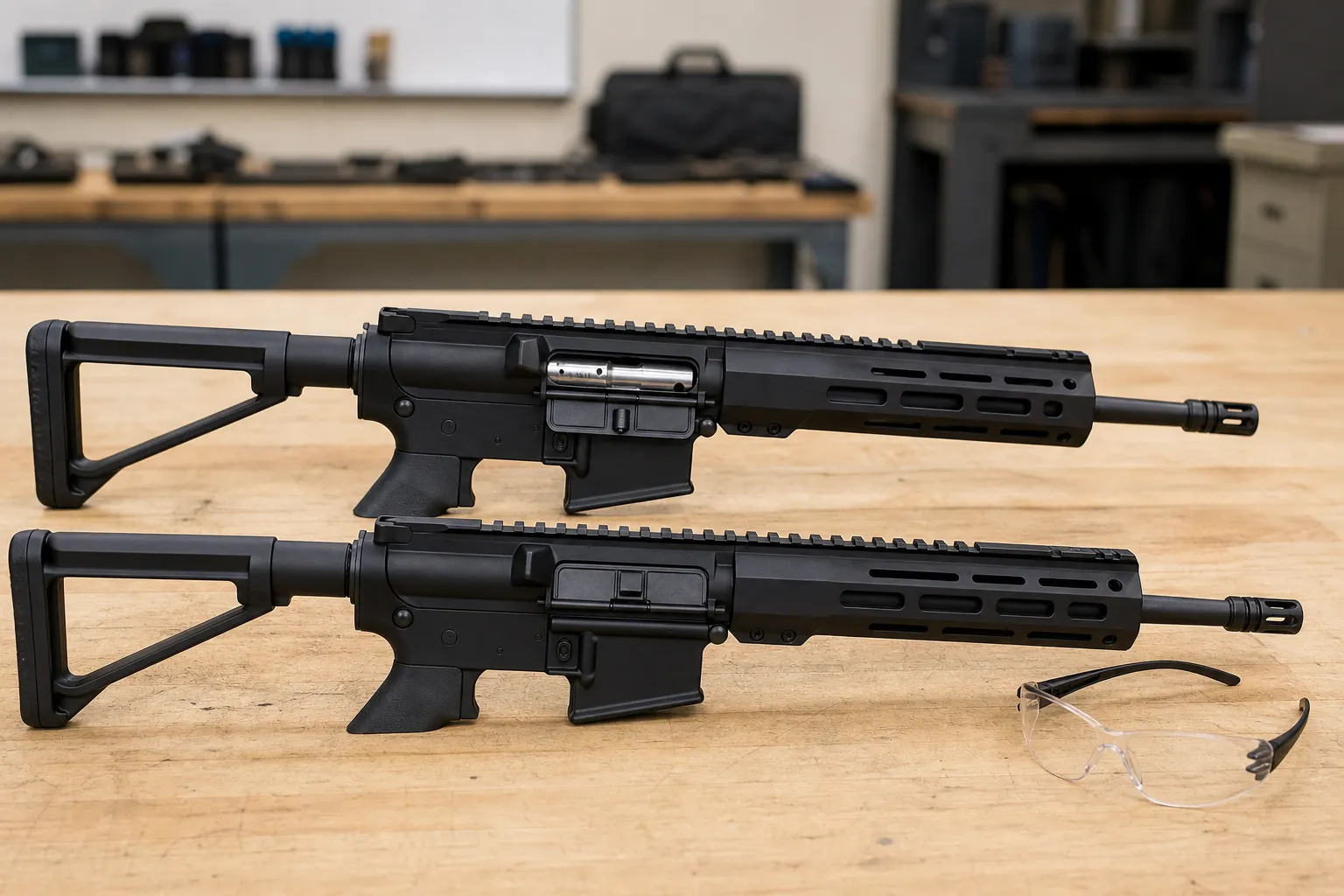
Open-bolt and closed-bolt operation describe the bolt’s starting position and firing sequence. In an open-bolt firearm, SAAMI defines the action as one in which the breech bolt is held open until the trigger is pulled. In a closed-bolt firearm, the shot starts with the bolt forward and the cartridge already chambered.
That difference matters because it affects the firing sequence, heat management, and the way the firearm feels when the shot breaks. It does not, by itself, tell you whether the firearm is semiautomatic, burst-fire, or fully automatic.
The basic difference
An open-bolt firearm starts with the bolt held to the rear. When the trigger is pressed, the bolt moves forward, feeds a cartridge, chambers it, and the cartridge fires as the bolt closes. NIJ training material describes many low-cost submachine guns as open-bolt firearms with a fixed firing pin, and it describes their sequence as beginning with the trigger mechanism holding the cocked bolt back.
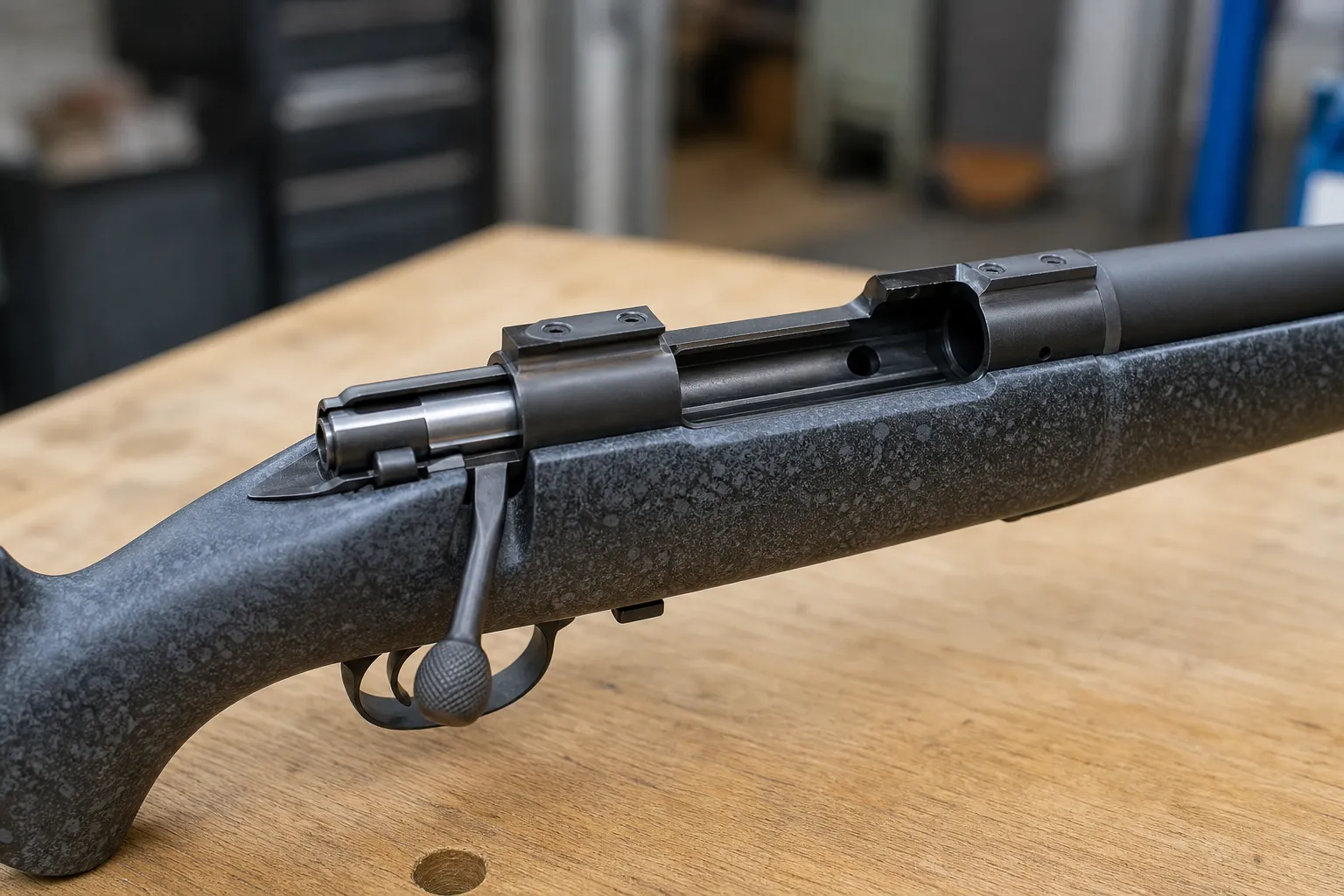
A closed-bolt firearm starts the shot with the bolt already forward. When the trigger is pressed, the firing step occurs from that closed condition.
Open bolt and closed bolt are not the same categories as semiautomatic or automatic. A firearm’s bolt position is one design feature. Its fire-control function is a separate question.
Open-bolt firing sequence
In a typical open-bolt sequence described by NIJ, the trigger mechanism holds the cocked bolt back, usually behind a box magazine. Pulling the trigger releases the bolt. The bolt travels forward, strips a cartridge from the magazine, feeds it into the chamber, and the cartridge fires as the bolt closes.
After firing, the bolt is driven back, and the cycle can repeat depending on the firearm’s design. In an automatic open-bolt firearm, the fire control system determines whether repeated fire continues.
This is a conceptual description, not a guide to building or modifying anything. Open-bolt firearms include different mechanical arrangements, and military rifle-caliber machine guns often add locking systems because of pressure.
NIJ explains that machine guns firing rifle cartridges must have a locking system to secure the breech against high pressures. NIJ also notes that some firearms require a locked breech to safely handle more powerful cartridges and longer peak pressure duration.
Those materials show an important point: “open bolt” does not necessarily mean “unlocked breech.” The term describes where the bolt starts before firing. A design may still lock before the cartridge fires.
Closed-bolt firing sequence
The closed-bolt sequence is easiest to understand as the reverse starting condition from an open-bolt firearm.
In plain English, the shot begins after the cartridge is already chambered and the bolt is already forward. When the firearm fires, the operating system cycles the action, extracts and ejects the spent case, cocks the mechanism, and prepares the next cycle.
This is why the M4 and M16 family are useful closed-bolt examples for this comparison.
Heat management and cook-off
Open-bolt operation is strongly associated with military automatic weapons because it can help manage heat during repeated firing. Under normal open-bolt operation, a cartridge is not left sitting in a hot chamber between bursts.
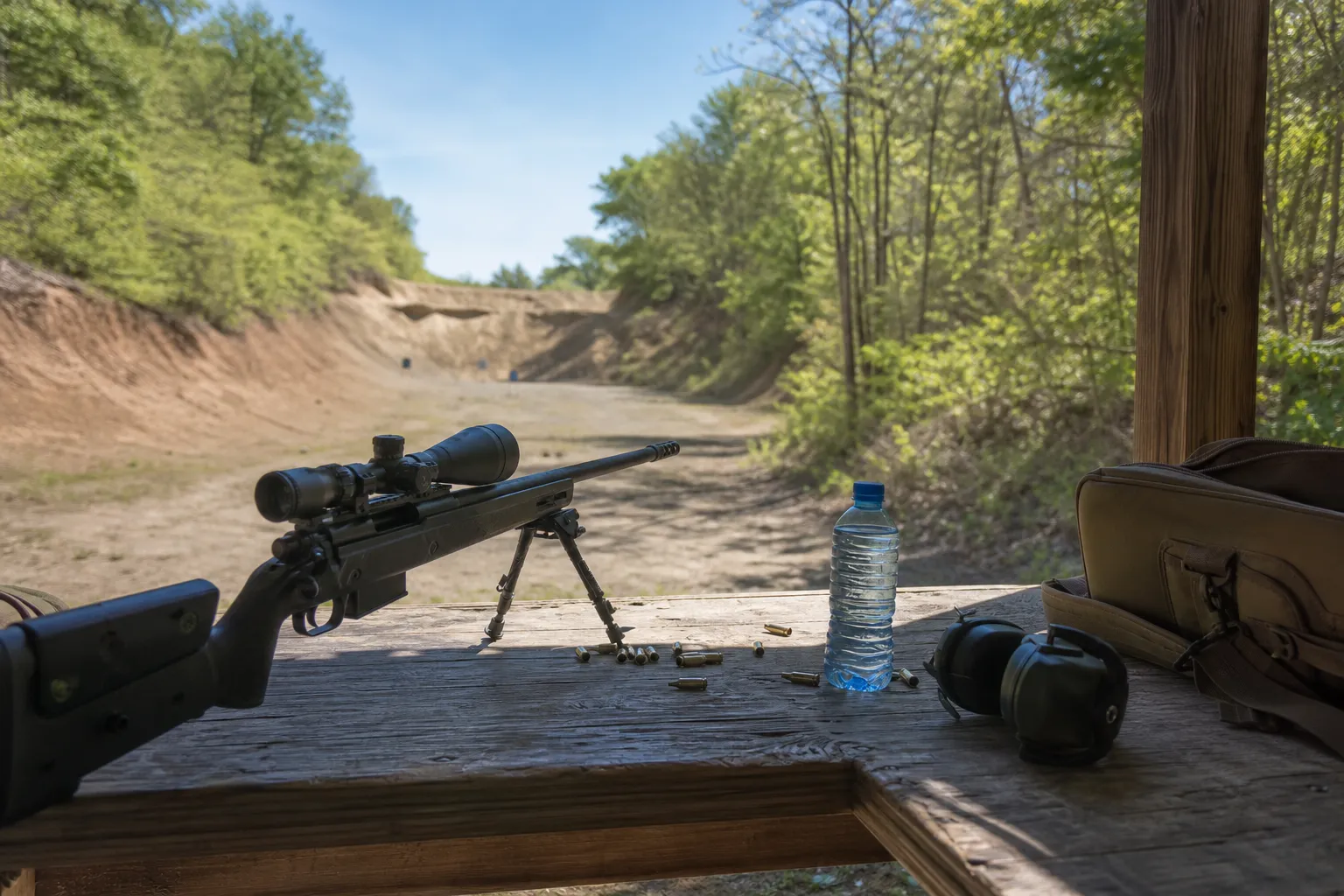
Heat is not only an open-bolt issue. The practical comparison is simple: open-bolt designs are often chosen for sustained automatic fire because the chamber is not normally left closed on a cartridge between bursts. Closed-bolt designs keep the next round chambered in the ready condition, which is useful for other reasons, but it changes the heat situation during prolonged firing.
Accuracy and handling considerations
Closed-bolt operation can be favorable for a carefully aimed first shot because the bolt is not traveling forward at the moment the trigger is pressed. A U.S. Justice Department-hosted reference on submachine guns states that closed-bolt fire is more accurate for carefully aimed semiautomatic fire because of faster lock time.
The same reference explains the handling reason: release of a cocked hammer is faster and less jarring to the shooter’s aim than the travel of an open bolt. In an open-bolt firearm, the bolt’s forward movement happens after the trigger press and before ignition, so the moving mass can disturb the sight picture.
That does not mean every closed-bolt firearm is more accurate than every open-bolt firearm. It means the design tradeoff is real: open-bolt operation has heat-management advantages, while closed-bolt operation can have an advantage for a carefully aimed semiautomatic shot.
Historical examples
M249 Squad Automatic Weapon
In mechanism discussions, the M249 is often contrasted with closed-bolt rifles and carbines because it represents a different design priority.
The important comparison point is broader than one model: an open-bolt starting position does not by itself determine whether the breech is locked at firing.
M4 and M16 series
The M4 and M16 series are commonly used as closed-bolt reference points in basic mechanism comparisons.
For readers comparing basic firearm mechanisms, that closed-bolt approach contrasts clearly with the open-bolt sequence where the bolt begins held to the rear.
STEN submachine gun
The STEN is a Second World War example of an open-bolt submachine gun. The Airborne Assault Museum describes the STEN as a basic war-economy design for a machine carbine, made to meet an urgent need for a simple home-produced weapon.
The museum lists the STEN action as blowback-operated and open bolt. It also says three million STENs were made from 1941 onward in several marks.
The STEN also shows that simplicity can bring practical drawbacks. The Airborne Assault Museum notes that the large side opening for the cocking handle could admit dust and debris, contributing to jams in early marks.
Open bolt vs closed bolt at a glance
| Feature | Open-bolt operation | Closed-bolt operation |
|---|---|---|
| Starting position | Bolt held open until the trigger is pulled, using SAAMI terminology | Bolt forward, with the cartridge already chambered |
| Typical firing sequence | Trigger releases bolt, bolt moves forward, feeds and chambers a cartridge, cartridge fires as bolt closes | The shot begins with the cartridge already chambered and the bolt already forward |
| Heat management | Associated with machine guns because a cartridge is not normally left chambered between bursts | A chambered round can remain in the ready condition |
| Aimed first-shot feel | Bolt movement before firing can disturb aim | Justice Department-hosted material says closed-bolt fire is more accurate for carefully aimed semiautomatic fire because of faster lock time |
| Example | STEN | M4/M16 series |
Legal classification is a separate question
Mechanical terms and legal categories are not the same thing. SAAMI says its glossary is a technical industry glossary and is not intended to provide legal definitions. That is important because open-bolt operation, closed-bolt operation, semiautomatic fire, and automatic fire may have different meanings in technical, military, and legal contexts.
ATF eRegulations defines a machine gun as a weapon that shoots, is designed to shoot, or can be readily restored to shoot automatically more than one shot without manual reloading by a single trigger function.
In Canada, the Criminal Code defines an automatic firearm as one capable of, or designed and manufactured with the capability of, discharging projectiles in rapid succession during one pressure of the trigger. The RCMP page on classes of firearms lists automatic firearms, whether or not altered to discharge only one projectile with one pressure of the trigger, under prohibited firearms.
Those legal references are included only to show that legal classification is separate from the mechanical comparison. For any current classification question, readers should confirm with ATF, the RCMP Canadian Firearms Program, or another competent authority. This article does not provide conversion, modification, build, or legal-workaround guidance.
Bottom line
Open-bolt and closed-bolt operation describe where the bolt is when the firearm is ready to fire and what happens immediately after the trigger is pressed. Open-bolt systems start with the bolt held back and are historically common in automatic weapons where heat management matters. Closed-bolt systems start with the bolt forward.
For history readers, the key tradeoff is straightforward: open-bolt operation helps explain why many machine guns and simple submachine guns were built the way they were, while closed-bolt operation helps explain why many rifles and carbines are suited to a more stable, carefully aimed first shot.
When legal classification matters, check the current wording and guidance from ATF, the RCMP Canadian Firearms Program, or the relevant authority for your jurisdiction.
Frequently asked questions
Does open bolt mean fully automatic?
No. Open bolt describes the bolt’s starting position and firing sequence. Fire-control function is a separate question.
Why do many machine guns fire from an open bolt?
Open-bolt operation is associated with heat management during repeated firing because a cartridge is not normally left sitting in a hot chamber between bursts.
Why can closed-bolt fire be more accurate for a first shot?
A Justice Department-hosted reference on submachine guns states that closed-bolt fire is more accurate for carefully aimed semiautomatic fire because of faster lock time. It explains that releasing a cocked hammer is faster and less jarring than the travel of an open bolt.
Is an open-bolt firearm always unlocked when it fires?
No. Open bolt describes the starting position of the bolt. Some firearms still use locking systems before the cartridge fires.
What is a historical open-bolt example?
The STEN is a Second World War open-bolt example. The Airborne Assault Museum lists the STEN action as blowback-operated and open bolt, and describes it as a basic war-economy machine carbine design.
Who should answer legal classification questions?
Legal classification should be checked with the relevant authority, such as ATF in the United States or the RCMP Canadian Firearms Program in Canada. Technical terms like open bolt and closed bolt are not the same as legal classifications.
Sources
- SAAMI Glossary, Letter O, Sporting Arms and Ammunition Manufacturers' InstituteOfficial source. Accessed November 1, 2026.
- Firearms Examiner Training: Semiautomatic and Automatic, National Institute of JusticeOfficial source. Accessed November 1, 2026.
- TC 3-22.249, Light Machine Gun, U.S. ArmyOfficial source. Accessed November 1, 2026.
- TM 9-1005-313-23&P, M240 Theory of Operation excerpt, U.S. Army technical manual copy hosted by Army Knowledge for Me. Accessed November 1, 2026.
- TC 3-22.9, Rifle and Carbine, U.S. ArmyOfficial source. Accessed November 1, 2026.
- Submachine Gun Design reference hosted by OJP/NCJRS, Office of Justice Programs / National Criminal Justice Reference Service. Accessed November 1, 2026.
- STEN Machine Carbine, Airborne Assault Museum / ParaData. Accessed November 1, 2026.
- 27 CFR § 478.11, Meaning of Terms, Bureau of Alcohol, Tobacco, Firearms and ExplosivesOfficial source. Accessed November 1, 2026.
- ATF Ruling 82-2, KG-9 pistol, Bureau of Alcohol, Tobacco, Firearms and ExplosivesOfficial source. Accessed November 1, 2026.
- Criminal Code, R.S.C., 1985, c. C-46, Section 84 definitions, Justice Laws Website, Government of CanadaOfficial source. Accessed November 1, 2026.
- Classes of firearms in Canada, Royal Canadian Mounted PoliceOfficial source. Accessed November 1, 2026.
- Chapter 2 and operation under normal conditions,. Accessed November 1, 2026.