Arrow FOC Explained: Front-of-Center Balance and Why It Matters
FOC is the percentage that shows how far an arrow’s balance point sits ahead of its midpoint. It is useful for understanding arrow balance, but it should be considered with spine, total weight, tuning, fletching and the head you plan to shoot.
By RaiS. Reviewed by RaiS. Published . 6 min read.
Research and drafting were assisted by AI. RaiS checked the facts against the sources below and approved this page.
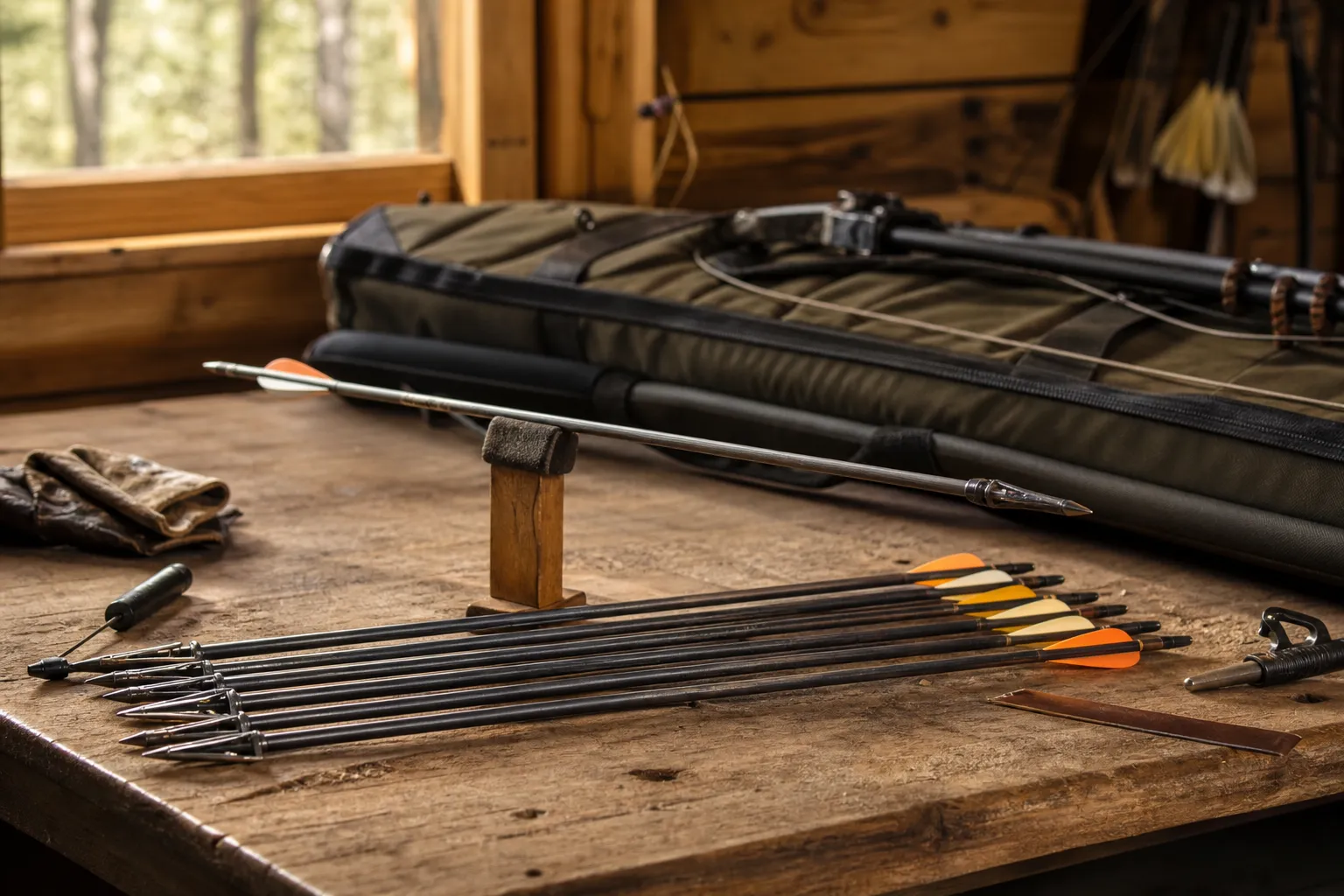
FOC, or front-of-center, is an arrow balance measurement. It tells you how far the finished arrow’s balance point sits in front of the arrow’s midpoint, expressed as a percentage of arrow length. It matters because Easton connects a forward balance point, within limits, with arrow stability, but FOC is only one part of the full arrow setup.
What FOC means
FOC describes how far the balance point is forward of the arrow’s midpoint, expressed as a percentage of total arrow length. ASTM F1435-08 is a standard specification for determining and designating the balance point location of archery arrows, and ASTM bases that percentage location on ATA arrow length.
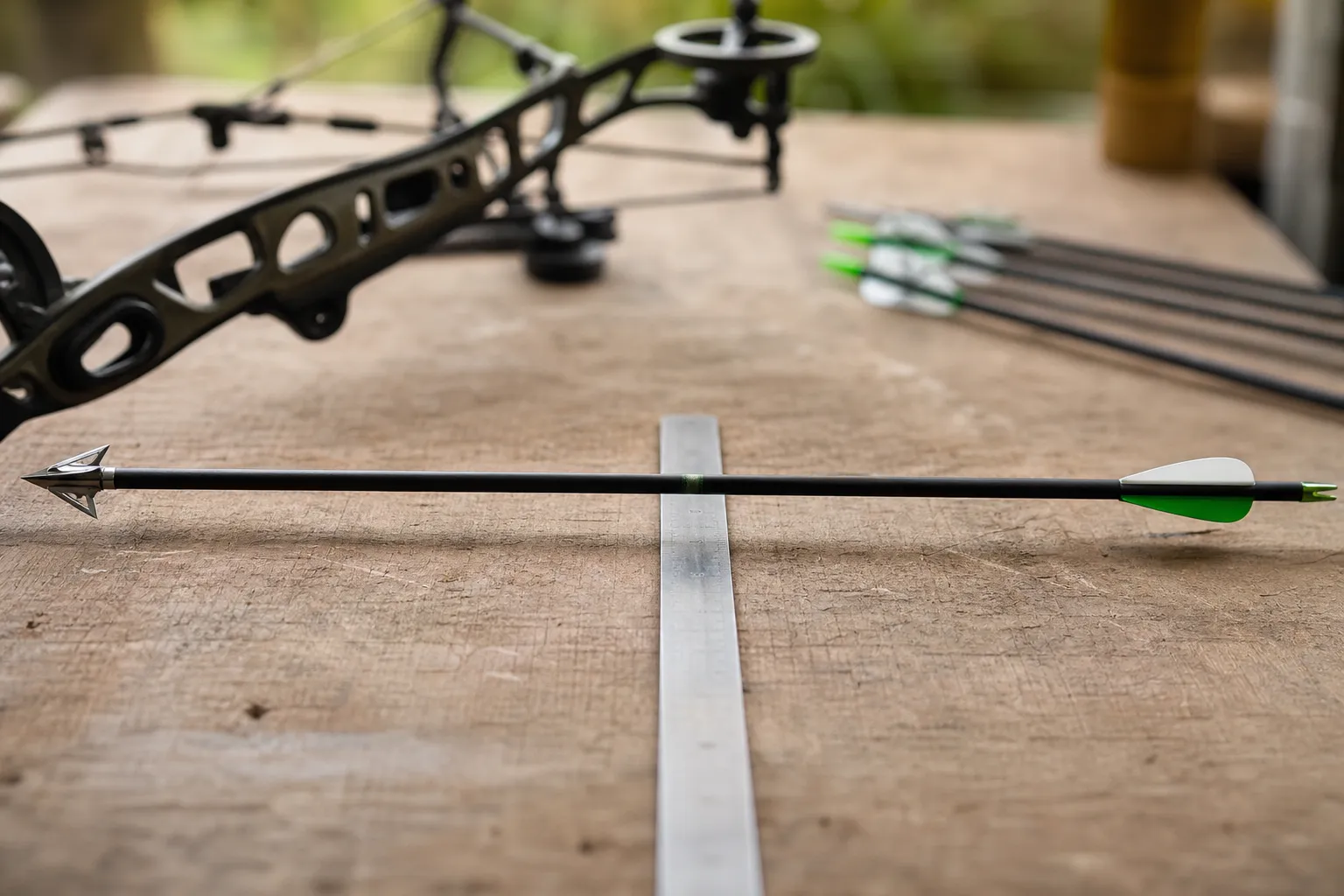
In plain English, FOC compares two places on the arrow:
- The arrow’s midpoint.
- The point where the finished arrow balances.
If the balance point is ahead of the midpoint, the arrow has positive FOC. Easton describes arrows with negative FOC, where the arrow is too light at the point end for normal target and bowhunting contexts, as inherently unstable in those contexts.
FOC is not the same thing as total arrow weight. Two arrows can weigh the same overall and still balance differently if one has more weight in the point, insert or broadhead and the other has more weight in the rear components.
If you are new to the parts being measured, see Parts of an Arrow: Shaft, Point, Fletching and Nock.
Measure FOC on a finished arrow
ASTM states that the arrow assembly should be complete, including the point, when the balance point is determined. Easton’s FOC calculator gives the same practical instruction for hunting arrows: install all the components you will use before determining FOC.
That means the arrow should be measured with the components that affect its real balance, including the point or broadhead, insert, nock and fletching. Easton’s FAQ defines the finished arrow balance position as including point and insert weight, nock system weight and fletching weight.
A common measurement process is:
- Assemble the arrow with the components you intend to use.
- Place the arrow on a knife edge, as ASTM describes, and move it until it balances.
- Mark the balance point.
- Measure the arrow length from the nock reference point to the end of the shaft, excluding the point.
- Measure from the same nock reference point to the balance point.
- Use those two measurements in the FOC formula.
Easton defines arrow length for FOC as measured from the nock throat to the shaft end, not including the point. Easton’s FAQ also describes the length as the distance from the bottom of the nock groove to the end of the shaft. Gold Tip’s FOC calculator likewise uses arrow length and the balance point measured from the nock throat.
The key is consistency. Use the same nock reference point for both measurements.
The standard FOC formula
Easton gives the AMO-standard FOC formula as:
FOC % = 100 x (A - L/2) / L
In that formula:
| Term | Meaning |
|---|---|
| L | The correct arrow length, measured from the bottom of the nock groove or nock throat to the end of the shaft, not including the point. |
| A | The distance from the nock groove or nock throat to the finished arrow’s balance point. |
| L/2 | The arrow’s midpoint. |
| A, L/2 | How far forward of the midpoint the balance point sits. |
Gold Tip uses similar measurement ideas in its calculator and describes the balance point as measured from the throat of the nock. Some sources use different letters, but the concept is the same: compare the finished arrow’s balance point with the arrow’s midpoint, then express the difference as a percentage of arrow length.
What changes FOC
Gold Tip describes FOC as the result of the relative weights of the arrow’s insert, point, fletching and nock. Easton identifies shaft mass, point and insert mass, and fletching and nock mass as variables that affect FOC.
Here is the general pattern:
| Change | Usual effect on FOC |
|---|---|
| Heavier point or broadhead | Moves the balance point forward and raises FOC. |
| Heavier insert or front-end component | Moves the balance point forward and raises FOC. |
| Lighted nock | Adds rear weight and can pull FOC down. |
| Wrap | Adds rear weight and can pull FOC down. |
| Larger or heavier vanes | Add rear weight and can pull FOC down. |
| Lighter shaft with the same point and lighter fletching | Easton says this can produce more positive FOC than a heavier shaft with heavier fletching. |
| Shorter shaft | Often reads higher as a percentage because arrow length is part of the formula. |
| Longer shaft | May need more front weight to keep the same percentage. |
Gold Tip says increasing point or insert weight pulls the balance point forward and raises FOC. Gold Tip also says rear-end additions such as lighted nocks, wraps and larger vanes pull FOC down.
Arrow length matters because FOC is a percentage of arrow length, not just a balance-point distance. A shorter shaft can show a higher FOC percentage, while a longer arrow may need more front weight to keep the same percentage.
FOC changes should not be treated in isolation. Easton says excess FOC can lower dynamic spine and create tuning problems. The Gold Tip catalog also defines point weight for selection charts as the combined weight of the point, insert, Ballistic Collar and FACT weight, which shows why front-end component choices matter when checking arrow selection information. For more on that part of arrow setup, see Arrow Spine Chart Explained.
FOC, flight stability and wind
Easton says more front-half weight moves the center of balance forward and can improve stability, but only within limits.
That last phrase matters. Easton warns that excessive positive FOC can cause a long-distance nosedive as the arrow loses momentum. Easton’s tuning guide also says changing FOC may change the shape of an arrow’s trajectory and affect preset sight locations.
So the practical lesson is not “more FOC is always better.” The better lesson is that FOC is one measurable part of arrow behavior. A change that improves one part of the system can still affect trajectory, dynamic spine or tune.
An FOC number should be considered with the rest of the setup, not used as a stand-alone target.
FOC and broadhead flight
FOC can be part of broadhead stability, but it is not the whole subject. IHEA-USA’s bowhunter education standard says fletching assists in stabilizing arrow flight, and it says helical fletching is used for greater arrow spin and flight stabilization.
For broadheads, the rest of the arrow setup still matters. IHEA-USA says practice points and hunting tips should be the same grain weight. Gold Tip’s catalog notes that a longer broadhead than a field point may call for a slightly stiffer shaft selection.
That means a broadhead change can involve more than balance. It can also involve head weight, head length, fletching, tune and spine selection. A high or low FOC number by itself does not prove that a broadhead will fly well from a particular bow.
For more background on head types, see Broadheads: Fixed vs Mechanical. For tuning context, see Paper Tuning a Bow: How to Read Arrow Tears.
How to use FOC without overusing it
FOC is most useful as a comparison tool. If you change a point, insert, nock, wrap, vane or shaft length, FOC helps you see how that change moved the arrow’s balance point.
It is less useful as a single pass or fail number. Easton’s tuning guide says FOC is most important in long-range archery events. Easton also notes that changing FOC may change trajectory and preset sight locations.
A careful way to think about FOC is:
- Measure it only on the finished arrow.
- Use the same nock reference point each time.
- Record the point, insert, shaft, nock and fletching combination.
- Remember that more front weight can also affect dynamic spine.
- Check the arrow manufacturer’s current calculator, selection chart and tuning information when you change components.
FOC is a helpful measurement because it turns “this arrow feels more front heavy” into a repeatable number. It is not a complete arrow prescription. Before changing an arrow setup, check the current arrow manufacturer’s technical information, FOC calculator, spine chart and tuning guide, and use current bowhunter education guidance when comparing practice points with hunting heads.
Frequently asked questions
What does FOC mean on an arrow?
FOC means front of center. It describes how far the arrow’s balance point is forward of the arrow’s midpoint, expressed as a percentage of total arrow length.
Do I measure FOC before or after installing the point?
Measure it after the arrow is finished. ASTM says the arrow assembly should be complete, including the point, and Easton tells users to install the components they will use before determining FOC.
What is the common FOC formula?
Easton gives the AMO-standard formula as FOC % = 100 x (A, L/2) / L, where L is arrow length and A is the distance from the nock reference point to the finished arrow’s balance point.
Does a heavier broadhead raise FOC?
Usually, yes. Gold Tip says increasing point or insert weight pulls the balance point forward and raises FOC.
Can too much FOC cause problems?
Yes. Easton says excessive positive FOC can create a long-distance nosedive as the arrow loses momentum, and it can lower dynamic spine and create tuning problems.
Is FOC the only thing that controls broadhead flight?
No. IHEA-USA says fletching stabilizes arrow flight, and Gold Tip notes that a longer broadhead than a field point may call for a slightly stiffer shaft selection. FOC is one factor among the full arrow setup.
Sources
- Bowhunter Education, International Hunter Education Association U.S.A.Official source. Accessed November 11, 2026.
- 2025 Gold Tip and Bee Stinger Catalog, Gold TipOfficial source. Accessed November 11, 2026.
- FITA Coaching Manual, Intermediate Level, World ArcheryOfficial source. Accessed November 11, 2026.
- ASTM F1435-08, Standard Specification for Designation of the Balance Point Location for Archery Arrows, ASTM International. Accessed November 11, 2026.
- F.O.C. Calculator, Easton ArcheryOfficial source. Accessed November 11, 2026.
- FAQs, Easton Archery Questions Answered, Easton ArcheryOfficial source. Accessed November 11, 2026.
- The Simple Guidelines to Correct Arrow Balance (FOC), Easton ArcheryOfficial source. Accessed November 11, 2026.
- Arrow Tuning and Maintenance Guide, Easton ArcheryOfficial source. Accessed November 11, 2026.
- FOC Arrow Calculator, Gold Tip ArrowsOfficial source. Accessed November 11, 2026.
- Arrow Spine Selector Tool, Gold Tip Arrows. Accessed November 11, 2026.