Parts of an Arrow: Shaft, Point, Fletching and Nock
A finished arrow is usually introduced as four main parts: the shaft, fletching, nock and point. Modern arrows may also include inserts or half-outs, broadheads, wraps and cresting, and each part can affect fit, weight, balance, tune or identification.
By RaiS. Reviewed by RaiS. Published . 7 min read.
Research and drafting were assisted by AI. RaiS checked the facts against the sources below and approved this page.
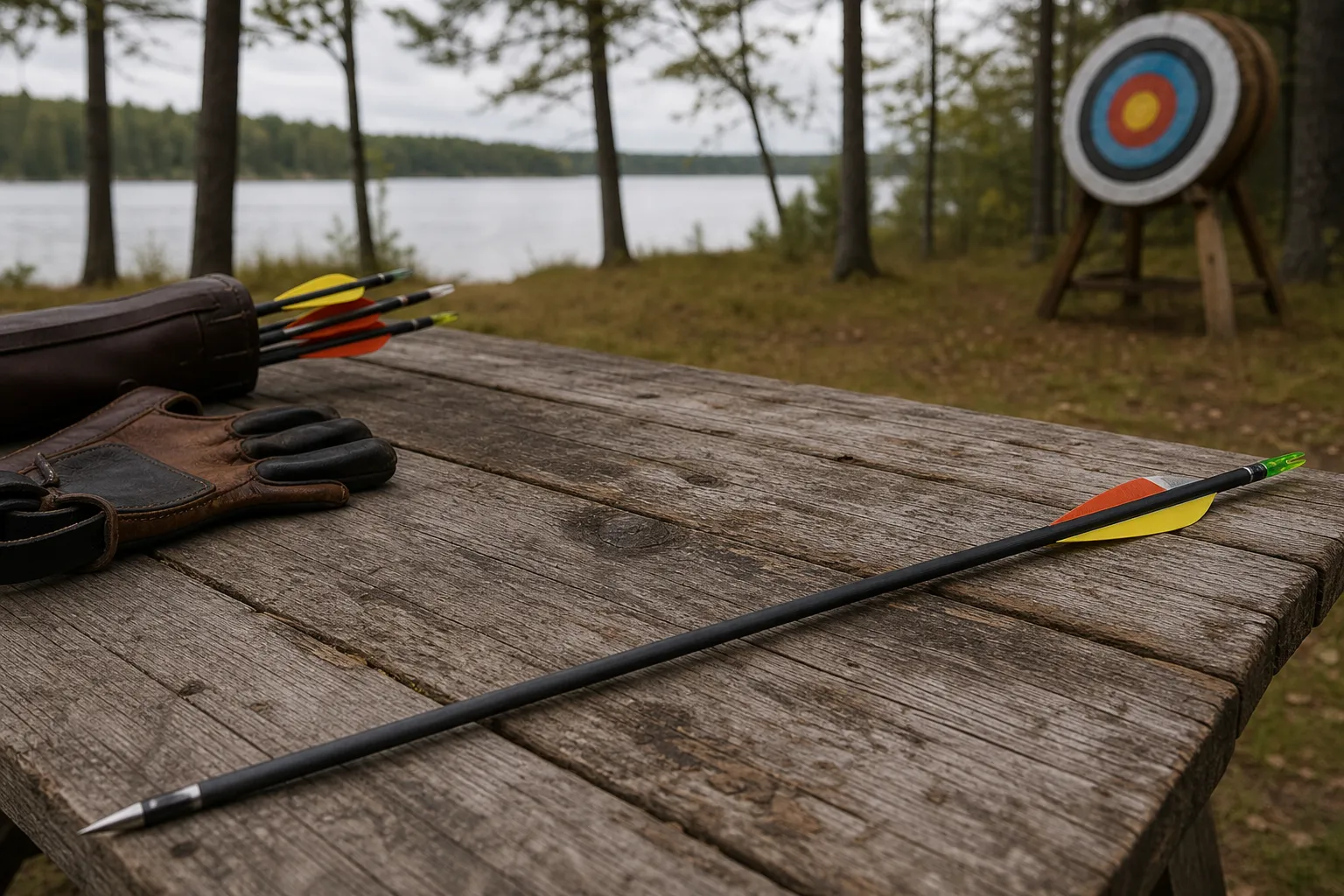
A finished arrow has four basic parts: shaft, fletching, nock and point, according to IHEA-USA bowhunter education standards. Modern arrows may also include an insert or half-out at the point end, a hunting broadhead, wraps, and optional cresting. For a beginner, the big idea is simple: every part can affect how the arrow fits the bow, how it balances, how it stabilizes in flight, and how consistently it groups.
The basic parts of an arrow
IHEA-USA introduces a finished arrow with four distinct parts:
| Part | What it is | Why it matters |
|---|---|---|
| Shaft | The arrow body | Material, length, spine and weight affect fit and flight |
| Fletching | Feathers or plastic vanes at the rear | Helps stabilize the arrow in flight |
| Nock | The part that attaches to the bowstring | Consistent nocking position supports accuracy |
| Point | The front end used for practice, games or hunting | Point type and grain weight affect use and tune |
USA Archery’s posted World Archery Book 3 rule describes an arrow in a similar way: a shaft with a tip, nocks, fletching and optional cresting. That rule is for competition context, but it is a useful anatomy checklist for beginners.
Shaft: the arrow body
The shaft is the main body of the arrow. IHEA-USA lists common shaft materials as wood, tubular aluminum, tubular carbon fiber, tubular fiberglass, solid fiberglass and aluminum-carbon combinations.
Wood shafts are described by IHEA-USA as mainly used by recurve or longbow archers, or for special recreational shafts such as flu-flu arrows. Aluminum shafts are tubular, and IHEA-USA says matching thickness and diameter to bow weight is critical for good arrow flight and bow shooting safety.
IHEA-USA describes tubular carbon-fiber shafts as smaller in diameter and lighter than aluminum shafts of corresponding strength, very durable and popular for bowhunting. It also describes aluminum-carbon combination shafts as popular for bowhunting because of durability and precision.
Three shaft specs show up early when you start comparing arrows:
- Length: Easton defines correct arrow length as the distance from the bottom inside of the nock groove to the cut end of the shaft, not including the point or insert.
- Spine: Spine is the arrow’s stiffness or flexibility.
- GPI: Easton says shaft weight is measured in grains per inch, or GPI. Listed shaft GPI does not include the point, nock, insert or fletching.
IHEA-USA says the length, spine and physical weight of a finished arrow should be matched to both the shooter and the bow. For more detail on matching stiffness to your setup, see our queued Arrow Spine Chart guide.
Point, insert and broadhead
The point is the working end of the arrow. IHEA-USA says arrow points are designed for different functions, including target practice, games, small game hunting and big game hunting.
For practice, many archers use field points. IHEA-USA says hunters should use practice points and hunting tips of the same grain weight.
An insert or half-out is part of the point-end component system. Easton says its components are model specific, so replacement components should be selected for the particular shaft. Easton describes its HIT insert system as fitting up inside the arrow shaft. Easton also describes a 4MM Half-Out Titanium Insert as enabling common 8-32 thread broadheads in specified 4MM shafts.
For shaft selection, Gold Tip defines point weight as the combined weight of the point, insert, Ballistic Collar and FACT weight. That is a helpful beginner reminder: the front of the arrow is not just the visible point. Inserts and other point-end parts add weight too.
Broadheads
IHEA-USA identifies broadheads as big-game hunting points and cautions that they must be kept razor sharp and handled with extreme care. It lists three broadhead types:
- Fixed blade broadheads: A fixed-blade hunting head category.
- Removable-blade broadheads: IHEA-USA says these use grooves in the ferrule to hold the blades, and damaged blades can be replaced without discarding the whole broadhead.
- Mechanical or expandable broadheads: IHEA-USA says these keep blades retracted close to the ferrule in flight, and the blades open on impact.
Broadhead rules can be specific to the place, species and season. For a primer on hunting heads, see our queued Broadheads guide, then confirm current rules with the wildlife agency for the area where you plan to hunt.
Arrow fletching and vanes
Fletching is the feathers or plastic vanes attached at the opposite end of the arrow from the point. IHEA-USA says fletching assists in stabilizing arrow flight.
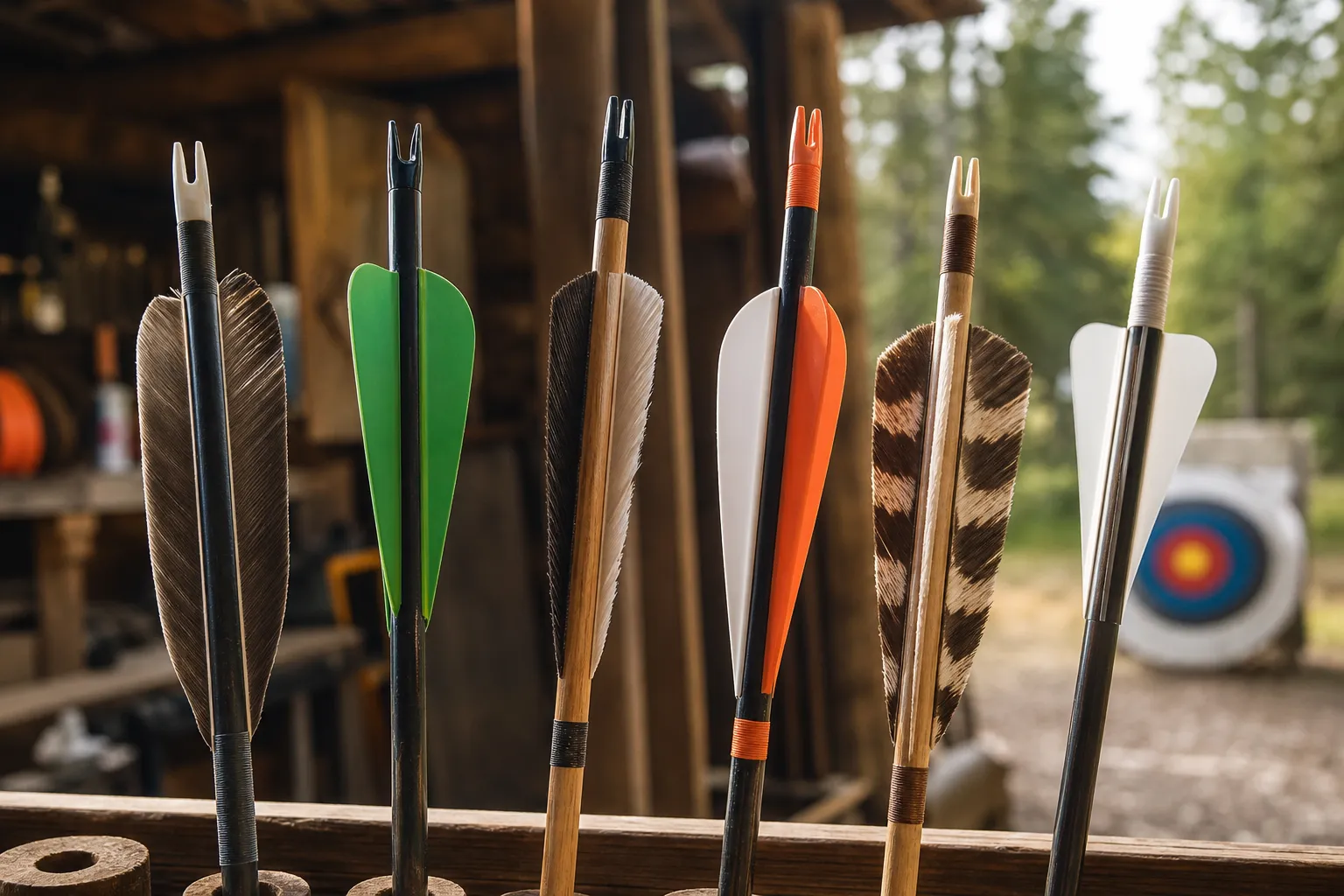
World Archery describes a common three-vane layout with two hen vanes and one cock vane. In that layout, the cock vane points away from the riser when the arrow is nocked to the string.
Fletching can be set up in different configurations. IHEA-USA identifies offset fletching as common, with three fletches set symmetrically 120 degrees apart, or four fletches set 90 degrees apart. IHEA-USA says helical fletching is used for bowhunting and target shooting, and it increases arrow spin and in-flight stabilization.
Flu-flu fletching is a special case. IHEA-USA describes flu-flu fletching as large or uncut feathers attached around the shaft. That large fletching slows arrow speed because of increased resistance.
Vane size also involves a tradeoff. World Archery explains that smaller, streamlined vanes with minimal surface area retain arrow speed while stabilizing the shaft over distance. It also describes larger indoor vanes as stabilizing faster over shorter distances.
For beginners, the simple rule is this: fletching helps the arrow recover and fly consistently, but the amount, shape and angle of that fletching can change drag, spin and stabilization.
Nock, wraps and cresting
The nock is the part of the arrow that attaches to the bowstring. IHEA-USA says the point on the bowstring where the arrow attaches is called the nocking point, and a consistent nocking point aids accuracy.
That is why the nock is more than a small plastic part at the back of the shaft. It controls how the arrow indexes on the string. Combined with the fletching layout, it helps the arrow start from the same orientation each shot.
Wraps are optional labels applied to arrows. World Archery says wraps are used for identification, labeling shafts with a name and number, protecting the shaft from fletching adhesive, and providing reliable vane markings.
Cresting is also optional in USA Archery’s posted World Archery arrow definition. In competition context, USA Archery’s posted World Archery Book 3 rule says arrow wraps are not counted in the 9.3 mm shaft-diameter limit if they do not extend more than 22 cm toward the point from the nock throat. That is a target-archery rule context, not a hunting regulation.
Key arrow specs: length, spine, weight and FOC
The most important beginner specs are length, spine, weight and FOC. IHEA-USA says finished arrow length, spine and physical weight should be matched to both the shooter and the bow.
Arrow length
Easton defines correct arrow length as measured from the bottom inside of the nock groove to the cut end of the shaft, not including the point or insert. When comparing charts or manufacturer instructions, use the arrow maker’s measurement method for that arrow system.
Static and dynamic spine
Static spine is measured by the amount of flex when an 880-gram weight is suspended from the center of a 29-inch arrow supported 28 inches apart.
Dynamic spine is how the arrow reacts when shot from the stored energy of a bow. Easton says dynamic-spine factors include arrow weight, spine, length, point weight, nock weight and fletching weight.
Easton says incorrect arrow spine can cause erratic arrow flight and poor shooting groups. Gold Tip tells readers to use draw weight, point weight and arrow length to start shaft selection.
GPI and finished arrow weight
Easton says arrow shaft weight is measured in grains per inch. The listed GPI is shaft weight only. It does not include point, nock, insert or fletching weight.
That distinction matters because two arrows with the same shaft GPI can finish at different total weights if they use different point weights, inserts, nocks or fletching.
FOC, or front-of-center
Easton defines FOC as front-of-center. It describes the percentage of the arrow’s total weight located in the front half of the arrow.
At a primer level, FOC percentage can be thought of this way:
FOC % = the distance the finished-arrow balance point is in front of the arrow’s midpoint, divided by correct arrow length, multiplied by 100.
Easton’s FOC formula uses the correct arrow length and the finished arrow’s balance position. That finished balance includes the weight of the point or insert, nock system and fletching. Easton recommends 10 to 15 percent FOC for hunting setups.
Small parts can change weight and balance. That is why arrow anatomy and arrow tuning are connected: the parts are small, but their combined effect can be large enough to show up in flight and groups.
What to check before buying or hunting
Before choosing arrows, check the arrow maker’s current shaft chart and component information for your exact shaft. Easton says components are model specific, and Gold Tip uses draw weight, point weight and arrow length as starting inputs for shaft selection.
For hunting, also check the current wildlife agency rules for the place, species and season you plan to hunt. Broadhead and archery-equipment rules can change, and the official agency is the place to confirm what applies.
Frequently asked questions
What are the main parts of an arrow?
IHEA-USA teaches that a finished arrow has four distinct parts: shaft, fletching, nock and point. Modern arrows may also include inserts or half-outs, wraps and optional cresting.
What does arrow fletching do?
Fletching may be feathers or plastic vanes attached near the rear of the arrow. IHEA-USA says fletching helps stabilize arrow flight.
What is arrow spine?
Arrow spine is the arrow’s stiffness or flexibility. Finished arrow length, spine and physical weight should be matched to both the shooter and the bow.
What does GPI mean on an arrow shaft?
Easton says GPI means grains per inch. It is the shaft’s weight measurement and does not include the point, nock, insert or fletching.
What is FOC on an arrow?
Easton defines FOC as front-of-center, the percentage of total arrow weight located in the front half of the arrow. Easton recommends 10 to 15 percent FOC for hunting setups.
Why should practice points and hunting tips match in weight?
IHEA-USA says it is critical for hunting that practice points and hunting tips are the same grain weight. Point weight affects finished arrow weight and balance.
Sources
- IHEA-USA Bow Hunter Education Standards, Addendum to Approved Hunter Education Standard, International Hunter Education Association-USAOfficial source. Accessed October 23, 2026.
- Archery Frequently Asked Questions, Easton ArcheryOfficial source. Accessed October 23, 2026.
- Components Guide, Easton ArcheryOfficial source. Accessed October 23, 2026.
- 4MM Titanium Half-Out, Easton ArcheryOfficial source. Accessed October 23, 2026.
- Arrow Spine Selector Tool, Gold Tip ArrowsOfficial source. Accessed October 23, 2026.
- Archery 101: How to fletch an arrow with plastic vanes, World ArcheryOfficial source. Accessed October 23, 2026.
- Archery 101: How to apply arrow wraps, World ArcheryOfficial source. Accessed October 23, 2026.
- 2023 USA Archery Arizona State Indoor Championship, Arrow Requirements, USA ArcheryOfficial source. Accessed October 23, 2026.