Shotgun Length of Pull Explained: Fit, Measurement and Why It Matters
Length of pull is the stock fit measurement from the trigger area to the butt or recoil pad. On a shotgun, it matters because it affects how the gun mounts, how easily the shooter reaches the trigger, how the face meets the stock, and how the eye lines up with the rib.
By RaiS. Reviewed by RaiS. Published . 8 min read.
Research and drafting were assisted by AI. RaiS checked the facts against the sources below and approved this page.
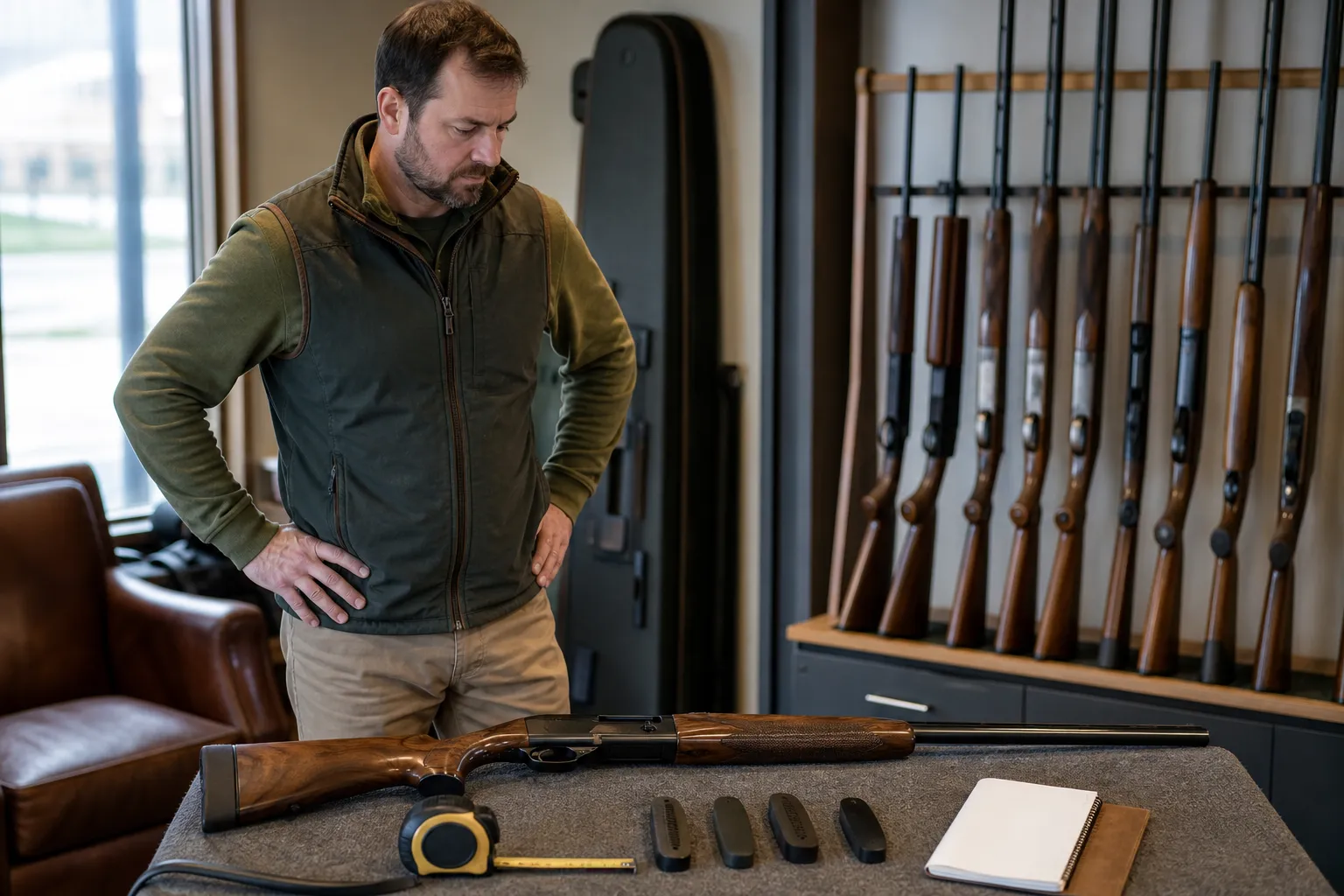
Shotgun length of pull is the distance from the trigger area to the butt or recoil pad of the stock. It is one of the main stock-fit measurements, and it matters because a shotgun is pointed with the eye aligned along the barrel or rib. If the stock is too long or too short for the shooter, the gun can mount awkwardly, the trigger can feel hard to reach or crowded, the face can land in the wrong place, and recoil can feel worse.
What length of pull means
Browning defines length of pull as the distance from the middle of the recoil pad or butt to the trigger. The National Sporting Clays Association Level I Instructor Certification Manual defines it as the measurement from the face of the trigger to the back of the butt plate or recoil pad. The University of Arizona shotgun instructor binder defines it as the distance from the center of the trigger to the center of the recoil pad.
Those definitions all describe the same basic idea: how far the trigger is from the rear of the stock. The exact reference points can vary slightly by manual or fitting guide, such as the face, front, or center of the trigger and the center or rear of the recoil pad.
Browning also describes length of pull as one of three important shotgun stock measurements, along with drop at comb and drop at heel. The NSCA manual lists length of pull, drop at comb, pitch, and cast as four major stock-fitting dimensions for a close-enough fit.
For a beginner, the key point is simple: length of pull is not the whole fit of the shotgun, but it is one of the first dimensions people notice because it affects reach, mount, and comfort.
Where length of pull is measured on a shotgun
To picture length of pull, imagine a straight line from the trigger area back to the butt or recoil pad. Browning’s Recoilless Trap manual defines it as the distance from the front of the trigger to the center of the butt stock. Other references use the face or center of the trigger, but all are describing the same stock-length relationship.
A recoil pad is the rear pad that contacts the shoulder. A butt plate is another rear surface on the stock. Some references measure to the center or middle of that rear surface.
Here is the plain-English version:
| Reference point | What it means |
|---|---|
| Trigger area | Manuals may refer to the front, face, or center of the trigger. |
| Rear of stock | Manuals may refer to the middle or center of the butt, butt plate, or recoil pad. |
| Length of pull | The distance between those two areas. |
Because the exact measuring points can differ by manufacturer or coaching reference, use the definition in the shotgun’s manual when comparing a specific model or adjustable stock setting.
Why shotgun fit is different from rifle fit
Hunter-ed.com explains that a shotgun is designed to be pointed rather than aimed, with the eye sighting along the top of the barrel or rib. Browning explains the same idea another way: because most shotguns lack rear sights, the shooter’s eye functions like the rear sight.
That makes the stock important. A shotgun’s stock helps place the eye in relation to the barrel or rib. The NSCA manual says a well-fitting shotgun should bring the iris into a centered position on the barrel rib during a proper mount. For a beginner learning about ribs and beads, see our guide to shotgun bead sights and vent ribs.
Length of pull is only one part of that fit. The University of Arizona shotgun instructor binder says drop at comb determines the vertical position of the shooter’s eye above the rib, while cast controls the horizontal relationship between the eye and rib. In other words, length of pull affects how the body reaches and mounts the gun, while other stock dimensions help control where the eye sits.
What happens if length of pull is too long
Browning says a stock that is too long may catch under the armpit or drag on the lower shoulder. Browning’s Recoilless Trap manual also says a length of pull that is too long can force the shooter to mount the gun on the edge of the shoulder or arm.
That matters because a shotgun mount should be smooth and repeatable. If the stock hangs up as it comes to the shoulder, the shooter may struggle to bring the gun into the same position each time.
The NSCA manual says a gun that is too long can increase felt recoil for the shooter. Browning’s trap manual also connects excessive length with poor shoulder placement, which helps explain why a too-long stock can feel uncomfortable even if the shotgun itself has not changed.
Common beginner signs of a stock that may be too long include:
- The butt catches on clothing, the armpit, or the lower shoulder during the mount.
- The gun feels stretched out when reaching the trigger.
- The butt tends to land on the edge of the shoulder or arm.
- Recoil feels harsher than expected during a proper shooting session.
These are fit clues, not a diagnosis. Shotgun fit also depends on drop, cast, pitch, stance, mount, clothing, and shooting style.
What happens if length of pull is too short
Browning says a stock that is too short may increase recoil felt at the shoulder and cheek. Browning’s Recoilless Trap manual says a length of pull that is too short places the shooter’s face too far forward on the stock.
The University of Arizona shotgun instructor binder says too short a gun can encourage head lifting. That is important because Hunter-ed.com identifies lowering the head and cheek to the stock as a common error, and hunter education materials emphasize bringing the gun to the face rather than bending the head down to find the stock.
A too-short stock can also make the shotgun feel cramped. The face may be too far forward, the hands may feel crowded, and the mount may not place the eye naturally over the rib.
Common beginner signs of a stock that may be too short include:
- The face feels crowded forward on the stock.
- Recoil is uncomfortable at the cheek or shoulder.
- The shooter tends to lift the head during the mount or shot.
- The gun feels cramped between the shoulder, cheek, hands, and trigger.
Again, length of pull is only one part of the fit. A short stock is not the only reason a shooter might lift the head or feel cheek discomfort.
A beginner mount check
Hunter-ed.com teaches that, when shouldering a shotgun, the stock should come to the cheek first and then back to the shoulder.
This is one of the simplest fit checks for a beginner. The goal is not to force the head down to the stock. Hunter-ed.com calls lowering the head and cheek to the stock a common error.
A beginner can think through the mount this way:
- Avoid dropping the head down to find the stock.
- Bring the shotgun to the cheek.
- Bring the stock back into the shoulder.
- Notice whether the mount feels natural, crowded, or stretched.
- Notice whether the eye settles in a useful position along the rib.
Hunter-ed.com says the stock should fit snugly against the cheek with the eye above the centerline on that side.
This is why a comfortable mount is not just about comfort. It also helps put the eye where the shotgun’s pointing system expects it to be.
The old crook-of-the-arm shortcut
Some shooters have heard of checking stock length by placing the butt in the crook of the elbow and seeing how the trigger reaches the finger. The University of Arizona shotgun instructor binder rejects that old crook-of-the-arm method as a way to determine proper shotgun stock length.
The issue is that shotgun fit is about the mounted gun, cheek position, shoulder contact, eye alignment, and trigger reach together. A simple arm measurement does not show how the gun fits when it is actually brought to the face and shoulder.
For a beginner, a real mount check is more useful than an arm shortcut.
Adjustable stocks, spacers, shims, and combs
Some current shotguns include factory systems for changing fit. Winchester’s SXP owner’s manual says some Super X Pump models adjust length of pull by adding or removing spacers at the rear of the stock, and that each spacer extends length of pull by one quarter inch on those models.
Mossberg’s 940 autoloading owner’s manual says the 940 stock is user adjustable for length of pull, rise or drop at heel, and cast. Mossberg lists the 940 length-of-pull adjustment range as 13 inches to 14 1/4 inches.
Those examples show why the owner’s manual matters. Adjustable systems are not all the same, and the correct procedure and parts depend on the shotgun model.
This guide does not cover cutting, reshaping, or modifying a stock. If a shotgun has factory spacers, shims, an adjustable stock, or an adjustable comb, follow the manufacturer’s manual for that exact model.
Length of pull and felt recoil
Length of pull does not change the ammunition, gauge, or action type, but the fit of the stock can change how recoil feels to the shooter. Browning says a too-short stock may increase recoil felt at the shoulder and cheek. The NSCA manual says a gun that is too long can increase felt recoil.
That may sound contradictory at first, but both can be true in different fit situations. A stock that is too short can put the face too far forward or make cheek contact uncomfortable. A stock that is too long can interfere with the mount or put the butt in a poor shoulder position.
For beginners comparing shotgun sizes, gauge and shell choice are separate topics from stock fit. See our guide to 12 gauge vs 20 gauge shotguns and our guide to shotgun shell length for those basics.
Length of pull is part of the whole fit picture
It is easy to focus only on length of pull because it has a simple measurement. But Browning, NSCA, and instructor materials all place it alongside other stock dimensions.
Important fit dimensions include:
- Length of pull: trigger area to butt or recoil pad.
- Drop at comb: Browning lists it as a major stock measurement, and the University of Arizona binder says it determines the vertical position of the eye above the rib.
- Drop at heel: Browning lists it as another important stock measurement.
- Cast: the University of Arizona binder says it controls the horizontal relationship between the eye and rib.
- Pitch: the NSCA manual lists pitch among the four major stock-fitting dimensions.
A shotgun can have a comfortable length of pull but still not place the eye correctly if other dimensions do not suit the shooter. The reverse can also happen: a shotgun can point reasonably well but feel awkward because trigger reach or shoulder position is off.
What to check next
For any adjustable shotgun, check the manufacturer’s manual for the exact model.
For a beginner, the practical takeaway is this: length of pull is the trigger-to-butt distance, and it affects mount, trigger reach, face position, felt recoil, and eye alignment. Check fit with the gun mounted to the cheek first and then the shoulder, and use the official manual for any factory adjustment system.
Frequently asked questions
What is shotgun length of pull?
Shotgun length of pull is the distance from the trigger area to the butt, butt plate, or recoil pad. Browning defines it as the distance from the middle of the recoil pad or butt to the trigger, while NSCA and other instructor references use similar trigger-to-pad definitions.
Where do you measure length of pull on a shotgun?
References vary slightly. Browning’s Recoilless Trap manual measures from the front of the trigger to the center of the butt stock. The NSCA manual measures from the face of the trigger to the back of the butt plate or recoil pad. The University of Arizona shotgun instructor binder measures from the center of the trigger to the center of the recoil pad.
Why does length of pull matter on a shotgun?
A shotgun is pointed with the eye sighting along the barrel or rib, and Browning explains that the eye functions like the rear sight on most shotguns. Length of pull affects how the gun mounts, how the shooter reaches the trigger, where the face lands on the stock, and how recoil feels.
What can happen if a shotgun stock is too long?
Browning says a stock that is too long may catch under the armpit or drag on the lower shoulder. Browning’s Recoilless Trap manual says excessive length can force the shooter to mount the gun on the edge of the shoulder or arm, and the NSCA manual says a gun that is too long can increase felt recoil.
What can happen if a shotgun stock is too short?
Browning says a stock that is too short may increase recoil felt at the shoulder and cheek. Browning’s Recoilless Trap manual says a too-short length of pull places the shooter’s face too far forward on the stock, and the University of Arizona shotgun instructor binder says too short a gun can encourage head lifting.
Are adjustable shotgun stocks common enough to check the manual?
Yes. Winchester and Mossberg manuals describe model-specific stock adjustment systems, so the owner’s manual should be checked for the exact shotgun.
Sources
- How do you determine the proper fit of your shotgun stock?, BrowningOfficial source. Accessed November 14, 2026.
- Recoilless Trap Single Barrel Manual, BrowningOfficial source. Accessed November 14, 2026.
- NSCA Level I Instructor Certification Manual, National Skeet Shooting Association, National Sporting Clays Association. Accessed November 14, 2026.
- Shouldering, Pointing, and Pulling the Trigger of a Shotgun, Hunter-ed.com. Accessed November 14, 2026.
- Hunter Education Manual 2021, Ohio Hunter Education ProgramOfficial source. Accessed November 14, 2026.
- Shotgun Instructor Binder Lessons, Fact Sheet 9, University of Arizona Cooperative ExtensionOfficial source. Accessed November 14, 2026.
- SXP Owner’s Manual, Winchester Repeating ArmsOfficial source. Accessed November 14, 2026.
- 940 Autoloading Owner’s Manual, O.F. Mossberg & SonsOfficial source. Accessed November 14, 2026.
- Semiauto Shotgun User Manual, MANO088/001, BerettaOfficial source. Accessed November 14, 2026.