Shotgun Wads Explained: What the Wad Does Inside a Shotshell
A shotgun wad is the seal, separator, or shot container between the powder and the shot or slug. It helps seal gas, protect pellets and the bore, cushion lead shot in many loads, and influence how the pattern forms downrange.
By RaiS. Reviewed by RaiS. Published . 9 min read.
Research and drafting were assisted by AI. RaiS checked the facts against the sources below and approved this page.
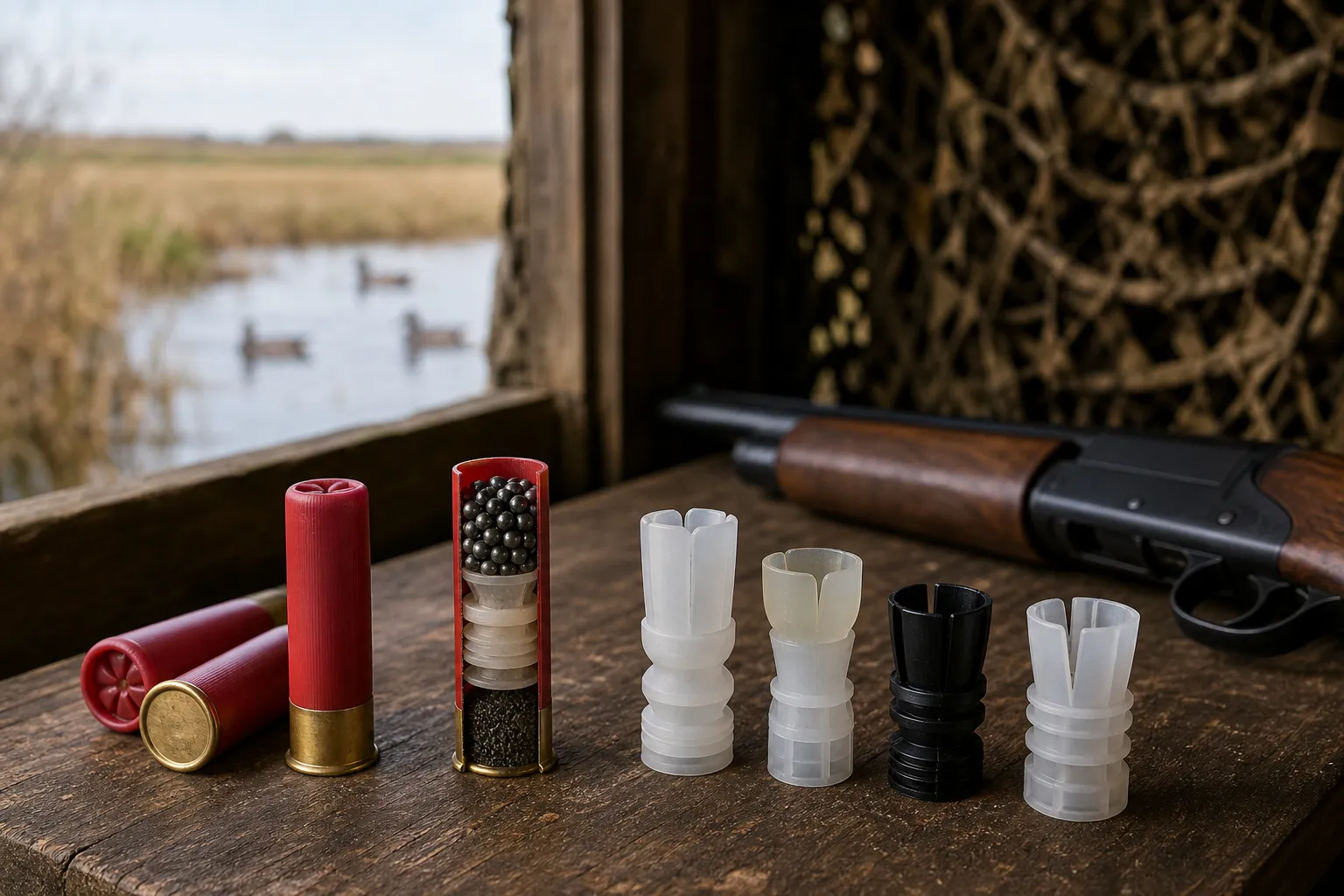
A shotgun wad is the part of a shotshell that sits between the powder and the shot or slug. In plain terms, it helps keep the burning powder gases behind the payload, separates the powder from the shot or slug, protects pellets and the bore, and, in many modern loads, helps shape how the pattern performs downrange.
If you have ever opened a fired shotshell or found a plastic cup on the ground at a clay range, you have seen a wad. It is a small part, but ammunition makers treat wad design as part of the whole shotshell system, not as a random spacer.
Where the wad sits in a shotshell
IHEA-USA lists the basic parts of shotgun ammunition as the hull, primer, powder, shot, and wad. In a typical shot load, the primer ignites the powder. The wad sits above the powder and below the shot. Winchester Ammunition describes the wad as the part, usually plastic, that separates the powder from the shot or slug.
The exact design varies. Federal Premium says wad design and powder vary with the type of shotshell and its intended use. A target load, a steel waterfowl load, a buckshot load, and a slug load may all use different wad concepts.
For beginners, the easiest mental picture is this component order:
- Hull, the outer shotshell body.
- Primer, in the head of the shell.
- Powder, inside the hull above the primer.
- Wad or wad column, above the powder.
- Shot or slug, above or with the wad depending on the load design.
- Crimp, which closes the shell.
SAAMI uses several terms that help make this clearer:
| Term | Plain meaning |
|---|---|
| Wad column | SAAMI defines this as the wads between the propellant and shot pellets in a specific shotshell. |
| Overpowder wad | SAAMI defines this as a separator, made in various designs and materials, used between the propellant powder and shot pellets. |
| Cup wad | SAAMI defines this as a shallow cup design that separates powder and shot, helps seal powder gases when loaded lips down, and protects the rear of the shot column. |
| Shot-protector wad | SAAMI defines this as a plastic shot cup design intended to reduce pellet deformation during barrel travel. |
| Base wad | SAAMI defines this as a cylindrical component assembled into the head end of a shotshell. It is not the same thing as the shot wad or wad column above the powder. |
That last point matters because the word “wad” can refer to different parts depending on context. In this guide, “wad” means the wad or wad column between the powder and the shot or slug.
The wad seals gas behind the payload
When a shotshell fires, Winchester Ammunition explains that gas from the burning powder rapidly expands in the cartridge and forces the shot out of the cartridge and down the barrel. The wad helps make that process consistent by sealing those expanding gases.
IHEA-USA says the wad prevents gas from escaping through the shot and holds the shot together as it passes through the barrel. Winchester Ammunition also says the wad seals expanding gases during ignition for consistent performance.
A simple way to think about it is this: the wad acts like a moving seal. It helps keep the pressure behind the shot or slug rather than letting gas leak through the pellet stack. SAAMI’s definition of a cup wad also points to this role, describing it as a separator that can help seal powder gases and protect the rear of the shot column.
This does not mean every wad looks the same. Some loads use plastic shot cups. Some slug loads use paper cup or fiber wads, which Winchester Ammunition says can provide gas pressure seals in slug loads. The principle is the same: the wad is part of how the shell transfers gas pressure to the payload.
The wad protects pellets and the barrel
The wad can also act as a barrier between the shot and the bore. Winchester Ammunition says the wad provides a barrier between the shot and the barrel while the shot travels down the barrel.
For lead shot, SAAMI defines a shot-protector wad as a plastic shot cup intended to reduce pellet deformation during barrel travel. Less deformation matters because the pellets are small, separate projectiles. Winchester Ammunition explains that shot leaves the barrel as a small, tight group and then disperses into a wider pattern farther downrange.
For steel and other non-lead shot, bore protection becomes especially important. Federal Premium says wads for steel shot are molded from high-density polyethylene with thick sidewalls to prevent steel pellets from contacting the shotgun bore surface. The National Institute of Justice also says nontoxic shot, particularly steel, may require a special wad with heavier shot-cup walls to protect the barrel.
SAAMI gives the same safety idea in stronger terms for non-lead shotshells. SAAMI warns that non-lead shotshell loads need special shot pouches, collars, or other protective means to insulate shot from the barrel wall during firing, and says conventional lead-shot pouches are not adequate for non-lead loads.
That is why steel shot and lead shot are not just different pellet materials. They may call for different wad protection inside the shell.
The wad can cushion lead shot
Many modern lead target and field loads use a flexible plastic wad with a shot cup and a cushion section. Federal Premium says traditional wads for lead shot are molded from flexible, low-density polyethylene plastic and have a cushion section on the bottom.
Federal Premium says that cushion helps reduce the number of deformed pellets and the amount of felt recoil. In beginner terms, the cushion section gives the wad some controlled compression as the shell fires.
This is one reason the wad is more than a plug. In a lead shot load, it may seal gas, hold the shot, protect pellets from the bore, and cushion the shot column as the load starts moving.
The amount and design of cushioning are not things to guess at when loading ammunition. SAAMI defines wad pressure as the force applied to a wad column as it is seated firmly against the propellant. That term belongs in the world of published ammunition specifications and loading data, not improvised component swapping.
The wad can influence pattern performance
A shotgun pattern is the distribution of pellets after they leave the muzzle and spread downrange. Winchester Ammunition says shot leaves the barrel as a small, tight group of projectiles and disperses into a wider pattern as it travels farther downrange.
The wad can influence that process because it controls how the shot is carried through the barrel and how it is released after leaving the muzzle. Some wad designs are meant mainly to seal and protect. Others are also designed to manage release timing and pattern shape.
Federal Premium describes its FLITECONTROL FLEX wad as opening at the rear to create an air brake that pulls the wad off the shot string. Federal says the pellets are released at an intended moment for performance on target.
Hornady makes a similar pattern-control claim for its Versatite wad technology. Hornady says Versatite wad technology delivers tight patterns in its #4 buckshot load without modification to the gun, and says the Versatite wad does the patterning in its reduced-recoil 12 gauge 00 buckshot load without requiring specialized chokes.
That does not mean a wad design will behave identically in every shotgun. Pattern performance is something to verify on paper with your own gun, load, and choke. For the practical side, see our guide to patterning a shotgun and our guide to shotgun chokes.
Common wad types in modern shotshells
Wads are load-specific parts. Federal Premium says wad design varies with shotshell type and intended use, and the National Institute of Justice says a wad consistent with the projectile type is inserted during shotshell loading.
Here are the main wad concepts a beginner is likely to encounter.
Lead target and field load wads
Modern lead target and field loads often use a one-piece plastic wad with a gas-sealing base, a cushion section, and a shot cup. Federal Premium describes traditional lead-shot wads as flexible, low-density polyethylene plastic with a cushion section on the bottom.
In these loads, the wad can seal gas, cushion the shot, reduce pellet deformation, and help carry the shot through the bore. The exact design depends on the ammunition maker and the load’s purpose.
Steel and other non-lead shot wads
Steel shot loads use different wad protection because the pellets should not contact the bore. Federal Premium says steel-shot wads use high-density polyethylene and thick sidewalls to prevent steel pellets from contacting the shotgun bore surface.
The National Institute of Justice says nontoxic shot, particularly steel, may require a special wad with heavier shot-cup walls to protect the gun barrel. SAAMI also warns that non-lead loads need protective shot pouches, collars, or other protective means, and that conventional lead-shot pouches are not adequate for non-lead loads.
This is one reason to use ammunition that matches your shotgun and the maker’s guidance, especially with older guns or unfamiliar loads.
Buckshot wads
Buckshot loads may use ordinary shot-cup concepts or specialty patterning wads, depending on the load. Winchester Ammunition says plastic shot cups protect buckshot pellets and can improve pattern performance in low-recoil buckshot loads.
Hornady says its Versatite wad does the patterning in a reduced-recoil 12 gauge 00 buckshot load and does not require shotgun modifications or specialized chokes. Federal Premium describes a different specialty system, the FLITECONTROL FLEX wad, as using a rear-opening air brake to pull the wad off the shot string.
If you are comparing pellet sizes and payloads, see our guide to buckshot sizes.
Slug load wads
Slug loads can use different wad approaches because the projectile is a single slug rather than a column of pellets. IHEA-USA describes the wad as a paper or plastic seal or shot container separating the powder from the slug or shot.
Winchester Ammunition says paper cup and fiber wads can provide effective gas pressure seals in slug loads. The National Institute of Justice says roll crimping can be used to hold an overshot wad or a slug.
Some slug designs use an attached wad system. AFTE defines a Brenneke slug as a formed rifled slug with a wad assembly pressed into or attached to its base by a screw. Brenneke USA says its BET plastic wad column and felt wad in Original Classic slugs are secured to the slug and remain fastened through penetration.
For more on slug categories, see shotgun slugs explained.
Wads are not interchangeable parts
A wad may look simple, but it is part of a pressure-tested ammunition design. Hodgdon warns shotshell handloaders not to substitute components unless indicated, because substitutions can create dangerous pressures.
That warning includes wads. A different wad can change internal space, sealing behavior, cushion behavior, and how the payload is supported. Those are not things to estimate by appearance.
This guide is not a handloading recipe and should not be used for load development. Use only current published data from the powder or ammunition component maker, and follow the shotgun and ammunition manufacturer’s instructions.
How to think about wad choice as a shooter
For factory ammunition, you usually do not choose the wad by itself. You choose a complete shotshell by gauge, shell length, shot material, shot size or slug type, payload, and intended use. The wad is one part of that complete design.
If you are new to shotguns, start with the shell basics first. Make sure you understand shotgun gauges and shotgun shell length, then look at the load’s intended purpose.
The practical test is patterning. A wad designed for tighter or more even patterns may help, but the result still needs to be checked with your shotgun, your choke, and the exact ammunition you plan to use.
What to check before shooting or hunting
Check your shotgun owner’s manual and the ammunition maker’s information for the gauge, shell length, shot material, and load type your firearm is designed to use. For handloading, use current published data and do not substitute wads or other components unless the data says to do so.
For hunting, confirm current ammunition rules with the agency that regulates the place you hunt, especially where non-lead shot requirements may apply. Then pattern the exact load in your shotgun before relying on it in the field.
Frequently asked questions
What is the wad in a shotgun shell?
The wad is the seal, separator, or shot container between the powder and the shot or slug. IHEA-USA describes it as a paper or plastic seal or shot container that separates the powder from the slug or shot.
Does the wad seal gas?
Yes. Winchester Ammunition says the wad seals expanding gases during ignition, and IHEA-USA says it prevents gas from escaping through the shot.
Why do steel shot loads need different wads?
Federal Premium says steel-shot wads use high-density polyethylene and thick sidewalls to prevent steel pellets from contacting the shotgun bore. SAAMI also warns that non-lead loads need protective shot pouches, collars, or other means to insulate shot from the barrel wall.
Can a wad affect the shotgun pattern?
Yes. Wad design can influence how pellets are carried and released. Federal Premium describes its FLITECONTROL FLEX wad as using a rear-opening air brake to pull the wad off the shot string, and Hornady says its Versatite wad technology delivers tight patterns in specific buckshot loads.
Are shotshell wads interchangeable for handloading?
No general substitution should be assumed. Hodgdon warns shotshell handloaders not to substitute components unless indicated, because substitutions can create dangerous pressures.
Do slug loads use wads?
Many do, but the design varies. Winchester Ammunition says paper cup and fiber wads can provide gas pressure seals in slug loads, and AFTE defines a Brenneke slug as having a wad assembly pressed into or attached to its base.
Sources
- SAAMI Glossary, W, Sporting Arms and Ammunition Manufacturers' InstituteOfficial source. Accessed November 2, 2026.
- Cup Wad, Sporting Arms and Ammunition Manufacturers' InstituteOfficial source. Accessed November 2, 2026.
- SAAMI Glossary Archive, Overpowder Wad, Sporting Arms and Ammunition Manufacturers' InstituteOfficial source. Accessed November 2, 2026.
- Shot-Protector Wad, Sporting Arms and Ammunition Manufacturers' InstituteOfficial source. Accessed November 2, 2026.
- Base Wad, Sporting Arms and Ammunition Manufacturers' InstituteOfficial source. Accessed November 2, 2026.
- SAAMI FAQs, Sporting Arms and Ammunition Manufacturers' InstituteOfficial source. Accessed November 2, 2026.
- Basic Components of Shotgun Shell, IHEA-USA Firearm Operator Safety Course. Accessed November 2, 2026.
- Ammo Basics, Shotshell, Federal PremiumOfficial source. Accessed November 2, 2026.
- Ammo 101, Shotshell, Winchester AmmunitionOfficial source. Accessed November 2, 2026.
- Wads and Shots, Winchester AmmunitionOfficial source. Accessed November 2, 2026.
- Firearms Examiner Training, Priming and Loading, National Institute of JusticeOfficial source. Accessed November 2, 2026.
- Varmint Express, Hornady ManufacturingOfficial source. Accessed November 2, 2026.
- Hornady Announces New Products for 2017, Hornady ManufacturingOfficial source. Accessed November 2, 2026.
- FAQ, Brenneke USAOfficial source. Accessed November 2, 2026.
- Brenneke Slug, Association of Firearm and Tool Mark Examiners. Accessed November 2, 2026.
- Warnings, Shotshell, Hodgdon Powder CompanyOfficial source. Accessed November 2, 2026.
- Faq. Accessed November 2, 2026.