The AR-15 Rifle Platform Explained: Origins, Parts and Operation
The AR-15 is commonly discussed as a rifle design family rather than as one fixed model. Modern terminology usually separates semiautomatic AR-15 sporting rifles from selective fire military M16 and M4 rifles, although early naming was less tidy.
By RaiS. Reviewed by RaiS. Published . 5 min read.
Research and drafting were assisted by AI. RaiS checked the facts against the sources below and approved this page.
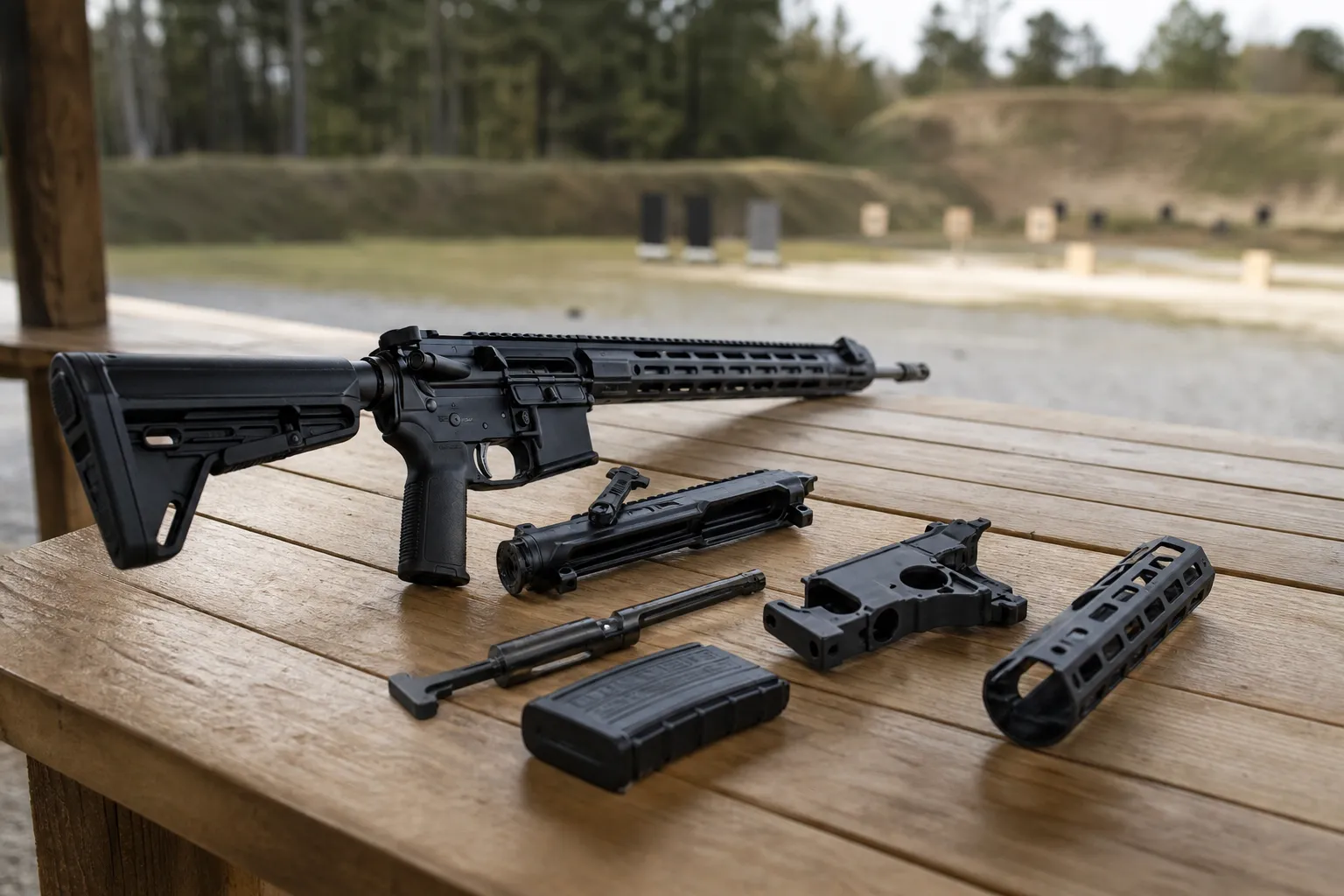
The AR-15 is a rifle design family, not just one fixed model. In modern use, the NRA National Firearms Museum distinguishes the AR-15 as a semiautomatic sporting rifle from the M16 as a selective fire military rifle, while also noting that the older terminology was more complicated.
What an AR-15 is, in plain terms
Rifle and semiautomatic rifle are legal and mechanical terms, and exact wording can matter by jurisdiction.
Legal definitions can be useful for understanding the basic mechanical category, but they are not a substitute for legal guidance. This guide uses the terms “rifle” and “semiautomatic rifle” in plain language.
In ordinary firearms reference use, “AR-15” often means a platform or design family. That is why people may use “AR-15 platform” when they are talking about shared design ancestry and general operating layout.
ArmaLite origins
ArmaLite’s historical material describes the AR-10 as a lightweight rifle that used aircraft-grade aluminum receivers, plastic furniture, and a bolt that locked into a steel barrel extension rather than into the receiver itself. That design context matters because the AR-15 followed from the AR-10.
According to ArmaLite’s history, Army officials asked ArmaLite in 1956 to develop a smaller version of the AR-10. The resulting rifle was called the AR-15. ArmaLite’s historical description identifies the original AR-15 entry as a basic infantry rifle using .223 caliber ammunition. For cartridge details, see our separate comparison of .223 Remington vs 5.56 NATO.
Colt, military development, and the name change
ArmaLite and Colt history overlap closely. ArmaLite’s historical material says ArmaLite licensed the designs and trademarks of the AR-10 and AR-15 to Colt in January 1959. Colt’s official timeline says Colt purchased exclusive manufacturing and marketing rights to the AR-15 from the ArmaLite Division of Fairchild Engine Corporation in 1961.
Those two statements use different wording and dates. The careful takeaway is that ArmaLite developed the AR-15, and Colt became the company that carried the design forward in major production and military procurement.
ArmaLite’s history also says early Colt AR-15s, magazines, and operator’s manuals were marked with ArmaLite’s name.
DARPA says the M16 was based on the Colt AR-15 and that Colt brought the weapon to DARPA in 1962. DARPA also states that Project AGILE purchased 1,000 AR-15s and issued them to combat troops in Southeast Asia for field trials. Colt’s official timeline says Colt won a 1963 government contract for 104,000 M16 rifles.
ArmaLite’s history says the military designation of the AR-15 is M-16. The NRA National Firearms Museum gives a more terminology-focused explanation: today, AR-15 refers to the semiautomatic sporting rifle, while M16 refers to the selective fire rifle used by the military. The museum also notes that selective fire rifles were known as AR-15s between 1958 and 1966, with M16 and AR-15 terminology separating in 1967.
For a fuller military history of that branch of the design, see our article on the M16 rifle.
Why “platform” is the right word
Calling the AR-15 a platform is a way to describe a design family with shared roots.
That does not mean every rifle called an AR-15 is identical. It means the term points to a common lineage and operating concept. This guide stays at that general reference level and does not cover building, customization, accessories, or conversions.
Basic parts of the AR-15 platform
The AR-15 layout is often described around two main receiver groups. The Smith & Wesson M&P15 manual defines the upper receiver as the part of the receiver containing the barrel, sights, bolt, and associated parts. The same manual defines the lower receiver as the lower part of the rifle containing the receiver, trigger, and associated parts.
For a broader beginner guide to common rifle parts, see parts of a rifle.
At a high level, commonly named parts include:
| Part | What the cited references say |
|---|---|
| Upper receiver | Smith & Wesson defines it as the receiver part containing the barrel, sights, bolt, and associated parts. |
| Lower receiver | Smith & Wesson defines it as the lower part containing the receiver, trigger, and associated parts. |
| Bolt | Smith & Wesson defines the bolt as the mechanism that houses the firing pin. |
| Barrel and sights | Smith & Wesson places these in the upper receiver group. |
| Magazine | ArmaLite notes that early Colt AR-15 magazines carried ArmaLite markings. |
This is enough vocabulary to follow most nontechnical explanations. It is not an assembly guide, and it does not describe modification or conversion work.
How the gas system works at a high level
The AR-15 descends from Eugene Stoner’s gas-operated bolt and carrier system. The Stoner patent was titled “Gas operated bolt and carrier system,” named Eugene M. Stoner as inventor, and was filed on August 14, 1956. The patent says the invention concerns automatic rifle mechanisms, especially the gas system used to operate the bolt and bolt carrier.
For a wider explanation of gas-operated firearm systems, see gas-operated rifles explained.
ArmaLite’s history gives a compact explanation of the Stoner system: gas ported from the barrel travels through a tube back into the upper receiver and into the bolt carrier. It enters an expansion chamber, expands, and drives the carrier rearward.
The Stoner patent describes the bolt carrier acting as a movable cylinder and the bolt acting as a stationary piston. The patent says this arrangement eliminates the need for a conventional gas cylinder, piston, and actuating rod assembly.
ArmaLite’s history also explains the unlocking motion at a high level. As the carrier moves rearward, a cam pin riding in a curved path engages the bolt and forces the bolt to rotate to unlock. This is the rotating-bolt part of the design description.
This explanation is intentionally broad. It is meant to describe the operating principle, not maintenance, tuning, repair, or parts selection.
Civilian AR-15, M16, and M4 terminology
The clean modern distinction is simple: the NRA National Firearms Museum says “AR-15” today refers to the semiautomatic sporting rifle, while “M16” refers to the selective fire rifle used by the military.
The historical language was not always that clean. The museum notes that selective fire rifles were known as AR-15s between 1958 and 1966, and that the terms separated in 1967. DARPA’s account also describes Project AGILE purchasing 1,000 AR-15s for Southeast Asia field trials before the M16 name became the better-known military designation.
The M4 is a later military carbine in the same broad historical family. Colt’s official timeline says the U.S. military first adopted the Colt M4 Carbine for special use in 1994, and that it later became the standard issue firearm of all branches of the U.S. military.
So, when reading older documents, museum labels, and modern product descriptions, context matters. “AR-15” can refer to an early Colt or ArmaLite-marked rifle in historical records, a modern semiautomatic sporting rifle in present-day reference use, or a broader platform family in general discussion.
What to check in official sources
For legal classification, possession rules, transport rules, or hunting use, check current official sources for your jurisdiction. State and provincial rules can use their own wording and can change. For military history and terminology, compare current museum records, manufacturer history pages, and government historical summaries.
Frequently asked questions
Who originally developed the AR-15?
ArmaLite developed the AR-15 after Army officials asked in 1956 for a smaller version of the AR-10.
How did Colt become involved with the AR-15?
ArmaLite’s history says the AR-10 and AR-15 designs and trademarks were licensed to Colt in January 1959. Colt’s timeline says Colt purchased exclusive manufacturing and marketing rights to the AR-15 from ArmaLite in 1961.
What is the difference between an AR-15 and an M16?
The NRA National Firearms Museum says that today AR-15 refers to a semiautomatic sporting rifle, while M16 refers to the selective fire rifle used by the military. The museum also notes that the terms were less distinct before 1967.
How does the AR-15 gas system work in simple terms?
ArmaLite describes gas moving from the barrel through a tube into the upper receiver and bolt carrier, where it expands and drives the carrier rearward. ArmaLite also explains that rearward carrier movement acts through a cam pin to rotate and unlock the bolt.
What are the upper and lower receivers?
The Smith & Wesson M&P15 manual defines the upper receiver as the part containing the barrel, sights, bolt, and associated parts. It defines the lower receiver as the lower part containing the receiver, trigger, and associated parts.
Sources
- About Us, ArmaLiteOfficial source. Accessed November 11, 2026.
- ArmaLite History, ArmaLite, Inc.. Accessed November 11, 2026.
- Timeline, Colt’s Manufacturing Company LLCOfficial source. Accessed November 11, 2026.
- M16 Rifle, DARPAOfficial source. Accessed November 11, 2026.
- Search results for Colt AR-15, Military, Smithsonian Institution, National Museum of American HistoryOfficial source. Accessed November 11, 2026.
- Colt AR-15, Model SP1, Smithsonian Institution, National Museum of American HistoryOfficial source. Accessed November 11, 2026.
- Colt AR-15 Automatic Rifle, NRA National Firearms Museum. Accessed November 11, 2026.
- AR-15, SIG SauerOfficial source. Accessed November 11, 2026.
- 27 CFR § 478.11, Bureau of Alcohol, Tobacco, Firearms and ExplosivesOfficial source. Accessed November 11, 2026.
- US2951424A, Gas operated bolt and carrier system, Google Patents, U.S. patent record. Accessed November 11, 2026.
- Smith & Wesson M&P15 Safety & Instruction Manual, Smith & Wesson, hosted by US Armorment. Accessed November 11, 2026.