The DP-27 and DP-28 Light Machine Guns: History and Design
The DP was Vasily Degtyaryov’s Soviet light machine gun, adopted in late 1927 and remembered for its top mounted 47 round pan magazine. Its family included aircraft, tank, and wartime modernized versions before the later RPD replaced it with a lighter 7.62×39 mm design.
By RaiS. Reviewed by RaiS. Published . 7 min read.
Research and drafting were assisted by AI. RaiS checked the facts against the sources below and approved this page.
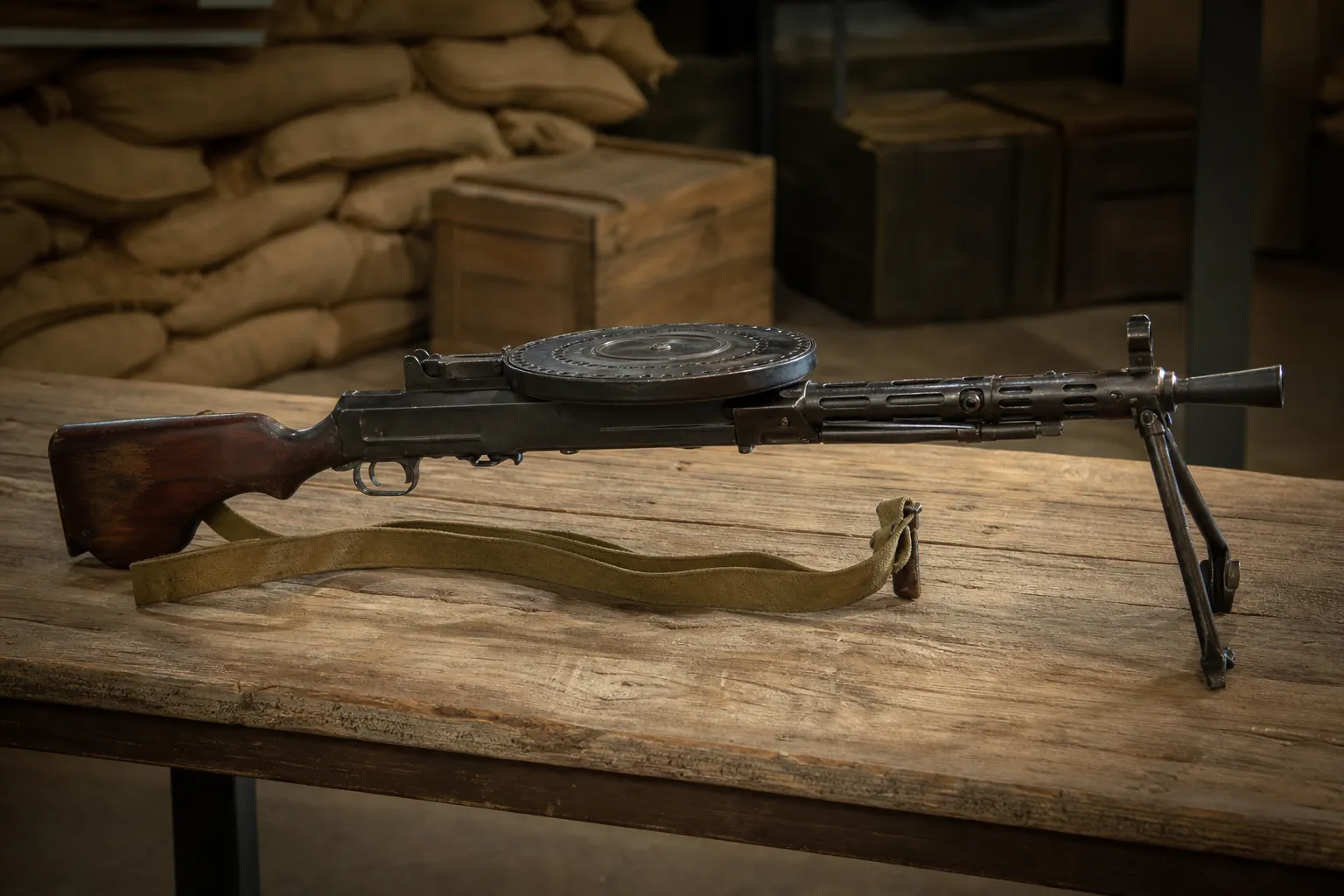
The DP was a Soviet 7.62 mm light machine gun designed by Vasily Alekseyevich Degtyaryov and adopted by the Workers’ and Peasants’ Red Army on December 21, 1927, according to the Kolomna Kremlin Museum Reserve. It is best known for its flat pan magazine on top of the gun, its gas operated action, and its long service as a rifle unit automatic weapon before the DPM modernization and the later RPD moved Soviet light machine gun design in a new direction.
What “DP-27” and “DP-28” mean
A Russian Ministry of Culture museum page explains that “DP” stood for “Degtyaryov, infantry gun.” The same museum network identifies the DP-27 as a 7.62 mm infantry light machine gun and describes it as the first mass produced light machine gun created in the Soviet Union.
The exact model naming can be confusing because readers will see both DP-27 and DP-28. The Kolomna Kremlin Museum Reserve says the first ten Degtyaryov machine guns were manufactured at the Kovrov plant in 1927, which is why they were called DP-27 in that account. HBSA gives the original Russian name as “7.62 mm Hand-Held Machine Gun Model 1927.”
HBSA also says DP-27, DP-28, and DP-1928 are names used largely outside Russia. In careful historical writing, DP-27 is the safer name when discussing the 1927 model and adoption story, while DP-28 is best treated as a common outside Russia or Western name.
From development to Red Army adoption
A Russian Ministry of Culture museum page says Degtyaryov began developing his own light machine gun in 1923. Another museum page states that a working model chambered for 7.62×54 mm was submitted for testing in 1926. The Kolomna Kremlin Museum Reserve says the weapon was tested at the Kovrov plant on November 12, 1927, and adopted by the Red Army on December 21, 1927.
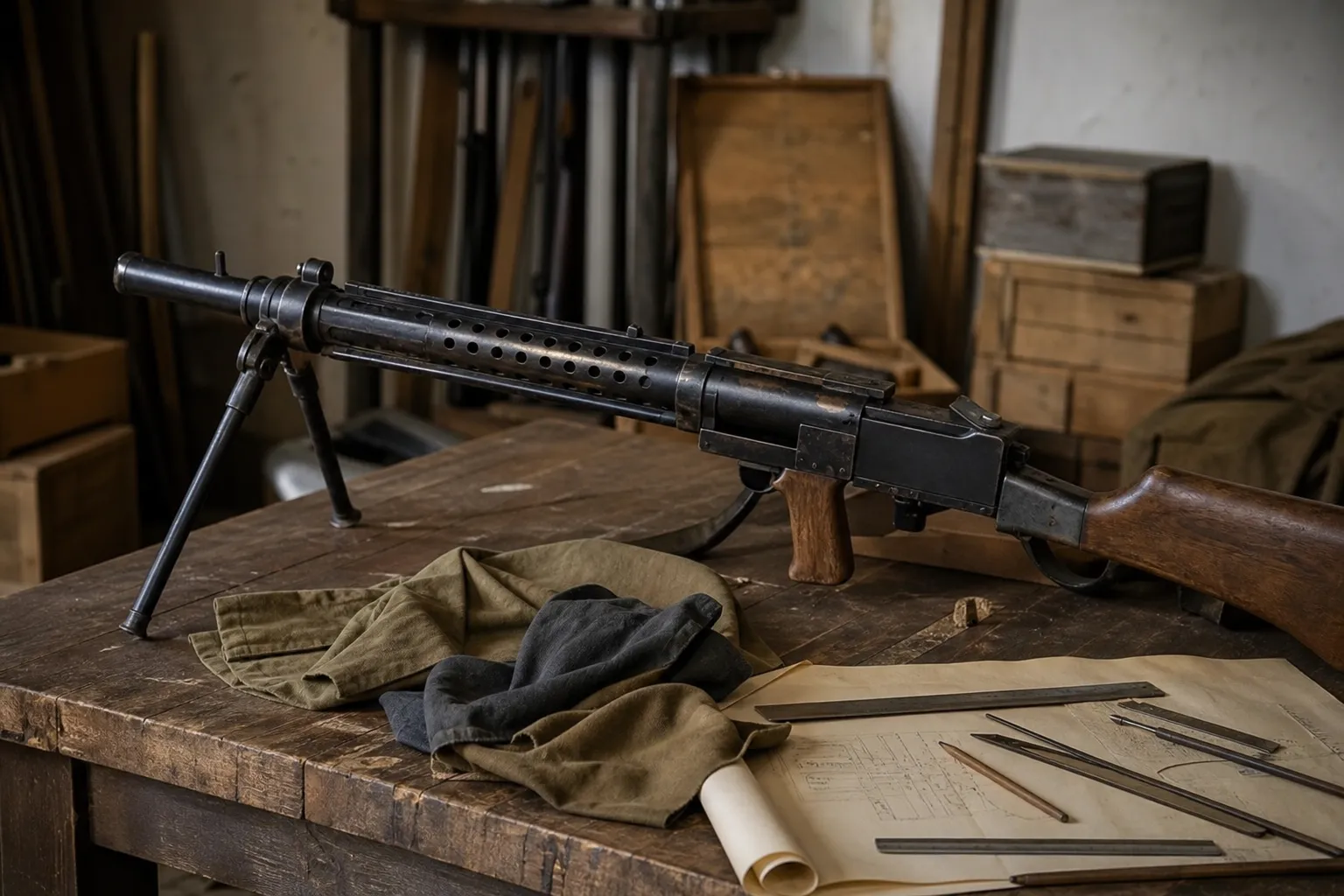
The DP used the 7.62×54 mmR rifle cartridge, which a Russian Ministry of Culture museum page identifies as Mosin rifle ammunition. Readers who want more background on the rifle most associated with that cartridge can start with our history of the Mosin-Nagant rifle.
The Red Army wanted a lighter automatic weapon for rifle units in a period when older and heavier machine guns still shaped infantry firepower. Russian museum pages describe the DP as becoming the main automatic weapon of rifle divisions or rifle units in the prewar and wartime period. The Kolomna Kremlin Museum Reserve says that by the beginning of the Great Patriotic War, the Red Army had 170,400 Degtyaryov light machine guns.
What role the DP filled
The DP was a rifle unit light machine gun rather than a heavy sustained fire gun. Russian museum pages note its folding bipod, fixed on the barrel shroud, and a cone shaped flash suppressor.
In practical terms, the DP was an infantry automatic fire support weapon for rifle units. The Kostroma State Art Museum Reserve says its trigger mechanism allowed firing only in bursts. Russian museum pages describe it as the main automatic weapon of rifle units until 1944, when the modernized DPM began to enter production and supply.
Gas operation, explained conceptually
A Russian Ministry of Culture museum page explains that the DP was gas operated: high pressure gas from the cartridge being fired was used to cycle the action. For readers new to the subject, that means the gun used some of the energy from each fired cartridge to operate the mechanism for continued automatic fire, rather than relying on the shooter to manually cycle it after each shot. For more background on this broad family of operating systems, see our guide to gas operated rifles.
Flap locking, without the workshop details
The DP’s locking system is often described as a flapper locking system. The Kostroma State Art Museum Reserve gives the essential concept: the firing pin pushed two locking flaps outward.
That is enough detail for historical understanding. The important design point is that the DP did not simply depend on the mass of the bolt to keep the action closed. It used a mechanical locking system, and the locking flaps were part of that system. This article does not cover assembly, alteration, conversion, or parts fitting.
The flat pan magazine on top
The DP’s most recognizable feature is the flat, disc shaped pan magazine mounted above the receiver. A Russian Ministry of Culture museum page says the pan magazine fed cartridges inward toward the center, with the cartridges facing inward. The same layout is especially relevant because the DP used rimmed 7.62×54 mmR ammunition.
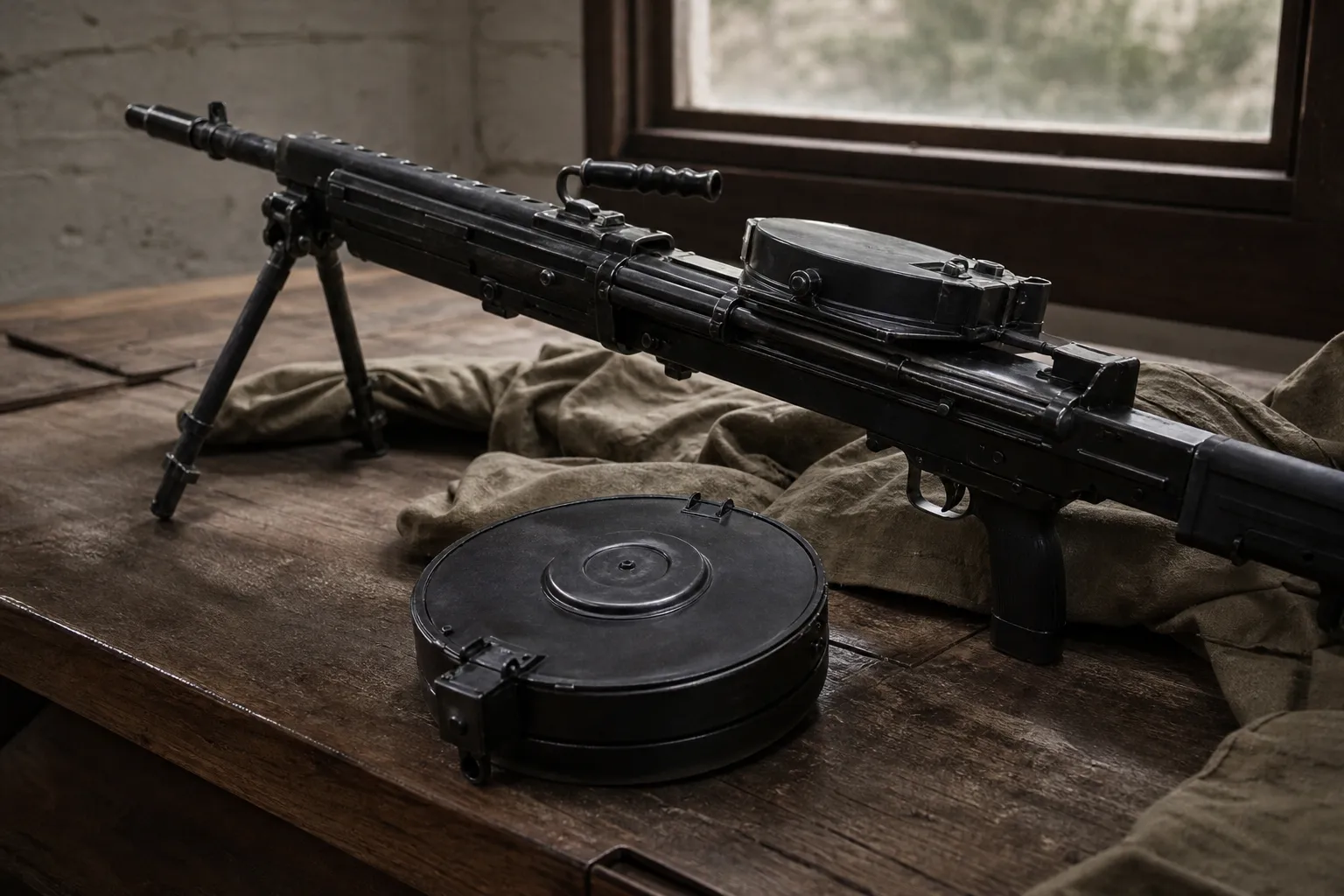
The Nikolai Kuznetsov Museum page states that the DP-27 pan magazine held 47 rounds of 7.62×54 mmR. That capacity gave the weapon a distinctive visual profile, and it is one of the reasons the DP is immediately recognizable in photographs.
The pan magazine also brought handling penalties. The Nikolai Kuznetsov Museum page describes it as heavy, cumbersome to carry, and especially difficult to load. Those criticisms help explain why the magazine is remembered both as the DP’s signature feature and as one of its practical drawbacks.
DA aircraft and DT tank versions
The DT is the more important variant for many readers because it shows how the DP mechanism was adapted to armored vehicle use. The Victory Museum describes the DT tank gun as having a metal buttstock, a 63 round magazine, and a Shpagin ball mount. The same Victory Museum page says the 63 round magazine was less cumbersome.
Those details show the direction of the tank version without turning the article into a parts guide. The DT was not just an infantry DP with a different label. Museum descriptions identify features suited to tank mounting and handling, including the metal buttstock, different magazine capacity, and ball mount.
The DPM wartime update
Russian museum pages say the DP remained the main automatic weapon of rifle units until 1944, when the DPM modernized version began entering production and supply. The City Duma Museum page identifies key changes in the 1944 model: the return spring was moved to the rear of the receiver, a pistol grip was added, and a blade fuse replaced the automatic safety fuse.
A museum page says the 1944 model began reaching troops in 1945 and was used at the end of the Great Patriotic War. That places the DPM as a late war modernization rather than the original interwar DP.
The Kolomna Kremlin Museum Reserve says the 1927 and 1944 types remained in rifle regiment service until the end of the 1940s, when they were gradually replaced by the RP-46. That makes the RP-46 an interim postwar step in this family, but it was not the long term conceptual successor most readers associate with the next Soviet light machine gun generation.
Replacement by the RPD
HBSA says Degtyaryov designed the RPD to replace his DP light machine gun with a lighter weapon using a smaller intermediate rimless cartridge. HBSA lists the RPD chambering as 7.62×39 mm M43. It also says the RPD was approved for issue in 1946 and entered full production from 1953.
That change matters because the DP used the full size rimmed 7.62×54 mmR rifle cartridge, while the RPD used the smaller 7.62×39 mm M43 intermediate rimless cartridge. In other words, the replacement was not just a revised pan fed DP. It reflected a shift in cartridge and light machine gun design.
Quick timeline
| Date | Event |
|---|---|
| 1923 | A Russian Ministry of Culture museum page says Degtyaryov began developing his own light machine gun model. |
| 1926 | A working model chambered for 7.62×54 mm was submitted for testing, according to a Russian Ministry of Culture museum page. |
| November 12, 1927 | The Kolomna Kremlin Museum Reserve says the DP-27 was tested at the Kovrov plant. |
| December 21, 1927 | The Kolomna Kremlin Museum Reserve says the Red Army adopted the weapon. |
| 1944 | Russian museum pages say the modernized DPM began entering production and supply. |
| 1945 | A museum page says the 1944 model began reaching troops and was used at the end of the Great Patriotic War. |
| 1946 | HBSA says the RPD was approved for issue. |
| 1953 | HBSA says the RPD entered full production. |
U.S. regulatory note
In the United States, federal law treats machine guns as National Firearms Act firearms. U.S. Code, Title 26, section 5845 lists “a machinegun” within the definition of an NFA firearm and defines a machinegun as a weapon that fires more than one shot automatically, without manual reloading, by a single function of the trigger.
Anyone dealing with a real firearm, receiver, registered item, or historic automatic weapon should confirm current requirements directly with ATF and any relevant state authority.
Frequently asked questions
Was it called DP-27 or DP-28?
Both names are seen. Russian museum accounts connect DP-27 with the 1927 model, early Kovrov production, and Red Army adoption in December 1927. HBSA says DP-27, DP-28, and DP-1928 are names used largely outside Russia.
What cartridge did the DP use?
A Russian Ministry of Culture museum page says the DP used the 7.62×54 mmR rifle cartridge, identified there as Mosin rifle ammunition.
How did the DP operate?
A Russian museum page explains that gas from the fired cartridge cycled the action.
How many rounds did the DP pan magazine hold?
The Nikolai Kuznetsov Museum page states that the DP-27 pan magazine held 47 rounds of 7.62×54 mmR.
What was the DT version?
The DT, or Degtyaryov tank, was a tank modification. The Victory Museum describes it with a metal buttstock, a 63 round magazine, and a Shpagin ball mount.
What replaced the DP?
The Kolomna Kremlin Museum Reserve says the 1927 and 1944 types remained in rifle regiment service until the end of the 1940s, when they were gradually replaced by the RP-46. HBSA says Degtyaryov designed the RPD to replace the DP with a lighter 7.62×39 mm M43 weapon.
Sources
- DP-27 light machine gun, Culture.ru, Ministry of Culture of the Russian Federation, Kostroma State Art Museum ReserveOfficial source. Accessed November 10, 2026.
- Degtyaryov light machine gun, Culture.ru, Ministry of Culture of the Russian Federation, Voronezh Museum of Local LoreOfficial source. Accessed November 10, 2026.
- Pan magazine from a Degtyaryov light machine gun, Culture.ru, Ministry of Culture of the Russian Federation, Museum of Intelligence Officer Nikolai KuznetsovOfficial source. Accessed November 10, 2026.
- DP-27 Degtyaryov light machine gun, Culture.ru, Ministry of Culture of the Russian Federation, Karelian Front MuseumOfficial source. Accessed November 10, 2026.
- Degtyaryov machine gun (DP-27), Culture.ru, Ministry of Culture of the Russian Federation, Kolomna Kremlin Museum-ReserveOfficial source. Accessed November 10, 2026.
- Degtyaryov machine gun, Culture.ru, Ministry of Culture of the Russian FederationOfficial source. Accessed November 10, 2026.
- Degtyaryov machine gun, Culture.ru, Ministry of Culture of the Russian Federation, City Duma MuseumOfficial source. Accessed November 10, 2026.
- Degtyaryov tank machine gun, Culture.ru, Ministry of Culture of the Russian Federation, The Victory MuseumOfficial source. Accessed November 10, 2026.
- Degtyaryov DP-series 7.62x54mm light machine gun, Historical Breechloading Smallarms Association. Accessed November 10, 2026.
- RPD 7.62x54mm light machine gun, Historical Breechloading Smallarms Association. Accessed November 10, 2026.
- Declassified U.S. military intelligence manual page on 7.62-mm “Degtyarev” DP Light Machine Gun, U.S. Army Command and General Staff College Digital Library. Accessed November 10, 2026.
- 26 U.S.C. § 5845: Definitions, Office of the Law Revision Counsel, U.S. House of RepresentativesOfficial source. Accessed November 10, 2026.
- National Firearms Act Division, Bureau of Alcohol, Tobacco, Firearms and ExplosivesOfficial source. Accessed November 10, 2026.