The PKM Machine Gun: History and Design
The Soviet PK and PKM are 7.62x54R general purpose machine guns associated with Mikhail Kalashnikov’s design bureau for infantry, tripod, vehicle, and tank roles. The PKM modernization entered service in 1969, and the family became a long lived belt fed machine gun system.
By RaiS. Reviewed by RaiS. Published . 6 min read.
Research and drafting were assisted by AI. RaiS checked the facts against the sources below and approved this page.
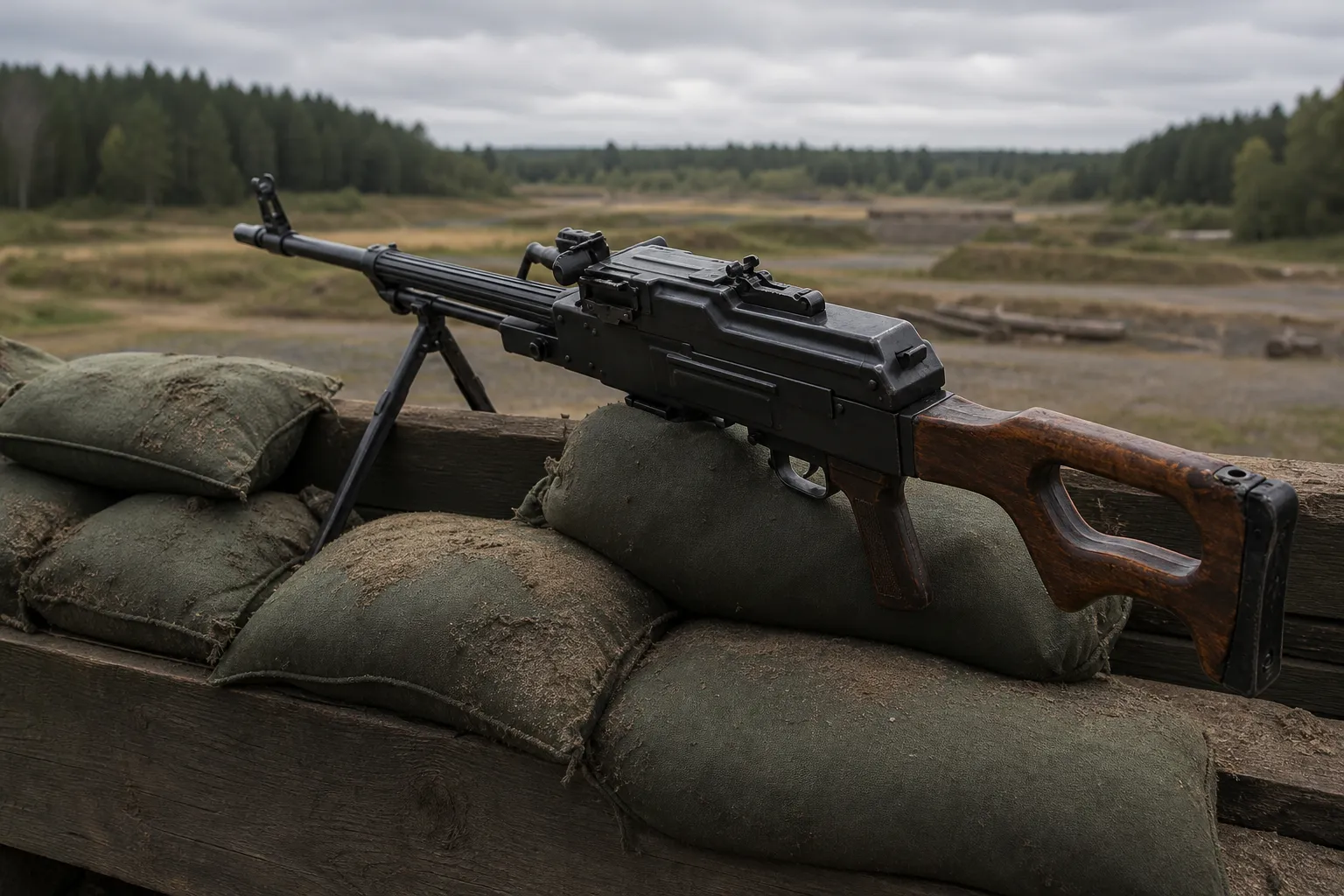
The PK and PKM are Soviet 7.62x54R general purpose machine guns designed to fill several battlefield roles with one family of weapons. Russian Ministry of Culture museum material places the Kalashnikov bureau’s sample in 1960 and the modernized PKM in 1969. The design’s lasting importance comes from that combination: a belt fed, gas operated machine gun adaptable to bipod, tripod, vehicle, and tank use.
Why the Soviet Army wanted a universal machine gun
Modern Firearms describes the Soviet requirement behind the PK as an effort to replace separate company, battalion, and tank machine guns with a single universal design that could be adapted to those roles. In Western terminology, that is close to the general purpose machine gun idea: one machine gun family used from a bipod, on a tripod, and in mounted applications.
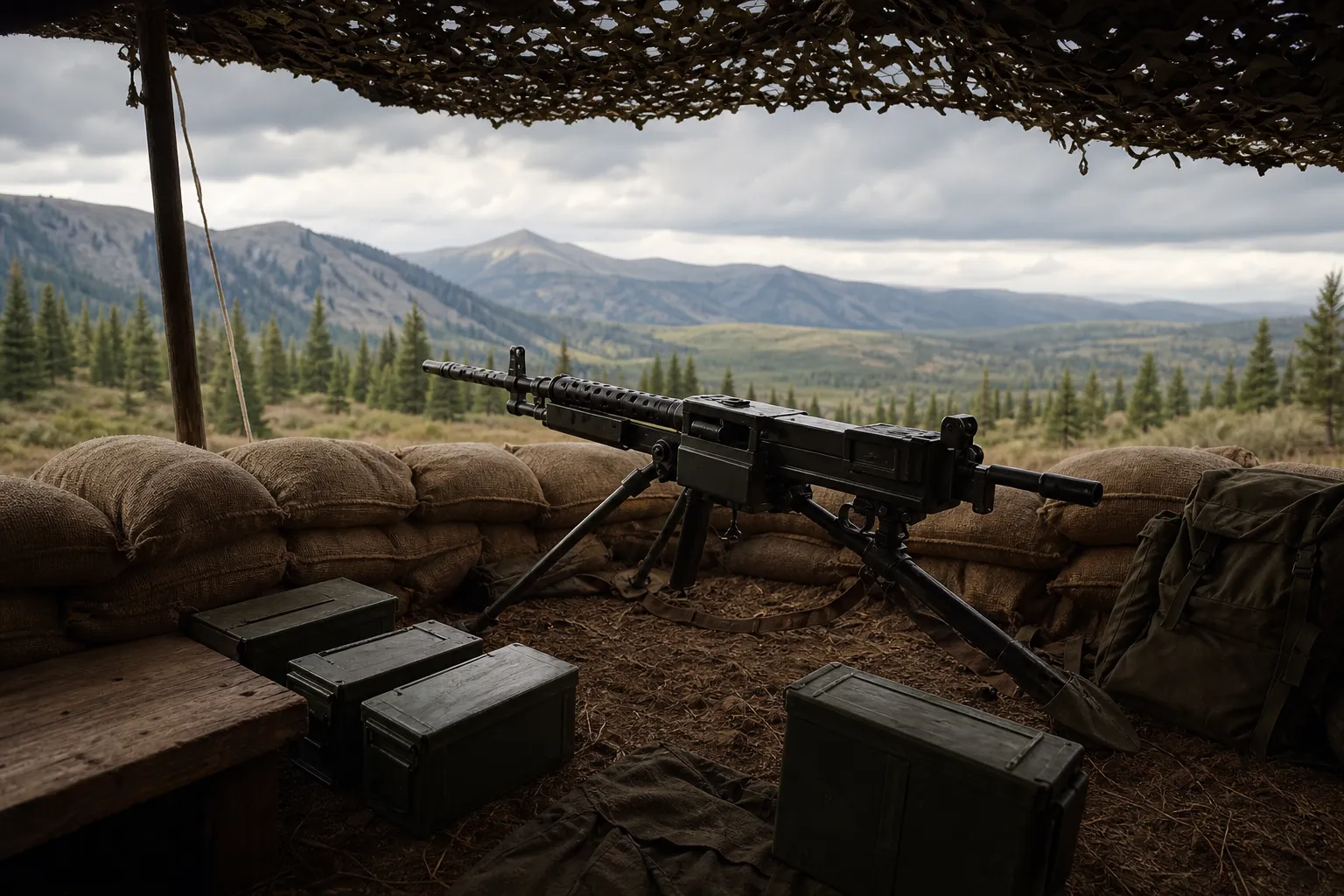
That goal shaped the whole PK family. The infantry gun could be carried and fired from its integral support arrangement, while related versions served on mounts and armored vehicles.
The PK followed earlier Soviet light and medium machine gun development, including the RPD machine gun, but it was built around the older, full power 7.62x54R cartridge rather than the intermediate 7.62x39mm cartridge.
Kalashnikov’s design bureau and adoption
A Russian Ministry of Culture museum entry says the Kalashnikov design bureau joined the Soviet machine gun competition after encouragement from Colonel Vladimir Deikin of the Main Artillery Directorate. The same museum entry says the Kalashnikov machine gun sample was ready in 1960.
The bureau was led by Mikhail Timofeevich Kalashnikov from 1957 to 1967, according to another Russian Ministry of Culture entry on the Izhevsk Machine Building Plant design bureau. Kalashnikov’s name is best known through the AK-47 and AKM, but the PK shows how his design group’s influence extended beyond assault rifles.
The Russian Ministry of Culture museum entry says trials showed advantages over the rival TKB-521, including compatibility with earlier ammunition belts and easier cleaning.
The modernized PKM entered Soviet service in 1969, according to the same Russian museum entry. The design bureau entry also identifies Vladimir Valentinovich Kamzolov as having worked on modernization of the unified machine gun.
Cartridge: 7.62x54R and the rimmed case
Small Arms Survey lists the illustrated Russian PKM as chambered in 7.62x54R, with non disintegrating metal belts in 100, 200, and 250 round capacities.
The “R” in 7.62x54R refers to the rimmed case. In simple terms, a rimmed cartridge has a projecting rim at the base, so the feed system has to manage cartridge movement without letting rims interfere with one another.
Modern Firearms describes the PK’s feed concept as a two stage system. A claw withdraws the cartridge rearward from the belt, then a spring loaded arm lowers it into the feedway. That description helps explain why the PK feed system is more than a straight push from belt to chamber. This is a conceptual explanation only, not a loading or assembly guide.
Operating system, in plain English
Modern Firearms describes the PK as gas operated, belt fed, air cooled, automatic only, firing from an open bolt, and having a quick detachable barrel.
For readers new to the term, a gas operated firearm uses propellant gas from firing to drive the action. In the PK family, that energy cycles the mechanism, moves the belt feed system, extracts and ejects the fired case, and chambers the next cartridge. For more background on the general concept, see our guide to gas operated rifles.
Modern Firearms describes the PK as firing from an open bolt. In an open bolt automatic firearm, the bolt is held to the rear before firing, then moves forward as part of the firing cycle. Open bolt operation is common in many machine guns because the chamber is not kept closed on a live round between shots. For a broader explanation of that concept, see open bolt vs closed bolt firearms.
PK to PKM: what changed in the modernization
Modern Firearms lists the PK or PKS gun weight as 9 kg, and the PKM or PKMS gun weight as 7.5 kg.
That weight reduction is the central practical difference between the original PK and the PKM. The Russian Ministry of Culture museum entry places the modernized PKM’s entry into service in 1969, after the original PK family appeared.
Modern Firearms also notes visible modernization differences, including an unfluted barrel, shorter flash hider, and improved tripod in the PKM family. These changes were part of making the system lighter and better suited to broad service use.
Small Arms Survey lists an illustrated Russian PKM at 1160 mm overall length and 7.55 kg unloaded weight, with 100, 200, and 250 round non disintegrating metal belts.
| Item | Listed information |
|---|---|
| Cartridge | 7.62x54R, according to Small Arms Survey and Modern Firearms |
| Operation | Gas operated and belt fed, according to Modern Firearms |
| Feed | Metal non disintegrating belt, according to Small Arms Survey |
| PK or PKS weight | 9 kg, according to Modern Firearms |
| PKM or PKMS weight | 7.5 kg, according to Modern Firearms |
| Russian PKM illustrated by Small Arms Survey | 1160 mm length and 7.55 kg unloaded weight |
Main variants: PK, PKS, PKM, PKMS, PKB, and PKT
The PK family was designed around adaptation. The basic idea was not one gun for one narrow use, but one weapon family for several mounts and roles.
Modern Firearms lists the PK, PKS, PKM, and PKMS as 7.62x54R weapons. In that naming pattern, the tripod mounted forms are commonly represented by the “S” variants. Modern Firearms lists the PKS with the PK and the PKMS with the PKM.
The Russian Ministry of Culture museum entry also refers to heavy, tank, and armored personnel carrier mounted variations. The editor’s commonly used family names for these roles include PKS or PKMS for tripod guns, PKT for tank or coaxial use, and PKB or PKMB for vehicle use.
The Pecheneg and later Russian development
The PKM did not end Russian development of the system. Modern Firearms describes the Pecheneg as a standard 7.62x54R PKM based gun without the rapid barrel change option, intended as a squad support weapon.
Modern Firearms also says the Pecheneg was being issued to certain Russian Army and Internal Affairs Ministry Spetsnaz units operating in Chechnya. That wording is important: the Pecheneg is a later development in the PKM line, not proof that all PKM type guns disappeared from Russian service.
Global distribution and licensed production
Small Arms Survey identifies the PK or close variants as a general purpose machine gun also referred to as PK or PKM. Its identification sheet lists foreign or close variants including examples associated with Russia, Kazakhstan, Romania, Bulgaria, China’s Type 80, Poland’s Karabin Maszynowy, and Yugoslavia or Serbia’s M84.
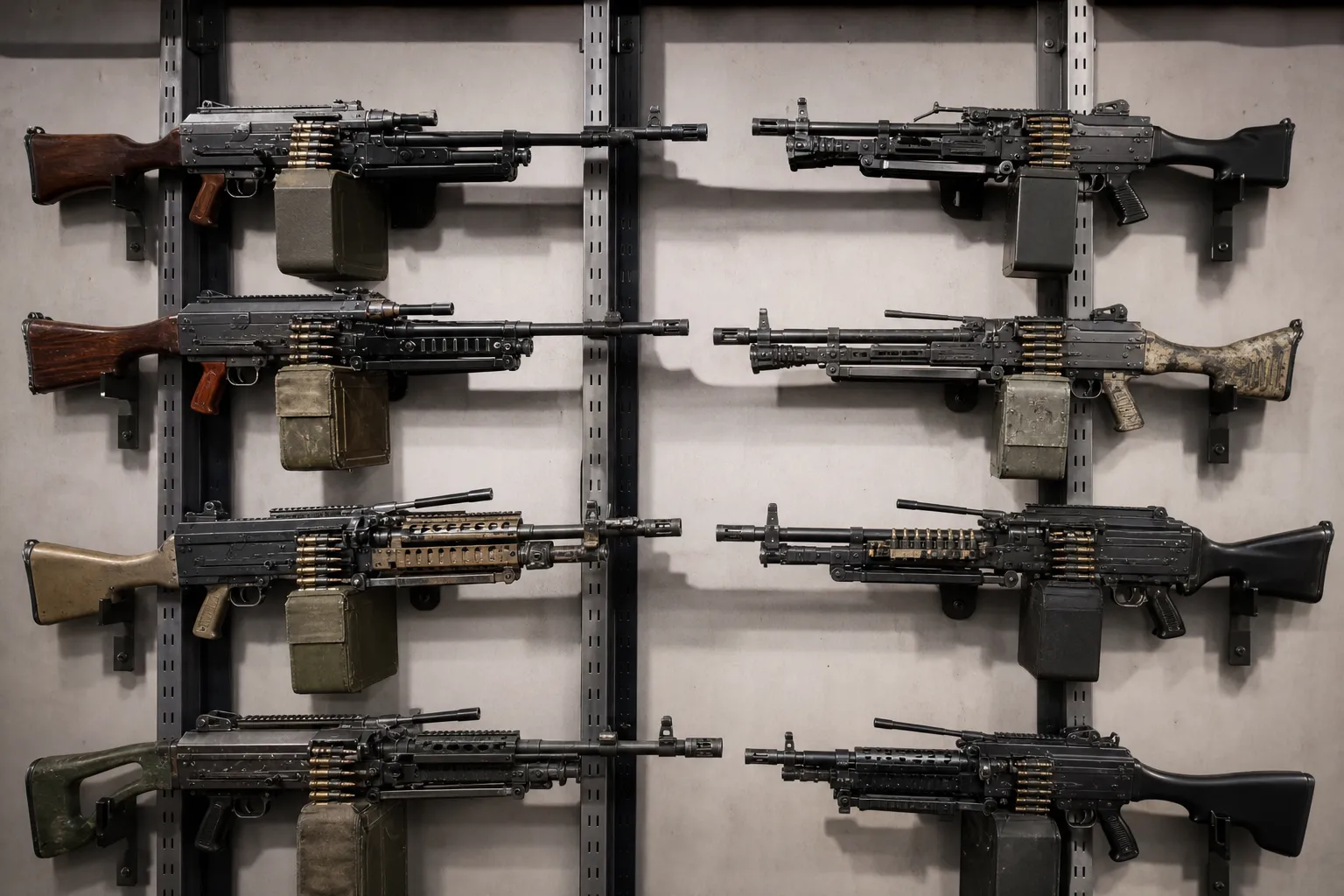
Zastava Arms lists the M84, M84 M, and M86 machine guns as 7.62x54R weapons manufactured by Zastava Arms for infantry, tank, and armored vehicle use. That mirrors the broader PK family idea: one basic machine gun system adapted to foot mobile and mounted roles.
These foreign and close variants help explain why the PKM remains one of the best known modern belt fed machine guns. Its legacy is not only Soviet use, but the way the design became a recognizable pattern for armies and manufacturers outside the Soviet Union.
U.S. regulation note
This article is historical and technical background, not legal advice. Anyone researching a machine gun in the United States should confirm current requirements directly with ATF and other official authorities before taking any action.
Frequently asked questions
When did the PKM enter service?
A Russian Ministry of Culture museum entry says the modernized PKM entered Soviet service in 1969.
What cartridge does the PKM use?
Small Arms Survey and Modern Firearms list the PKM family as using the 7.62x54R cartridge.
How is the PKM different from the original PK?
Modern Firearms lists the PK or PKS at 9 kg and the PKM or PKMS at 7.5 kg. It also notes visible modernization differences, including an unfluted barrel, shorter flash hider, and improved tripod in the PKM family.
Is the Pecheneg a replacement for the PKM?
Modern Firearms describes the Pecheneg as a standard 7.62x54R PKM based gun without the rapid barrel change option, intended as a squad support weapon. It also says the Pecheneg was being issued to certain Russian Army and Internal Affairs Ministry Spetsnaz units operating in Chechnya, so it is best understood as a later development in the PKM line rather than proof that all PKM type guns disappeared from Russian service.
Sources
- Kalashnikov Machine Gun, Ministry of Culture of the Russian Federation, Culture.ruOfficial source. Accessed November 9, 2026.
- Design Bureau of M.T. Kalashnikov, Ministry of Culture of the Russian Federation, Culture.ruOfficial source. Accessed November 9, 2026.
- FM 100-2-3: The Soviet Army, Troops, Organization, and Equipment, U.S. Army, hosted by U.S. Marine Corps Training CommandOfficial source. Accessed November 9, 2026.
- Weapons Identification Sheet: PK (& close variants), Small Arms Survey, with technical assistance from the National Firearms Centre, Royal Armouries. Accessed November 9, 2026.
- Kalashnikov PK / PKM, Modern Firearms, Maxim Popenker. Accessed November 9, 2026.
- Legends and Reality of the AK, Charlie Cutshaw and Valery Shilin, Paladin Press. Accessed November 9, 2026.
- PK (Pulemyot Kalashnikova), Bonn International Centre for Conflict Studies, SALW Guide. Accessed November 9, 2026.
- Machineguns, Zastava ArmsOfficial source. Accessed November 9, 2026.
- PKM Handy Fire Support, RosoboronexportOfficial source. Accessed November 9, 2026.
- Пулемет «Печенег», Federal Service of National Guard Troops of the Russian Federation, RosgvardiyaOfficial source. Accessed November 9, 2026.
- Pecheneg, Modern Firearms, Maxim Popenker. Accessed November 9, 2026.
- National Firearms Act, Bureau of Alcohol, Tobacco, Firearms and ExplosivesOfficial source. Accessed November 9, 2026.