Point-Blank Range
Point blank range can mean a very close shot in ordinary English, but in ballistics it usually refers to a distance window where a center hold stays inside a chosen target zone without holdover or sight adjustment.
By RaiS. Reviewed by RaiS. Published . 5 min read.
Research and drafting were assisted by AI. RaiS checked the facts against the sources below and approved this page.

Point-blank range has two related but different meanings. In everyday English, it means a shot fired with the gun touching or very close to the target. In ballistics, especially in the phrase maximum point-blank range, it means the farthest useful distance over which a shooter can aim at the center of a chosen target zone and keep the bullet within that zone without dialing sights, changing the point of aim, or holding high or low.
Everyday meaning: very close range
Oxford Learner’s Dictionaries defines a point-blank shot as one fired with the gun touching or very close to the target. SAAMI also defines point-blank range, in its basic glossary sense, as very close range.

That is the meaning many readers already know from news, crime writing, or ordinary speech. Oxford also records a figurative meaning, where point-blank describes speech that is direct, definite, and not very polite.
In firearm ballistics, however, point-blank range often means something more specific than “very close.” It is about trajectory, line of sight, and a chosen target-size window.
Ballistic meaning: a no-holdover distance window
In the ballistic sense, point-blank range is a distance span where a bullet remains inside a predefined target area when the shooter holds on the same aiming point. Lapua describes point blank range as the minimum-to-maximum distance within which the bullet will hit the predefined target area without changing point of aim or adjusting the scope.
Federal describes MPBR as the maximum distance at which a rifle and ammunition combination can be held dead center on a target of a given size without holding high or low.
That makes MPBR a practical trajectory concept. The shooter chooses the vertical window first, then selects a sight-in distance that keeps the bullet path inside that window for as long as practical. Lapua says point blank range calculation can be used to optimize the sight-in distance so the PBR is as long as possible.
For more background on zeroing and sighting systems, see our sight-in guide.
Maximum point-blank range, or MPBR
Maximum point-blank range is the optimized far end of the point-blank window. It is not simply the distance where the firearm is zeroed.
Federal gives another way to understand the idea. In its MPBR discussion, Federal uses a 6-inch vital zone for deer and says the proper zero is selected so the midrange trajectory does not exceed the allowed rise. Federal also notes that the numbers change significantly with vital-zone size and cartridge trajectory.
The key point is that MPBR depends on the target-size zone. A larger allowed vertical window produces a different result than a smaller one. A cartridge and bullet combination with a different trajectory also produces a different result.
How MPBR works in plain language
A bullet’s path does not follow the line of sight exactly. SAAMI defines a trajectory table as a computed table describing downrange projectile trajectory.
A simplified MPBR process looks like this:
- Choose a target-size zone, such as a vital-zone diameter or another acceptable vertical window.
- Pick a sight-in distance that keeps the bullet path inside that zone for the longest practical span.
- Use the same center hold inside that span, without holding high or low.
- Treat the far end of that span as the maximum point-blank range for that specific setup and target-size zone.
Lapua says users should define the target hit area size in relation to the point of aim. Federal’s example does the same thing by starting with a 6-inch vital zone.
Several factors affect the result, including line of sight, sight-in range, bullet drop, trajectory, muzzle velocity, ballistic coefficient, sight height, and target size. SAAMI defines ballistic coefficient as an index of how a projectile decelerates in free flight and as a measure of its ability to overcome air resistance. Hornady likewise describes ballistic coefficient as a bullet’s relative ability to overcome air resistance and notes that BC is not absolute and can change with atmospheric conditions.
For more on bullet efficiency and air resistance, see ballistic coefficient.
Point-blank range is not maximum range
Point-blank range should not be confused with maximum range. Maximum range concerns the farthest distance a projectile can travel.
MPBR is much narrower. It is about where the bullet stays inside a chosen vertical zone relative to the aiming point. Maximum range is about the farthest distance a projectile can travel.
That distinction matters because a bullet may travel much farther than its point-blank range. For the separate safety and distance question, see how far can a bullet travel.
Point-blank range is not an ethical hunting limit
MPBR is a trajectory concept, not a complete hunting decision. It tells you how a specific rifle, ammunition, sight setup, and target-size zone relate to line of sight. It does not, by itself, decide whether a shot is responsible in the field.
Federal’s MPBR example uses a deer vital-zone diameter to explain trajectory planning, but Federal also notes that the numbers change with vital-zone size and cartridge trajectory. That means MPBR is setup-specific and target-zone-specific, not a universal field limit.
Where the term may come from
The origin of point-blank is usually connected with early gunnery and target language, but dictionaries do not frame the French connection in exactly the same way.
Oxford dates point-blank to the late 16th century and says it is probably from point plus blank, with blank meaning the white spot in the center of a target. American Heritage gives a Middle French model and connects blanc with white, bull’s-eye, or target.
Because those references differ in wording, it is safest to say the term is often linked to French or Middle French target language involving blanc, meaning white or bull’s-eye, rather than saying it has one settled, simple origin.
Quick comparison
| Term | What it means |
|---|---|
| Point-blank, everyday use | A shot fired with the gun touching or very close to the target. |
| Point-blank, ballistic use | A distance window where the bullet stays inside a chosen target area without changing point of aim or adjusting sights. |
| Maximum point-blank range, MPBR | The optimized far end of that window for a specific setup and target-size zone. |
| Maximum range | A separate distance concept about how far a projectile can travel. |
What to check in official data
For a real rifle and ammunition setup, check the ammunition maker’s ballistic table or trajectory data. SAAMI defines a ballistic table as an ammunition performance data sheet that usually includes bullet weight, velocity, energy, and trajectory data at various ranges.
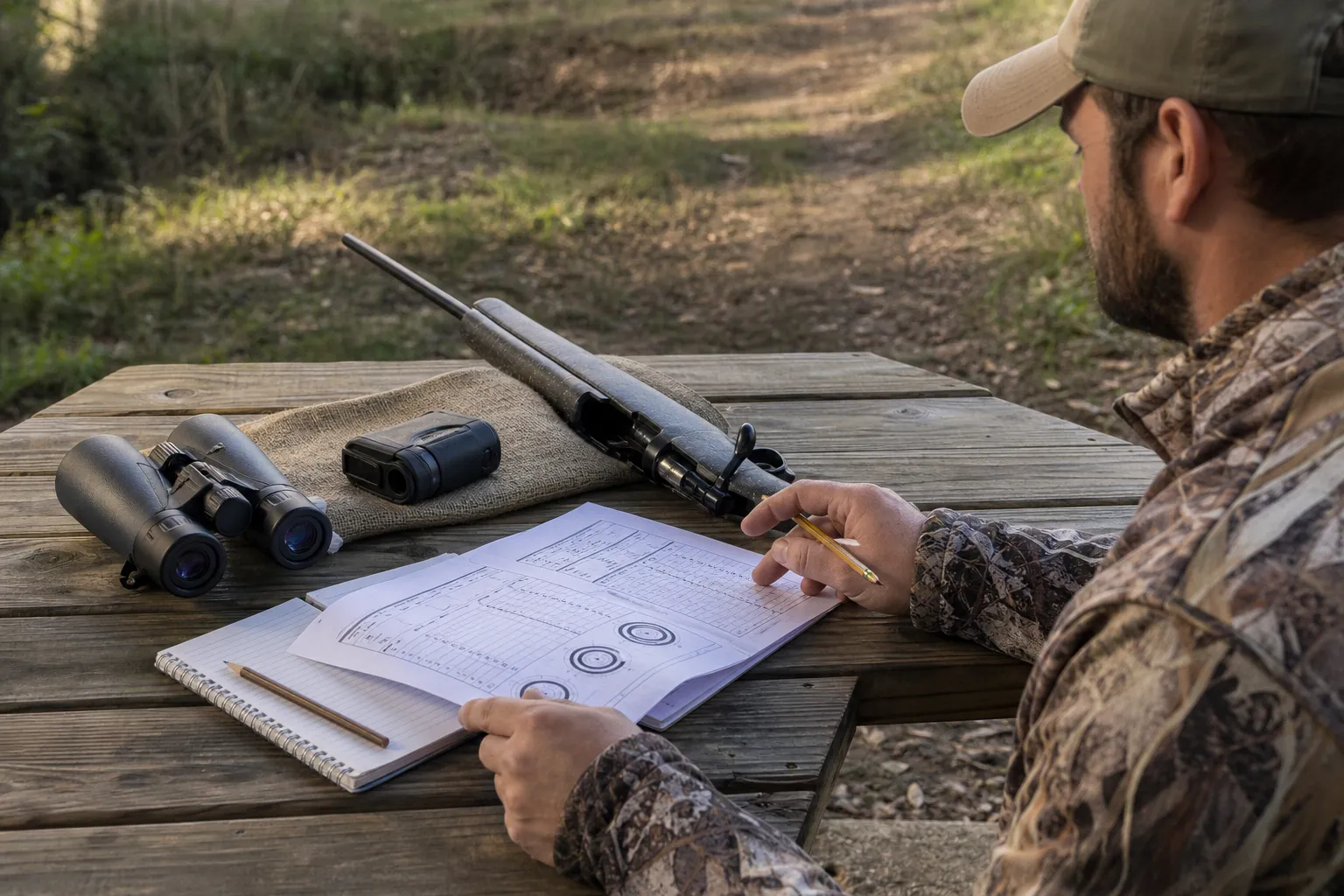
Also confirm the sight-in distance, the target-size zone, and the assumptions used in any trajectory table or calculator. A point-blank range number is only meaningful when those inputs are known.
Frequently asked questions
Does point-blank always mean very close?
No. In ordinary English it can mean a shot fired with the gun touching or very close to the target. In ballistics, point-blank range can mean a distance window where the bullet stays inside a chosen target area without holdover or sight adjustment.
What does maximum point-blank range mean?
Maximum point blank range is the farthest end of the no holdover window for a specific setup and target size zone.
Is MPBR the same as zero distance?
No. Zero distance is the sight in distance for the setup, while MPBR is the far end of the point blank window for a chosen target zone. They should not be treated as the same value.
What changes a point-blank range number?
The result depends on the chosen target-size zone, sight-in distance, bullet drop, trajectory, muzzle velocity, ballistic coefficient, sight height, and the rifle and ammunition setup. Federal notes that MPBR numbers change with vital-zone size and cartridge trajectory.
Is point-blank range the same as maximum range?
No. Maximum range is about how far a projectile can travel. Point-blank range is about staying within a chosen vertical target zone.
Where does the phrase point-blank come from?
Dictionaries connect it to late 16th century gunnery and target language, but they differ in detail. Oxford links it to point plus blank, and American Heritage connects Middle French blanc with white, bull’s eye, or target.
Sources
- point-blank adjective, Oxford Learner's Dictionaries, Oxford University Press. Accessed October 22, 2026.
- American Heritage Dictionary Entry: point-blank, The American Heritage Dictionary of the English Language, Fifth Edition, HarperCollins. Accessed October 22, 2026.
- Origin and history of point-blank, Online Etymology Dictionary. Accessed October 22, 2026.
- SAAMI Glossary: Point-Blank-Range, Sporting Arms and Ammunition Manufacturers' InstituteOfficial source. Accessed October 22, 2026.
- Lapua Ballistics Tips: Point blank range and V0 calculation, LapuaOfficial source. Accessed October 22, 2026.
- What Is Point-Blank Range?, Federal Premium AmmunitionOfficial source. Accessed October 22, 2026.
- .224 Dia., 55 Gr. HPBT, Sierra BulletsOfficial source. Accessed October 22, 2026.
- SAAMI Glossary: Ballistic Coefficient, Sporting Arms and Ammunition Manufacturers' InstituteOfficial source. Accessed October 22, 2026.
- External Ballistics, Hornady ManufacturingOfficial source. Accessed October 22, 2026.
- SAAMI Glossary: Ballistic Table, Sporting Arms and Ammunition Manufacturers' InstituteOfficial source. Accessed October 22, 2026.
- SAAMI Glossary: Trajectory Table, Sporting Arms and Ammunition Manufacturers' InstituteOfficial source. Accessed October 22, 2026.
- SAAMI Glossary: Ballistics, Sporting Arms and Ammunition Manufacturers' InstituteOfficial source. Accessed October 22, 2026.