Blowback Pistols Explained: How Simple Blowback Operation Works
Simple blowback pistols use cartridge pressure, slide or bolt mass, and a recoil spring instead of a locked breech. The system is common in smaller handgun cartridges, while higher power pistols often use locked breech systems.
By RaiS. Reviewed by RaiS. Published . 5 min read.
Research and drafting were assisted by AI. RaiS checked the facts against the sources below and approved this page.
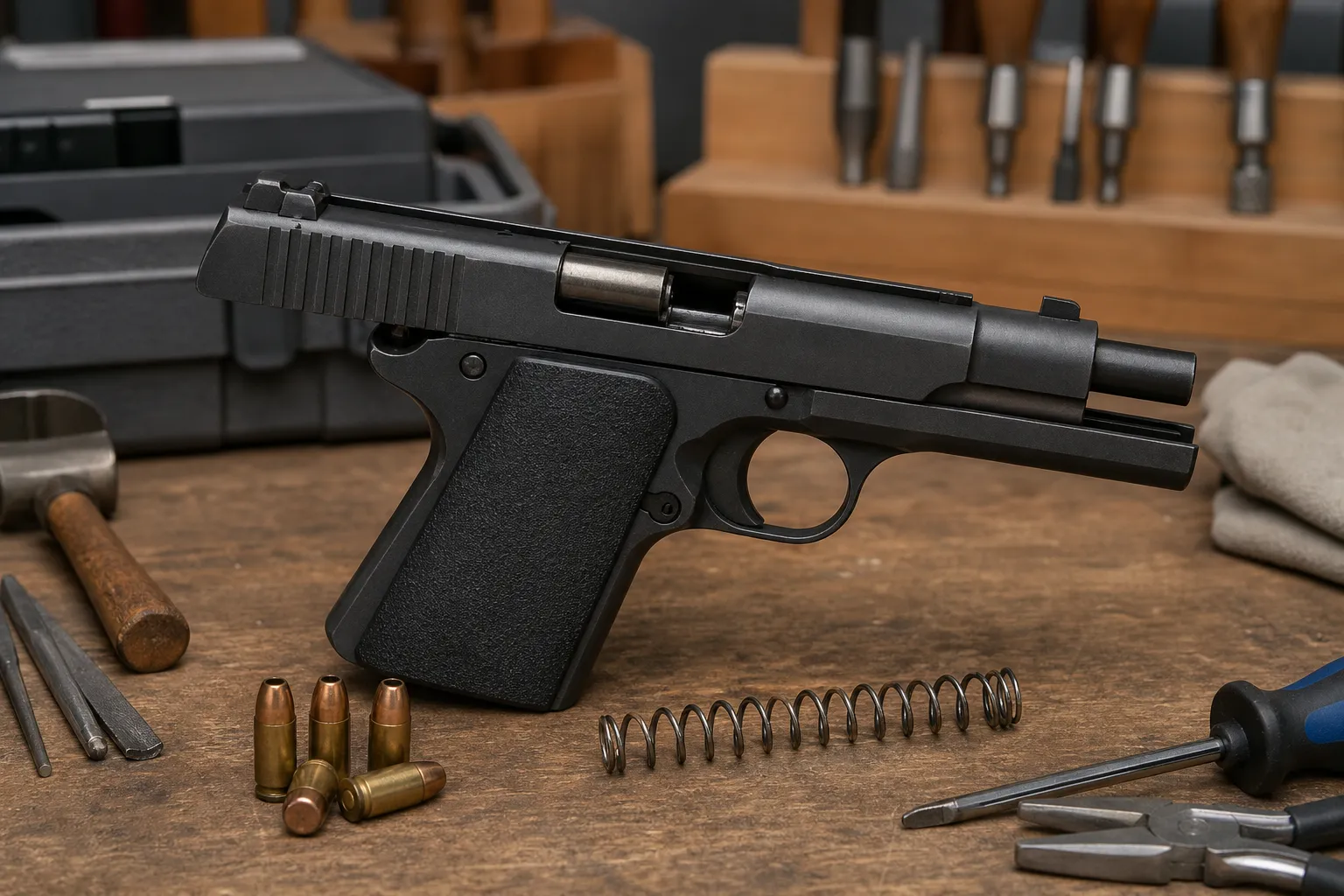
Simple blowback is a semi-automatic firearm action with an unlocked breech. When the cartridge fires, pressure pushes the bullet forward and also pushes the cartridge case rearward against the slide or bolt. In a simple blowback pistol, there is no mechanical lock holding the breech shut. Instead, the slide or bolt’s inertia, helped by the recoil spring, slows opening long enough for pressure to fall.
That simple idea explains why blowback is often seen in smaller pistol cartridges, especially .22 LR.32 Auto, and .380 Auto, and why higher power service cartridges often use locked-breech systems instead. More pressure and impulse can require more moving mass if the breech is not locked.
What “blowback” means
SAAMI defines blowback as a semi-automatic or automatic action where rearward propellant-gas pressure is transmitted through the inside of the cartridge case to the bolt or slide, starting its rearward travel. SAAMI also states that the barrel and receiver are typically fixed in this type of action, and that a spring returns the bolt or slide to battery and holds it in place.
AFTE describes blowback firearms as designs where bolt weight, slide inertia, a recoil spring, and sometimes a delay provide the main locking force, with no mechanical locking of the breech. AFTE’s definition of simple blowback is more specific: it is a totally unlocked breech that relies on breech-bolt mass and return-spring strength to keep the cartridge case from emerging during peak pressure.
In a handgun, readers usually see this as a slide or internal bolt that moves rearward after firing. For a refresher on the major handgun components involved, see parts of a semi-automatic pistol.
The simple blowback firing cycle
The National Institute of Justice describes blowback as a design that directly uses breech pressure on the cartridge-case head to actuate the mechanism. In plain English, firing starts two movements at once: the bullet moves forward through the barrel, and the case head pushes rearward on the slide or bolt.
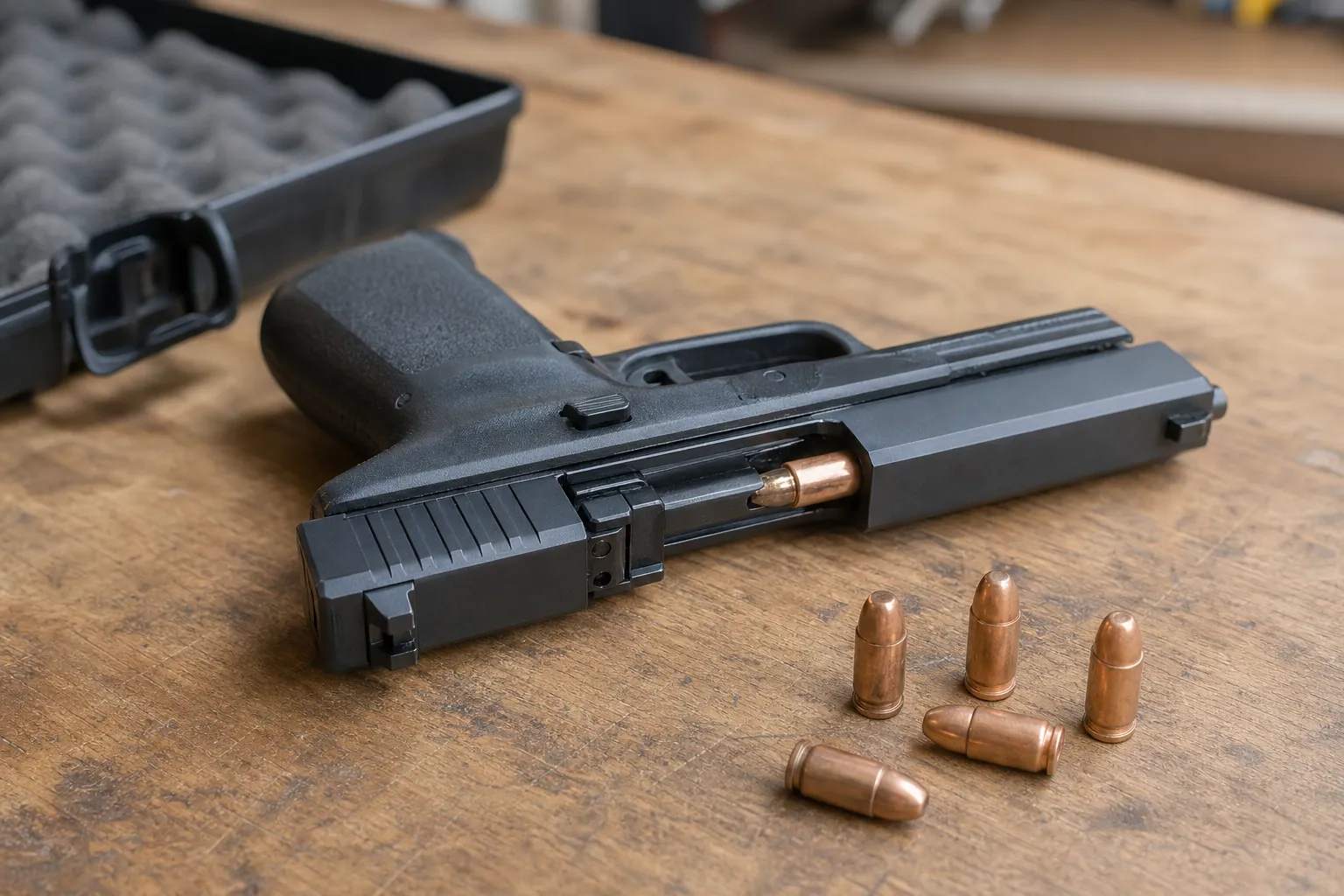
In a simple blowback action, the slide or bolt is not locked to the barrel.
A simplified cycle looks like this:
- The cartridge fires, and pressure pushes the bullet forward.
- The same pressure pushes the case head rearward against the slide or bolt.
- The slide or bolt begins moving rearward, but its mass keeps acceleration low.
- Rearward movement compresses the recoil spring.
- The spring uses stored energy to return the slide or bolt forward.
- The forward movement places the action back in battery and loads the next round, depending on the design.
SAAMI describes the spring as returning the bolt or slide into battery.
Browning’s Buck Mark manual gives a familiar .22 pistol example. Browning describes the Buck Mark as a single-action autoloading pistol that uses a straight blow-back, recoil-operated design. Browning also states that the pistol feeds cartridges from a removable magazine and fires one cartridge per trigger pull until the chamber and magazine are empty.
Why slide mass matters more than people expect
The most important beginner point is this: the recoil spring is not the whole answer.
That is why slide or bolt mass matters so much. A heavier moving part accelerates more slowly. In simple blowback, that slow acceleration is what gives chamber pressure time to drop while the cartridge case is still supported.
AFTE’s definition says the system relies on breech-bolt mass and return-spring strength to prevent the case from emerging during peak pressure.
This is also why simple blowback becomes less attractive as cartridge impulse rises. In a compact pistol, extra slide or bolt mass can quickly become a design problem.
Why .22 LR.32 Auto, and .380 Auto fit the idea
NIJ training says that for low-powered cartridges that reach peak firing pressure quickly, bolt mass and the return spring can hold the bolt closed briefly during firing. NIJ adds that this is common in semi-automatic .22 caliber rimfire arms.
AFTE also gives .22 rimfire semi-automatic rifles or pistols as examples of simple blowback operation.
Manufacturer manuals show the same pattern in real pistols. Browning identifies the Buck Mark .22 pistol as a straight blow-back autoloading pistol. Beretta’s Bobcat and Tomcat manual lists the 20X Bobcat as .22 LR and the 30X Tomcat as .32 Auto, and lists their system of operation as direct blowback.
Pressure alone is not the entire design question. NIJ specifically mentions both cartridge power and peak-pressure duration when explaining why some firearms need locked breeches.
For a cartridge-level comparison of .380 Auto and 9mm Luger, see .380 ACP vs 9mm.
Why higher power pistols often use locked breeches
NIJ says some firearms require a locked breech to safely handle cartridges of greater power and longer peak-pressure duration. In a locked-breech pistol, the slide and barrel, or a locking part, stay mechanically locked together during the high-pressure part of firing.
That is the key contrast with simple blowback. A simple blowback pistol relies on inertia and spring force. A locked-breech pistol uses a mechanical lock for the early part of the cycle, then unlocks after initial movement.
For more on the Beretta design, see the Beretta 92.
This shows the basic engineering choice. With simple blowback, the moving mass must restrain opening without a lock. With locked breech, the mechanism mechanically delays opening during the part of firing when pressure is highest.
What “fixed barrel” means in this context
SAAMI says the barrel and receiver are typically fixed in a blowback action. This is one reason blowback pistols often look mechanically simple compared with locked-breech pistols, although the details vary by model.
Some rimfire pistols do not use a conventional moving slide in the way many centerfire pistols do. Ruger describes the Mark IV as using internal cylindrical bolt construction rather than a conventional moving-slide design. That description is useful because it reminds readers that “blowback” describes the operating principle, not only the outside shape of the moving part.
The important point is still the same: pressure on the case head starts the rearward movement of the bolt or slide, and mass plus spring force control that movement until pressure has fallen.
Safety and ammunition notes
This guide is a conceptual explanation, not a modification guide. Changing springs, slides, bolts, barrels, ammunition, or operating parts can affect how a firearm functions and should not be treated as a casual experiment.
Beretta’s Tomcat and Bobcat manual tells users to use only new factory ammunition made to CIP or SAAMI specifications, and to make sure every round is the proper caliber and type for the firearm. The same manual warns users not to attempt firearm repairs without proper knowledge or training, not to alter parts, and to have operating-mechanism alterations performed by Beretta or an authorized service center.
If you own a blowback pistol, read the current manufacturer manual for that exact model, use only the ammunition type the manufacturer specifies, and confirm any maintenance or repair question with the manufacturer or a qualified service center.
Frequently asked questions
What is a simple blowback pistol?
A simple blowback pistol has an unlocked breech. Cartridge pressure pushes the case rearward against the slide or bolt, while slide or bolt mass and the recoil spring keep opening slow enough for pressure to fall.
Does the recoil spring keep a blowback pistol closed by itself?
No. In simple blowback, slide or bolt mass is an important part of slowing opening. The recoil spring is not the whole answer.
Why are .22 LR pistols often blowback operated?
NIJ training says blowback is common in semi-automatic .22 caliber rimfire arms because low-powered cartridges that reach peak pressure quickly can be handled by bolt mass and the return spring.
How is locked-breech operation different?
A locked-breech pistol mechanically locks the barrel and slide, or uses a locking part, during the high-pressure part of firing. A simple blowback pistol relies on inertia and spring force instead of a mechanical lock.
Can I change recoil springs to tune a blowback pistol?
This guide does not provide modification instructions. Beretta warns users not to alter operating parts or use substitute parts, and says operating-mechanism alterations should be handled by the manufacturer or an authorized service center.
Sources
- SAAMI Glossary, Blowback, Sporting Arms and Ammunition Manufacturers’ InstituteOfficial source. Accessed November 27, 2026.
- AFTE Glossary, Version 6.07302025, Association of Firearm and Tool Mark Examiners. Accessed November 27, 2026.
- AMCP 706-260, Engineering Design Handbook, Guns Series, Automatic Weapons, U.S. Army Materiel Command, hosted PDF copy. Accessed November 27, 2026.
- Firearms Examiner Training, Semiautomatic and Automatic, National Institute of JusticeOfficial source. Accessed November 27, 2026.
- Buck Mark Owners Manual, BrowningOfficial source. Accessed November 27, 2026.
- Mark IV Overview, Sturm, Ruger & Co.Official source. Accessed November 27, 2026.
- Tomcat & Bobcat Pistol User Manual, Beretta U.S.A. Corp.Official source. Accessed November 27, 2026.
- ANSI/SAAMI Z299.1-2018, Rimfire Ammunition, Sporting Arms and Ammunition Manufacturers’ InstituteOfficial source. Accessed November 27, 2026.
- ANSI/SAAMI Z299.3-2022, Centerfire Pistol and Revolver Ammunition, Sporting Arms and Ammunition Manufacturers’ InstituteOfficial source. Accessed November 27, 2026.
- SIG Sauer P320 Pistols Operator’s Manual, SIG SauerOfficial source. Accessed November 27, 2026.
- Beretta Series 92 Manual, BerettaOfficial source. Accessed November 27, 2026.
- AMCP 706-260 Engineering Design Handbook, Guns Series, Automatic Weapons Metadata Page, T.REX ARMS Field Manual Vault. Accessed November 27, 2026.