Duck Calls Explained: Single Reed, Double Reed and the Calls They Make
Duck calls are reed instruments that imitate common mallard vocalizations. Single reed and double reed calls differ in range and forgiveness, while acrylic, wood and polycarbonate affect loudness, sharpness and tone.
By RaiS. Reviewed by RaiS. Published . 7 min read.
Research and drafting were assisted by AI. RaiS checked the facts against the sources below and approved this page.

Duck calls work by pushing air over a reed so it vibrates, then using the call body to shape that vibration into ducklike sound. Mallard style calling is built around common mallard vocalizations. From there, hunters choose between single reed and double reed calls, pick a material that fits the setting, and learn a small set of useful sounds: the quack, greeting call, hail call, feed chuckle and comeback call.
What a duck call is trying to imitate
Most common duck calling discussed here is based on the mallard, including mallard vocalizations used in hunting instruction.
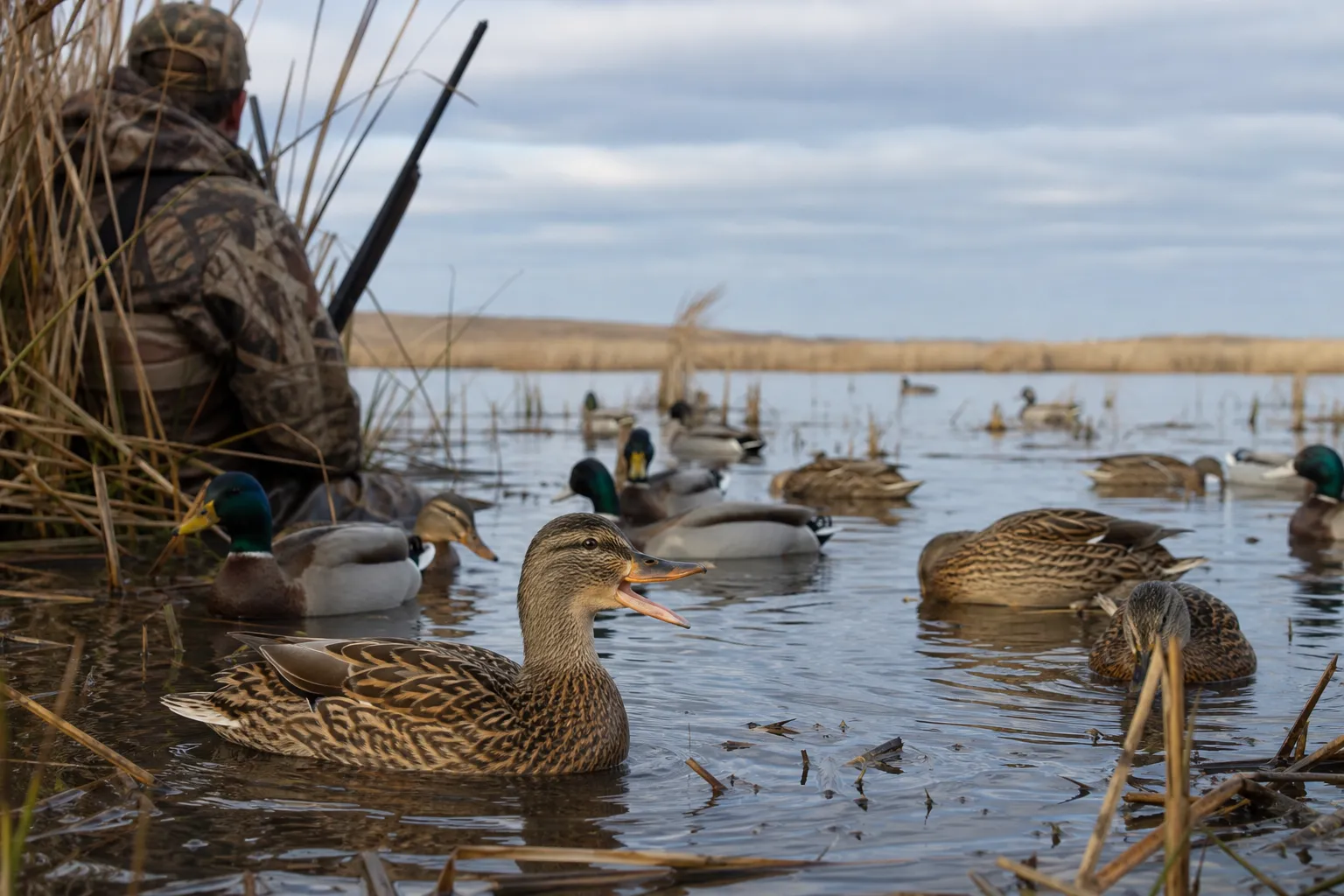
That does not mean every duck sound is the same. Ducks Unlimited notes that female mallards make a range of vocalizations, including decrescendo calls, feeding and flight assembly chuckles, and single and multiple quacks.
For a broader identification guide, see our Types of Ducks guide. This article stays focused on mallard style duck calls because those are the calls most often discussed when hunters talk about single reeds, double reeds, quacks and hail calls.
How a duck call works
Ducks Unlimited describes a duck call as working like a woodwind instrument: the caller forces air across a reed, and the reed vibrates to produce sound. The body of the call, the reed setup and the tuning all help shape the tone that comes out.
Ducks Unlimited describes modern Arkansas style duck calls as having five main parts:
Part: Barrel What it does: The hollow body the caller blows into.
Part: Insert What it does: The part that fits into the barrel.
Part: Tone board What it does: A sound shaping surface in the insert.
Part: Reed What it does: The vibrating part that produces the sound.
Part: Wedge What it does: The part that anchors the reed.
Small changes can make a call sound and feel different. Ducks Unlimited says reed length affects pitch: a longer reed vibrates more slowly and lowers pitch, while a shorter reed raises pitch. Reed thickness also matters because a thicker reed needs more air to vibrate and produces greater volume.
The body of the call matters too. Ducks Unlimited says a thicker barrel absorbs more vibration and produces a deeper, mellower tone. Ducks Unlimited also lists reed count, tone channel diameter, tone board length and the reed tip’s position relative to the tone board as sound shaping factors.
Single-reed versus double-reed duck calls
Ducks Unlimited describes single reed and double reed calls as the two most common duck call types. The difference sounds simple, one reed or two reeds, but it changes how the call behaves.
Single-reed calls
A single reed call uses one vibrating reed. Buck Gardner Calls says single reed calls offer a broader range of volume and tone, but usually require better air control and tongue pressure. RNT similarly says a single reed requires more voice from the caller, but becomes more versatile once the caller learns to run it.
In plain terms, a single reed can give the caller more room to shape sound. That can help with different volumes, tones and inflections. The tradeoff is that the call is more dependent on the caller’s mechanics.
Double-reed calls
A double reed call uses two reeds. Buck Gardner Calls says double reed calls are more user friendly and more forgiving of air control and mechanics errors. RNT says a double reed can produce a raspy sound with straight air, but has a more limited sound range.
That is why many callers describe double reeds as easier to make sound ducky. The tradeoff is less tonal range compared with a single reed.
Which one should a hunter choose?
There is no single best choice. Ducks Unlimited’s Rick Dunn of Echo Calls says hunters should choose a duck call according to where and how they intend to use it.
Ducks Unlimited recommends a louder, higher pitched call for long distance calling over open lakes and big rivers because the notes carry farther. For close ducks in places such as flooded timber, potholes and beaver ponds, Ducks Unlimited recommends softer volume and pitch.
That same idea applies to reed choice. A caller who wants a broad range and is willing to work on mechanics may prefer a single reed. A caller who wants forgiveness and natural rasp may prefer a double reed. The better choice is the one that matches the hunter, the place and the sounds needed.
Materials and tone: acrylic, wood and polycarbonate
Ducks Unlimited says most duck calls are made of acrylic, wood or polycarbonate. Material does not replace calling skill, but it does influence sharpness, loudness, consistency and tone.
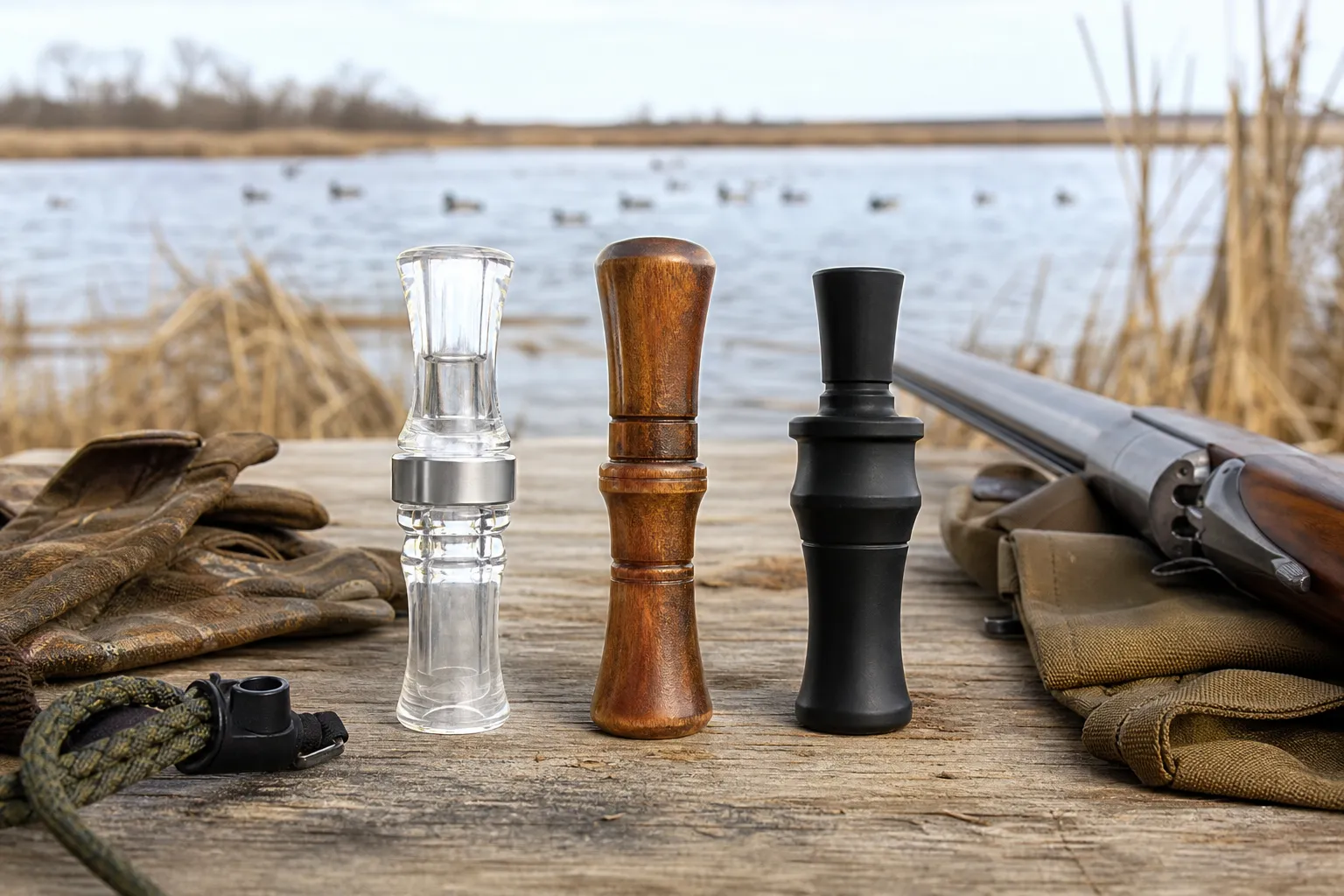
Material: Acrylic General sound and behavior: Ducks Unlimited says acrylic calls are typically sharper and louder than wood or polycarbonate. Ducks Unlimited also says acrylic is nonporous, while wood can absorb moisture and swell, so acrylic is more consistent across hunting conditions.
Material: Wood General sound and behavior: Ducks Unlimited says wooden calls are usually softer and mellower than acrylic calls and can be useful for close up calling. Ducks Unlimited also notes that wooden calls can absorb moisture and swell.
Material: Polycarbonate General sound and behavior: Ducks Unlimited says polycarbonate, a molded plastic, falls between acrylic and wood for sharpness and loudness.
For open water and long distance work, a sharper and louder sound may be useful because Ducks Unlimited recommends louder, higher pitched calls for long distances. For close work, softer and mellower sound can fit the situations where Ducks Unlimited recommends lower volume and pitch.
Basic duck calls and when hunters use them
Beginning callers do not need a long list of sounds at first. Ducks Unlimited’s Buck Gardner article says beginning callers should master the basic quack before moving to more advanced calls.
Ducks Unlimited also advises callers to use diaphragm air rather than puffing their cheeks, and to give the quack a clear ending. That matters because the quack is the foundation for many other mallard style sounds.
Quack
The quack is the basic single note. It is the sound most people associate with a duck.
For practice and calling structure, treat the quack as the base note. Ducks Unlimited’s calling instruction places it before the greeting call, feed call, comeback call and other advanced sounds.
Greeting call
Ducks Unlimited describes the greeting call as five to seven steady notes that start strong and high, then get lower and softer. Ducks Unlimited says to use it when ducks are first seen at a distance.
This is one of the most important sequences because it is built from controlled quacks rather than a completely separate sound. It is not just noise. The notes should have shape, with the first notes stronger and the later notes softer.
Hail call or highball
Ducks Unlimited defines a highball, also known as a hail call, as a loud series of ringing quacks used to catch the attention of ducks that are far away. Ducks Unlimited also says a hunter can create a hail call by drawing out the notes of a five note greeting call and adding controlled volume.
Ducks Unlimited’s waterfowl science material connects this to the mallard decrescendo, which it describes as usually five or six notes that begin loud and forceful, then get shorter and softer. Ducks Unlimited notes that this decrescendo is also called the hail call because hen mallards appear to use it to greet ducks flying overhead.
Use this as an attention call, not as a constant background sound. The purpose is to reach distant ducks, especially when ordinary calling may not carry.
Feed chuckle
Ducks Unlimited says the rolling feed call is also called a feeding chuckle. Ducks Unlimited says it is often used to add excitement while birds are working close to the decoys.
That makes it a close range confidence or excitement sound rather than a long distance attention call. It belongs around birds that are already working close, not as a replacement for a hail call.
Comeback call
Ducks Unlimited describes the comeback call as short, fast and urgent, with rapid pleading notes. Ducks Unlimited says hunters use it when ducks look interested in decoying but have not committed.
Think of it as a response to bird behavior. If ducks are drifting away or circling without finishing, the comeback call is meant to sound more urgent than a greeting call.
Silence
Calling is not always the answer.
Ducks Unlimited makes the same general point in its real world calling advice: calling ducks is not just powering through a fixed sequence. Watch how birds react, then adjust. Sometimes that means a hail call, sometimes a comeback call, and sometimes no call at all.
Putting it together
A simple way to understand duck calls is to separate the tool from the sounds.
The tool is a reed instrument. Its barrel, insert, tone board, reed and wedge shape the sound. A single reed generally gives more range but asks more from the caller. A double reed is generally more forgiving and naturally raspy, but with less range. Acrylic tends to be sharp and loud, wood tends to be soft and mellow, and polycarbonate sits between them.
The sounds are the vocabulary. Start with the quack. Use a greeting call when ducks are first seen at a distance. Use a hail call or highball for far ducks that need an attention getting sound. Use a feed chuckle to add excitement when birds are close to the decoys. Use a comeback call for ducks that seem interested but are not committing.
Before hunting, check the current waterfowl regulations and season information from the wildlife agency for the state, province or territory where you plan to hunt. Calling technique does not replace knowing the rules for species, seasons, limits, licenses and hunting areas.
Frequently asked questions
Is a single reed or double reed duck call better for beginners?
Buck Gardner Calls describes double reed calls as more user friendly and forgiving of air control and mechanics errors. Single reed calls offer broader volume and tone range, but Buck Gardner Calls says they usually require better air control and tongue pressure.
Why do many duck calls imitate mallards?
The U.S. Fish and Wildlife Service says the mallard is the most abundant duck species in North America. Ducks Unlimited also describes several female mallard vocalizations used in calling instruction.
What is the difference between a greeting call and a hail call?
Ducks Unlimited describes the greeting call as five to seven steady notes used when ducks are first seen at a distance. Ducks Unlimited defines the hail call, also called a highball, as a louder series of ringing quacks used to catch the attention of ducks that are far away.
What does a feed chuckle do?
Ducks Unlimited says the rolling feed call, also called a feeding chuckle, is often used to add excitement while birds are working close to the decoys.
Do acrylic, wood and polycarbonate duck calls sound different?
Ducks Unlimited says acrylic calls are typically sharper and louder than wood or polycarbonate, wooden calls are usually softer and mellower than acrylic, and polycarbonate falls between acrylic and wood for sharpness and loudness.
When should a hunter stop calling?
Ducks Unlimited advises adjusting calling to duck behavior rather than running a fixed sequence. If birds are responding well, less calling or no calling can be the right choice.
Sources
- Mallard Sounds, Cornell Lab of Ornithology, All About BirdsOfficial source. Accessed October 25, 2026.
- Mallard (Anas platyrhynchos), U.S. Fish and Wildlife ServiceOfficial source. Accessed October 25, 2026.
- Understanding Waterfowl: Science and Duck Calling, Ducks Unlimited. Accessed October 25, 2026.
- Waterfowl Vocalizations, Ducks Unlimited. Accessed October 25, 2026.
- Anatomy of a Duck Call, Ducks Unlimited. Accessed October 25, 2026.
- Duck Calls, Missouri Department of ConservationOfficial source. Accessed October 25, 2026.
- Harvesting the River: Duck Calls, Illinois State MuseumOfficial source. Accessed October 25, 2026.
- How To Choose A Call, Buck Gardner CallsOfficial source. Accessed October 25, 2026.
- FAQs, RNT CallsOfficial source. Accessed October 25, 2026.
- Choosing a Duck Call, Ducks Unlimited. Accessed October 25, 2026.
- Calling Basics, Ducks Unlimited. Accessed October 25, 2026.
- Duck Hunting Lingo 101, Ducks Unlimited. Accessed October 25, 2026.
- Five Duck Calls to Master this Off-Season, Ducks Unlimited. Accessed October 25, 2026.
- Mastering the Comeback Duck Call, Ducks Unlimited. Accessed October 25, 2026.
- How to Hunt Ducks, Missouri Department of ConservationOfficial source. Accessed October 25, 2026.
- Real-World Calling Tactics, Ducks Unlimited. Accessed October 25, 2026.