AR-10 vs AR-15: Receiver Size, Cartridges and Parts Compatibility
The AR-10 is the larger rifle family that led to the smaller AR-15. Cartridge size, receiver size and magazine pattern are the clearest practical differences. The biggest caution is compatibility: large frame AR rifles do not share one universal AR-10 parts standard.
By RaiS. Reviewed by RaiS. Published . 5 min read.
Research and drafting were assisted by AI. RaiS checked the facts against the sources below and approved this page.
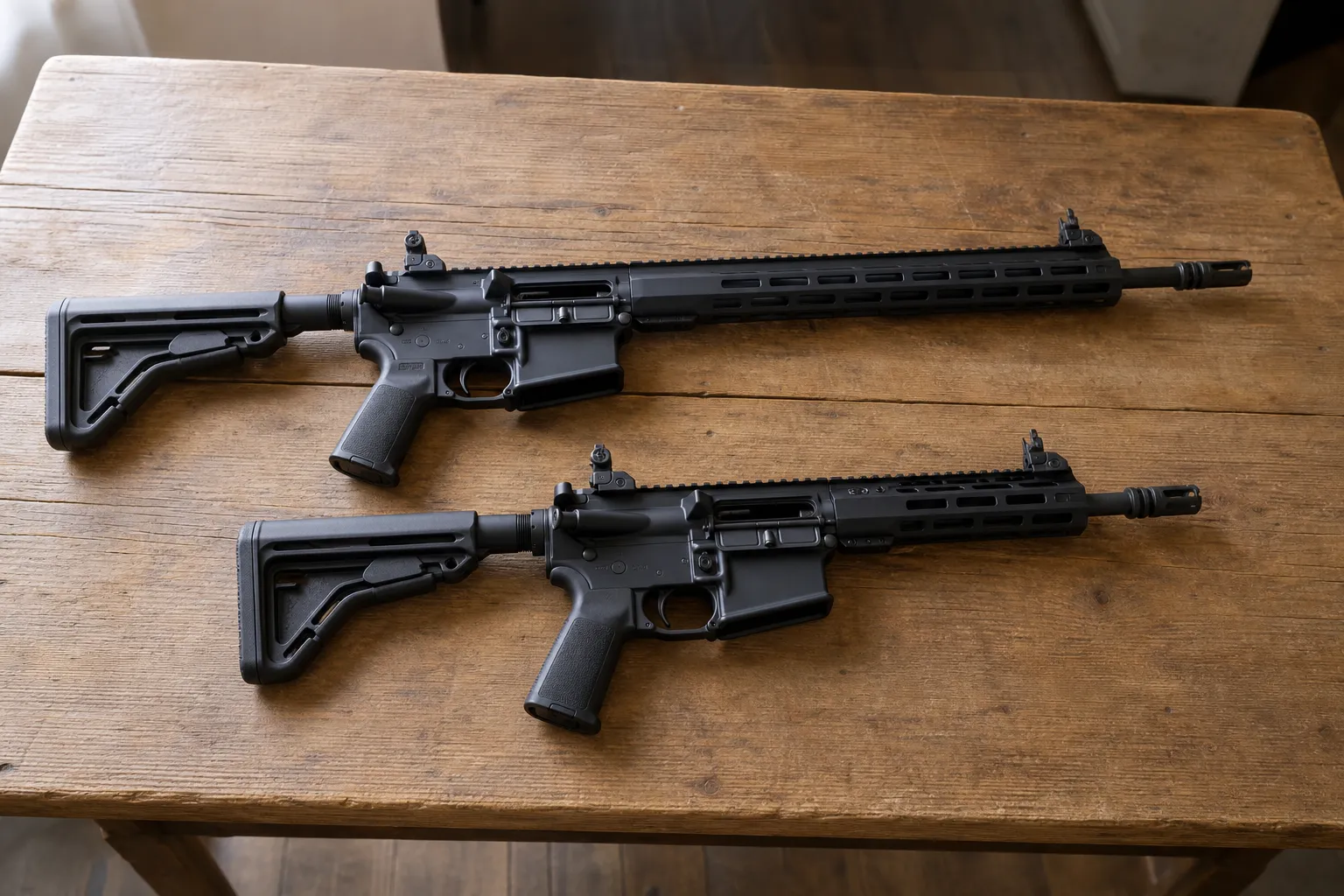
The short answer: an AR-10 is the larger AR-pattern rifle family, while an AR-15 is the smaller one. Cartridge size is one practical difference. SAAMI lists .223 Remington at 2.260 inches maximum overall cartridge length. The other big difference is compatibility: large-frame AR rifles do not have one universal AR-10 parts standard.
AR-10 and AR-15 origins in plain English
The NRA National Firearms Museum describes Eugene Stoner’s AR-10 as the rifle that led to the AR-15 and then to the M16. The museum also states that the AR-10 was originally designed around .30-06 and later modified to accept the 7.62mm NATO cartridge.
The AR-15 came later as a smaller rifle. The NRA National Firearms Museum says that between 1956 and 1959, ArmaLite engineers developed a scaled-down version of the AR-10, with many of the same features. The museum adds that the AR-15 used the same recoil and gas systems as its larger cousin, but in a smaller rifle.
That history is useful because it explains why the two families look related. They are not simply the same rifle in two chamberings. One is a larger pattern, and one is a smaller pattern.
Side-by-side specifications from one maker
Specifications vary by manufacturer and model. A meaningful comparison uses exact product data for the rifles being compared, rather than assuming that every AR-10 or every AR-15 shares the same dimensions.
Cartridge size is the easiest way to understand receiver size
The AR-15 pattern is strongly associated with 5.56x45 NATO and .223 Remington length cartridges. For more detail on that cartridge and chamber topic, see .223 Remington vs 5.56 NATO.
The AR-10 pattern is associated with longer cartridge families, including 7.62x51 NATO and .308 Winchester.
SAAMI’s centerfire rifle ammunition standard lists .223 Remington at 2.260 inches maximum overall cartridge length.
Cartridge dimensions help explain why receiver and magazine sizes differ. A magazine well and receiver sized for .223 Remington length cartridges is not the same as one sized for larger short-action cartridges. Modern large-frame AR rifles are commonly discussed around this short-action length class. For a cartridge comparison involving two common short-action rounds, see 6.5 Creedmoor vs .308 Winchester.
SAAMI Z299.4-2025 states that its centerfire rifle standard provides pressure, velocity and dimensional characteristics for centerfire rifle sporting ammunition. Its role here is dimensional: cartridge lengths are the best simple explanation for why AR-15 and AR-10 receiver and magazine sizes differ.
Magazine differences are not cosmetic
The smaller AR-15 magazine pattern and the larger .308 size magazine pattern are different. Magpul describes the PMAG 30 AR/M4 GEN M3 as a 30 round polymer magazine for AR15/M4 compatible weapons chambered in 5.56x45 NATO or .223 Remington.
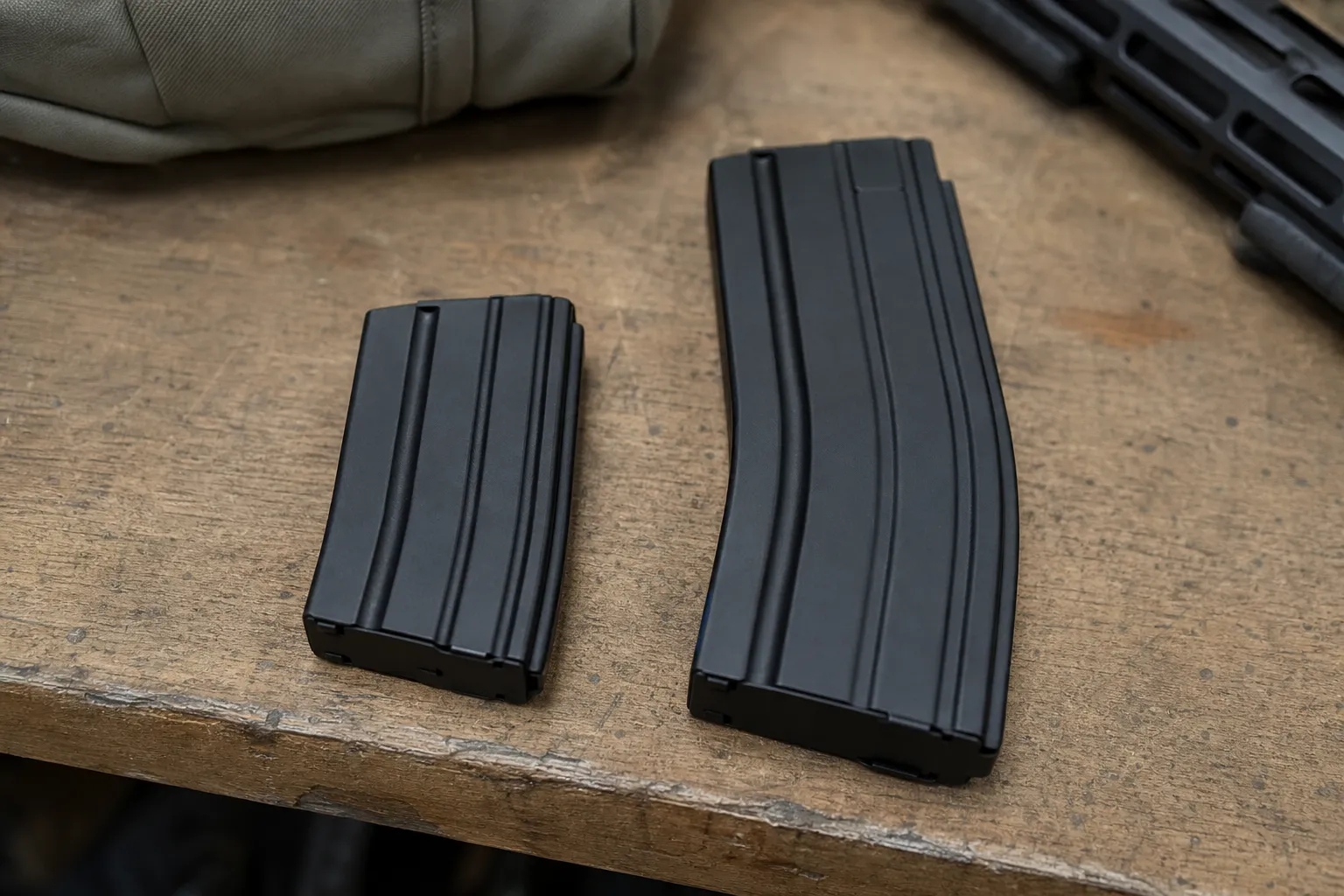
Magpul describes the PMAG 20 LR/SR GEN M3 differently: it is a 20 round 7.62 NATO or .308 Winchester SR-25 form factor magazine. That is a larger cartridge and a different magazine form factor.
The important safety point is that “AR magazine” is not precise enough. Use the magazine type specified by the firearm manufacturer, and confirm it matches the exact firearm and cartridge marking. For terminology background, see clip vs magazine.
Recoil system versus recoil feel
The AR-10 and AR-15 are related designs, and the NRA National Firearms Museum says the AR-15 used the same recoil and gas systems as the AR-10, but in a smaller rifle. That statement is about the operating system relationship, not a claim that the two rifles feel the same when fired.
The useful takeaway is narrower: the AR-10 is the larger pattern used for longer cartridges, and the AR-15 is the smaller pattern used for shorter 5.56x45 NATO and .223 Remington length cartridges.
For a broader explanation of operating systems, see gas-operated rifles.
The biggest compatibility trap: there is no single AR-10 standard
Many readers know the AR-15 world first, where the term “AR-15 compatible” is common in parts descriptions. Large-frame AR rifles require more caution. The market also includes other .308 size AR-pattern systems, and published product data shows that not everything called AR-10, AR308, LR/SR, M5, or .308 AR fits everything else.
Aero Precision gives another example from the AR308 side of the market. Aero says its M5 Enhanced Handguards are patterned to the DPMS High Profile Standard. Aero also says an M5 handguard is specific to the M5 .308/M5E1 platform and is not compatible with the AR15/M4E1 platform.
That does not mean one pattern is better than another. It means the name alone is not enough. Manufacturer compatibility information matters.
Ammunition markings matter more than pattern names
The safe habit is to read the firearm’s cartridge marking and the manufacturer’s manual, not just the platform name.
This matters because “AR-10” may be used in casual speech to mean a large-frame AR, but the firearm itself may be marked for a specific cartridge. The correct cartridge is the one specified by the firearm marking and manufacturer documentation.
For general safety basics, see the basic rules of firearm safety.
Parts substitution caution
This comparison is not a build guide, and it should not be used to choose parts for assembly, conversion, or repair.
The larger lesson of the AR-10 versus AR-15 comparison is that visible family resemblance does not guarantee parts compatibility. The larger receiver set, larger magazines, different magazine families, and maker-specific standards all matter.
If a rifle needs service, the safest route is to follow the manufacturer’s manual and use a qualified armorer or gunsmith where appropriate. Confirm the exact model, cartridge marking, magazine type, and parts compatibility from the manufacturer before use.
Bottom line
The AR-15 is the smaller AR-pattern family associated here with 5.56x45 NATO and .223 Remington length cartridges. The AR-10 is the larger rifle family associated here with longer cartridge families, including 7.62x51 NATO and .308 Winchester, with modern large-frame examples also discussed around cartridges such as 6.5 Creedmoor.
The receiver and magazine differences are not just styling. Cartridge dimensions and magazine form factors help explain why AR-10 and AR-15 receiver and magazine sizes differ.
The most important practical point is compatibility. Aero Precision identifies DPMS High Profile dimensions for certain M5/AR308 handguards. Before using any firearm, confirm the cartridge marking, magazine type, manual, and parts compatibility with the manufacturer’s official information.
Frequently asked questions
Is an AR-10 just a bigger AR-15?
They are related rifle families, but not simply the same rifle in different sizes. The NRA National Firearms Museum says the AR-15 was developed as a scaled-down version of the AR-10, and that it used the same recoil and gas systems in a smaller rifle.
Why is an AR-10 receiver larger than an AR-15 receiver?
The simplest explanation is cartridge size. The AR-15 pattern is associated with 5.56x45 NATO and .223 Remington length cartridges, while large frame patterns use larger receiver and magazine layouts for longer cartridge families.
Do AR-10 and AR-15 magazines interchange?
No. Magpul describes its AR/M4 PMAG as a 5.56x45 NATO/.223 Remington AR15/M4 magazine, while its LR/SR PMAG is a 7.62 NATO/.308 Winchester SR-25 form factor magazine.
Are all AR-10 parts interchangeable?
No. Large frame AR parts should be matched to the exact platform. Aero Precision says its M5 Enhanced Handguards are patterned to the DPMS High Profile Standard and are specific to the M5 .308/M5E1 platform, not the AR15/M4E1 platform.
Sources
- About Us, ArmaLiteOfficial source. Accessed November 21, 2026.
- AR-10 16 inch Tactical Rifle, ArmaLiteOfficial source. Accessed November 21, 2026.
- M-15 16 inch Tactical Rifle V2, ArmaLiteOfficial source. Accessed November 21, 2026.
- Owner’s Manual for AR-10A / AR-10B Rifles and Carbines, ArmaLiteOfficial source. Accessed November 21, 2026.
- Owner’s Manual for M-15 Rifles and Carbines, ArmaLiteOfficial source. Accessed November 21, 2026.
- SAAMI Z299.4-2025, Voluntary Industry Performance Standards for Pressure and Velocity of Centerfire Rifle Ammunition, Sporting Arms and Ammunition Manufacturers’ InstituteOfficial source. Accessed November 21, 2026.
- PMAG 30 AR/M4 GEN M3, Magpul IndustriesOfficial source. Accessed November 21, 2026.
- PMAG 20 LR/SR GEN M3, 7.62x51, Magpul IndustriesOfficial source. Accessed November 21, 2026.
- Handguard Lengths, M5/AR308, Aero PrecisionOfficial source. Accessed November 21, 2026.
- M5 15 inch Enhanced M-LOK Handguard, Gen 2, Aero PrecisionOfficial source. Accessed November 21, 2026.
- Armalite AR-10 Semi-Automatic Rifle, NRA National Firearms Museum. Accessed November 21, 2026.