Short-Action vs Long-Action Rifles: Cartridge Length and Receiver Size
Short action and long action describe rifle receiver and bolt length categories, not cartridge power. Cartridge overall length is the main driver, so shorter cartridges generally need less receiver room and bolt travel than longer cartridges.
By RaiS. Reviewed by RaiS. Published . 5 min read.
Research and drafting were assisted by AI. RaiS checked the facts against the sources below and approved this page.
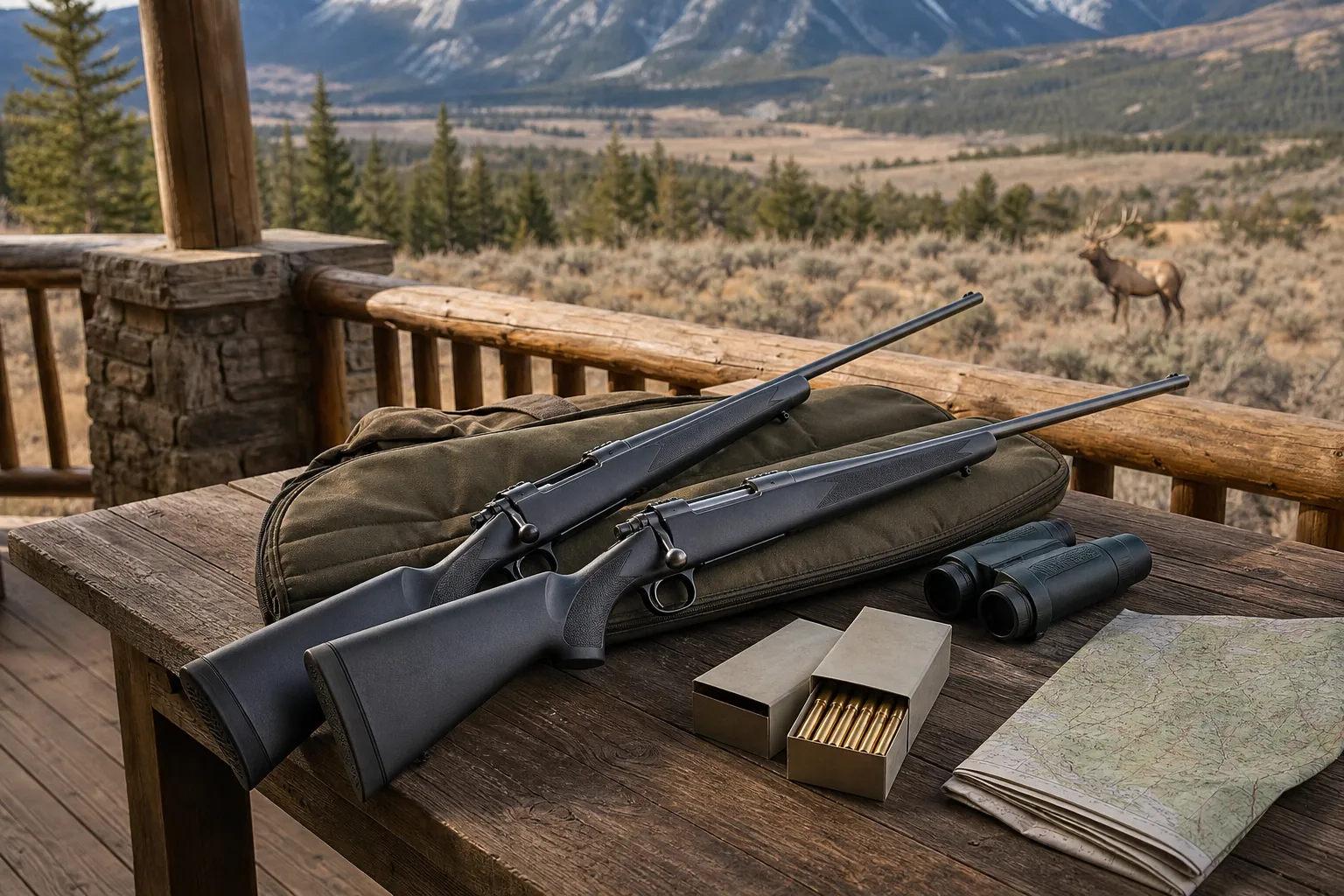
Short action and long action describe the size of a rifle action, especially the receiver length and bolt length in many bolt-action rifles. They are mainly about fitting, feeding and cycling cartridges of different overall lengths, not about whether a cartridge is automatically more powerful, more accurate or better for hunting.
SAAMI defines an action as the receiver or frame together with the parts that load, fire and unload the firearm. In a turnbolt rifle, SAAMI describes the bolt as being unlocked by rotating the bolt handle upward, pulled rearward, then closed and rotated downward to lock. That rearward and forward bolt movement is where cartridge length starts to matter.
What short action and long action mean
The National Shooting Sports Foundation’s Let’s Go Shooting reference explains that “long action” and “short action” refer to two related dimensions: the length of the rifle’s receiver and the length dimension of the bolt. Savage Arms gives the same basic explanation, stating that the main difference between short-action and long-action firearms is receiver length.
In plain terms, a short-action rifle is built around shorter cartridges. A long-action rifle is built around longer cartridges. In many common bolt rifles, that means the longer cartridge needs more room in the magazine area, more room in the receiver opening and more bolt travel to move the cartridge into and out of the chamber.
If you are new to the parts involved, the action, receiver, barrel, stock and magazine are covered in parts of a rifle. For the operating cycle itself, see bolt-action rifles.
Cartridge overall length is the main driver
The simplest way to understand action length is to compare cartridge overall length, which SAAMI lists from the case head to the bullet tip in its centerfire rifle standard. Short-action examples are commonly around 2.8 inches maximum overall length. Long-action examples are commonly around 3.34 inches maximum overall length. Some magnum-length cartridges are longer still.
Cartridge names can be misleading. A cartridge is not long action only because its name includes “magnum.”
The same point works the other way too. A long-action cartridge is not defined only by being called “magnum.” Savage lists .30-06 Springfield as a common long-action cartridge, along with .300 Winchester Magnum and similar cartridges. For a closer look at one of the classic long-action examples, see .30-06 Springfield. For a direct comparison of two common .30-caliber families, see .308 Winchester vs .30-06 Springfield.
Receiver length, bolt travel and magazine fit
A longer cartridge needs a rifle that gives it enough room to sit in the magazine, rise into feeding position, enter the chamber and eject through the receiver opening. In a conventional turnbolt layout, the bolt also has to travel far enough rearward to clear the cartridge.
Savage describes long-action rifles as using a longer receiver to accommodate longer cartridges. Savage describes short-action rifles as using a shorter receiver for shorter cartridges. As examples, Savage gives .223 Remington as a shorter cartridge used in short-action firearms, and .25-06 Remington.270 Winchester and .30-06 Springfield as longer cartridges used in long-action firearms.
Manufacturer catalogs often turn this idea into specific dimensional limits.
Common short-action examples
The .308 Winchester is often used as an example when explaining short-action rifles.
The .243 Winchester is another shorter centerfire rifle cartridge often discussed in this context, and ProjectGuns covers it separately in .243 Winchester.
The 6.5 Creedmoor is another common modern comparison point in short-action discussions. For more on that cartridge family, see the 6.5 Creedmoor guide or the direct 6.5 Creedmoor vs .308 Winchester comparison.
Common long-action and magnum-length examples
Savage gives .30-06 Springfield as a longer cartridge used in long-action firearms.
Savage also lists .300 Winchester Magnum as a common long-action cartridge. ProjectGuns covers that cartridge separately in .300 Winchester Magnum.
Some cartridges are longer than the usual 3.34 inch long-action examples. The National Shooting Sports Foundation’s Let’s Go Shooting reference states that magnum-length actions are reserved for the longest cartridges, giving examples such as .375 H&H Magnum.416 Rigby and .300 Remington Ultra Magnum.
Fit, weight and cycling differences
Savage says short-action rifles are generally lighter and more compact than long-action rifles. Savage also says the shorter bolt travel in short-action rifles can result in faster cycling.
Those are general tendencies, not promises that every short-action rifle will be lighter or faster to run than every long-action rifle. Ruger’s older official American Rifle specifications show how small the difference can be inside one product family: the .30-06 Springfield model 6901 was listed with a 22 inch barrel, 42.50 inch overall length and 6.2 pound weight, while the .308 Winchester model 6903 was listed with the same barrel length, 42 inch overall length and 6.1 pound weight.
That example is useful because it keeps the difference in perspective. Action length matters, but a rifle’s final size and weight also depend on the exact model specification. The safe way to compare rifles is to read the maker’s specification sheet for the exact chambering and model.
Exceptions and why manufacturer specs matter
Action-length language is not perfectly universal. Savage’s 2024 action-length article gives a clear exception: all Savage Axis receivers are the same length regardless of caliber. Savage says Axis rifles differ by magazine well size, with longer magazine wells for cartridges such as .30-06 or .270 Winchester and shorter magazine wells for cartridges such as .308 Winchester and .223 Remington.
That means “short action” and “long action” are useful categories, but they are not a substitute for the manufacturer’s parts and compatibility information. This is especially important for scope bases, magazines, stocks and chassis systems, because those parts often depend on the exact receiver pattern and magazine arrangement.
A simple way to think about it
Short action and long action are best understood as packaging terms. The cartridge has a certain maximum overall length. The rifle needs a receiver, bolt travel distance and magazine system that fit that cartridge.
For many new buyers and hunters, familiar examples often used in action-length discussions include .308 Winchester, 6.5 Creedmoor.30-06 Springfield and .300 Winchester Magnum. The longest examples, such as .300 Remington Ultra Magnum.375 Holland & Holland Magnum and .416 Rigby, may require magnum-length action categories depending on the rifle maker’s design.
Before choosing bases, magazines, stocks or a chassis, check the current specification sheet from the rifle maker for the exact model and chambering. Also confirm the cartridge dimensions in SAAMI materials when comparing cartridge families, because action-length labels are shorthand, not a universal standard.
Frequently asked questions
Is 6.5 Creedmoor a short-action cartridge?
It is commonly discussed in the short-action-length group.
Is .30-06 Springfield long action?
Savage gives .30-06 Springfield as an example of a longer cartridge used in long-action firearms.
Does “magnum” always mean long action?
No. Action length depends on cartridge overall length and rifle design, not the word “magnum.”
Are all rifles from the same brand divided into separate short and long receivers?
No. Savage says all Axis receivers are the same length regardless of caliber, while the magazine well changes by caliber.
Why does bolt travel matter?
In a turnbolt rifle, the bolt must move far enough rearward to handle the cartridge. Longer cartridges generally need more bolt travel and receiver room than shorter cartridges.
Sources
- SAAMI Glossary: Action, Sporting Arms and Ammunition Manufacturers' InstituteOfficial source. Accessed November 27, 2026.
- SAAMI Glossary: Turnbolt Action, Sporting Arms and Ammunition Manufacturers' InstituteOfficial source. Accessed November 27, 2026.
- SAAMI Z299.4 2025 Centerfire Rifle Voluntary Performance Standards, Sporting Arms and Ammunition Manufacturers' InstituteOfficial source. Accessed November 27, 2026.
- What is the difference between a short action and long action?, Savage ArmsOfficial source. Accessed November 27, 2026.
- Savage Action Lengths: Long Action vs Short Action, Savage ArmsOfficial source. Accessed November 27, 2026.
- 2006 Winchester Repeating Arms Catalog, Winchester Repeating ArmsOfficial source. Accessed November 27, 2026.
- Ruger Firearms Catalog, Ruger American Rifle Specifications, Sturm, Ruger & Co.Official source. Accessed November 27, 2026.
- Shooting Vocabulary: Long-Action Bolt Rifles versus Short-Action Bolt Rifles, Let's Go Shooting, National Shooting Sports Foundation. Accessed November 27, 2026.
- How Do Guns Work? Bolt-Actions, NRA Family. Accessed November 27, 2026.
- Ruger American Rifle Models. Accessed November 27, 2026.