Single-Pin vs Multi-Pin Bow Sights: What Is the Difference?
Multi-pin bow sights keep several fixed aiming references ready for set distances, while single-pin sights use one adjustable aiming reference, usually with a sight tape or yardage indicator. For bowhunters, the main trade-off is a ready set of preset pins versus a cleaner sight picture and a pin that can be adjusted to a measured distance.
By RaiS. Reviewed by RaiS. Published . 7 min read.
Research and drafting were assisted by AI. RaiS checked the facts against the sources below and approved this page.
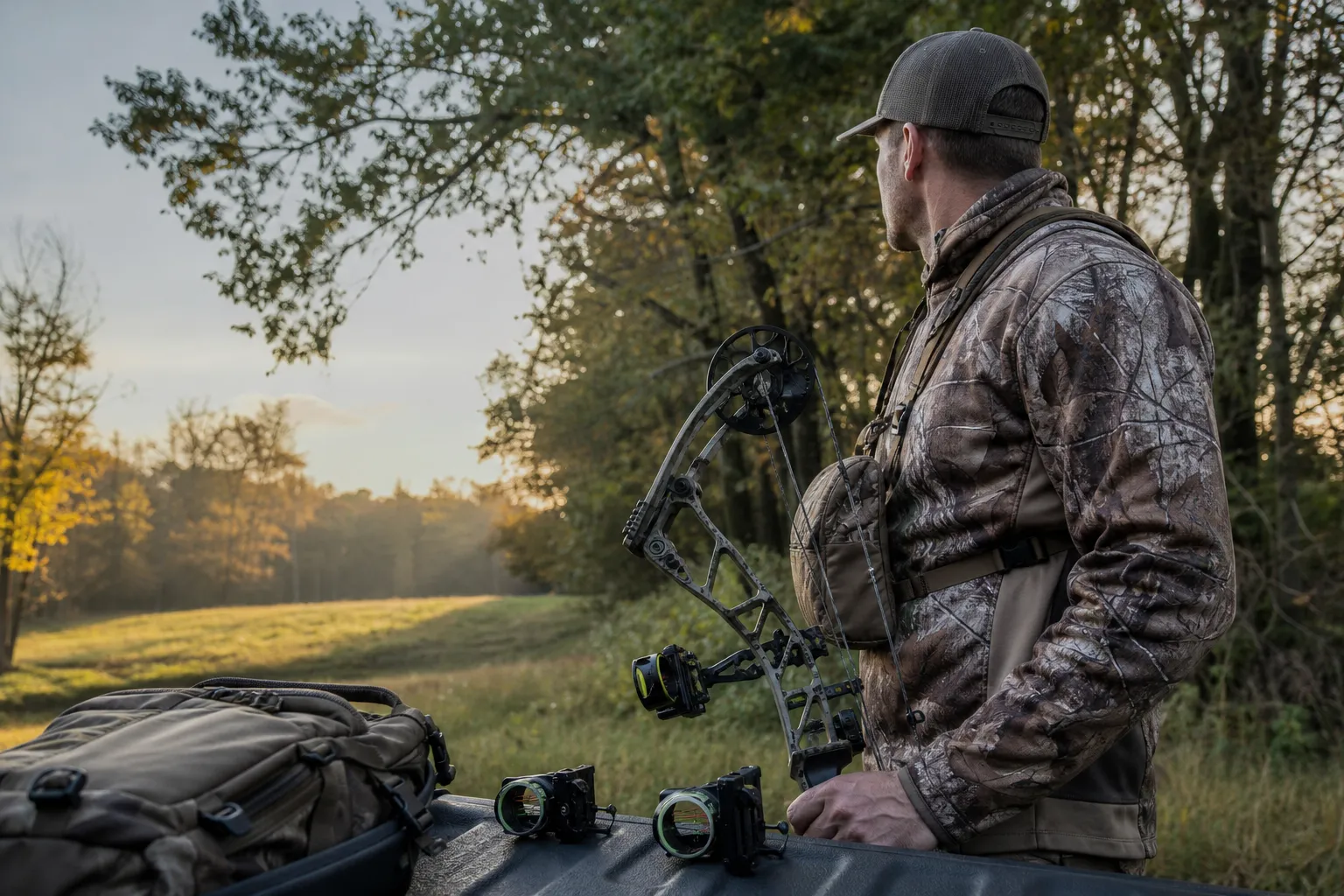
A multi-pin bow sight uses several fixed pins that are set for different distances and then locked in place. A single-pin bow sight uses one adjustable pin, often with a sight tape or yardage indicator, so the archer can move the sight to a distance mark. The practical difference for bowhunters is speed versus adjustment: a fixed multi-pin sight keeps several aiming references ready, while a single-pin slider gives one clear aiming reference but may need to be reset if the animal moves.
Bowhunter Ed describes a peep-and-pin system as one where the archer centers the pin in the peep while holding on the target. This comparison is about how the front sight layout changes what the archer sees and adjusts on a compound bow.
The basic layout
Archery 360 describes the sight housing as the round part at the front of a compound-bow sight. That housing may contain one sight pin, several pins, or, in some setups, a lens with a dot. In this comparison, the two common hunting layouts are fixed multi-pin and adjustable single-pin.
A fixed multi-pin sight has several aiming references. Archery 360 says the archer sets the pins at different distances and locks them in place. It gives 20, 30, 40, and 50 yards as an example of a four-pin layout.
A single-pin sight has one adjustable pin. Archery 360 describes this as one pin that is adjustable, with sight tape that includes distance markings. Archery 360 also calls a one-pin sight used for multiple distances a “slider” sight.
Trophy Ridge also separates React sight-in instructions into single-pin sights with yardage indicators and multi-pin sights. For this article, “single-pin” means one adjustable aiming reference, and “multi-pin” means several fixed aiming references.
Quick comparison
| Feature | Fixed multi-pin sight | Adjustable single-pin sight |
|---|---|---|
| Aiming references | Several pins set for different distances | One pin adjusted for distance |
| Setup position | Archery 360 says pin positions are fixed after setup | Archery 360 describes one adjustable pin |
| Yardage system | Pins are sighted for chosen distances, such as 20, 30, 40, and 50 yards | Uses a sight tape or yardage indicator |
| Sight picture | More pins appear in the housing | One pin appears in the housing |
| Between marked distances | Archery 360 explains that the target may be framed between two fixed pins | The archer can move the sight to the marked yardage, if there is time |
| Hunting movement issue | Common close distances can be covered without moving the sight | Archery 360 warns that if game moves after the sight is set, the archer may need to reset the sight or estimate the hold |
Sight picture: one pin or several pins
The most visible difference is inside the housing. A multi-pin sight places several pins in the sight picture. A single-pin sight places one adjustable pin in the sight picture.
Archery 360 notes that pin size affects what the archer sees: larger pins are easier to see but cover more of the target. That point applies to either layout, but the overall view is different because a multi-pin sight shows more than one aiming reference at once.
For a bowhunter, this is the simple visual trade-off. A multi-pin sight gives several fixed references inside the housing. A single-pin sight gives one reference, which can make the aiming reference less crowded, but that one reference has to match the distance setting or be held above or below the target as needed.
Known-distance shooting
Both sight types can be used with known distances, but they handle those distances differently.
With a fixed multi-pin sight, each pin is assigned a distance during setup. Archery 360 gives a four-pin example of 20, 30, 40, and 50 yards. Archery 360 also says the top pin is generally used for the closest distance and the bottom pin for the farthest distance.
With a single-pin sight, the pin is adjusted to a distance mark. Archery 360 says single-pin users add sight tape with distance markings. Archery 360 describes sight tapes as containing distance numbers and being applied to the bow sight.
Trophy Ridge’s React single-pin procedure also uses yardage indicators. Trophy Ridge says its single-pin procedure starts by sighting in the 20-yard pin and then zeroing a 30-yard or 40-yard mark. After two marks are sighted in, Trophy Ridge says the pointer is lined up with the corresponding yardage indicator.
Pin gap: what happens between fixed pins
Pin gap is the space between fixed pins when the target distance falls between the yardages assigned to those pins. Archery 360 explains the idea by saying that targets between fixed-pin distances require framing the target between two sight pins.
For example, if a multi-pin sight is set with fixed distances like the 20, 30, 40, and 50 yard example used by Archery 360, a distance between two of those marks does not have its own fixed pin. The archer is using the space between the two pins as the aiming reference.
A single-pin sight approaches the same problem differently. Instead of choosing between fixed pins or framing between them, the archer can move the one pin to the distance mark on the sight tape or yardage indicator, if there is time and the setup has been calibrated for that bow.
Slider, sight tape, housing, windage, and elevation
These terms come up often when comparing single-pin and multi-pin sights.
Housing means the round front sight body. Archery 360 describes it as the round housing at the end of a compound-bow sight. It can hold a single pin, multiple pins, or a lens with a dot.
Slider means a moveable single-pin sight setup. Archery 360 refers to a one-pin “slider” sight used for multiple distances, and says it needs a sight tape.
Sight tape is the distance-number scale applied to the sight. Archery 360 says sight tapes contain distance numbers and are applied to the bow sight. Archery 360 also says sight tapes vary with arrow speed and weight and must be calibrated to the bow setup.
Yardage indicator is a term used by Trophy Ridge for single-pin sights in its React sight-in instructions. Trophy Ridge says the pointer is lined up with the corresponding yardage indicator after two marks are sighted in.
Pin gap means aiming between fixed pins when the target distance falls between the sighted-in yardages. Archery 360 describes this as framing the target between two sight pins.
Windage is the left and right sight adjustment. Archery 360 defines windage adjustment as moving the pin left or right.
Elevation is the up and down sight adjustment. Archery 360 defines elevation adjustment as sliding the pin up or down.
Hunting movement and time to adjust
Archery 360 says a fixed multi-pin sight can be attractive to bowhunters because it gives aiming references that do not need to be moved when game is close. That is the main hunting advantage of the fixed layout: the pins are already in place for the distances chosen during setup.
The single-pin trade-off is different. Archery 360 says a single-pin sight gives one adjustable pin and uses sight tape with distance markings. That can match a measured distance, but Archery 360 warns that if game moves after a single-pin sight is set, the archer may need to reset the sight or estimate the hold.
This is why the comparison is not simply “better” or “worse.” It is about what happens during the shot. A fixed multi-pin sight keeps multiple references available without moving the sight. A single-pin sight keeps one aiming reference in view and can be adjusted to the marked distance, but the distance setting matters if the target changes position.
How the two systems are adjusted
Archery 360 says a multi-pin sight allows movement of the housing as well as individual pins. Mathews describes its Bridge-Lock Fixed 5-Pin Sight as a fixed five-pin sight with micro-adjustable windage, elevation, and individual pins, and lists individual micro-adjustable pins as a feature.
For a single-pin slider, Archery 360 says a sight tape is needed when one pin is used for multiple distances. For a factory-printed sight tape, Archery 360 says the archer first sights in at 20 and 40 yards to match the proper tape. Archery 360 also says the correct sight tape accounts for arrow weight and flight speed.
That arrow-specific point matters because sight tape is not just a decoration on the sight. Archery 360 says sight tapes vary with arrow speed and weight and must be calibrated to the bow setup. For arrow setup basics, see Arrow Spine Chart Explained and Parts of an Arrow.
Which one fits which bowhunter?
Choose the layout by matching it to the way you want the sight to work.
A fixed multi-pin sight fits the archer who wants several preset references visible in the housing. Archery 360’s example of 20, 30, 40, and 50 yards shows the basic idea: the archer has a set of fixed distances already represented by pins. The trade-off is that distances between those pins require using the gap between them.
An adjustable single-pin sight fits the archer who wants one aiming reference and a yardage system. Archery 360 describes the single-pin layout as one adjustable pin with sight tape markings. The trade-off is that the sight setting may need to change when the target distance changes.
Neither layout removes the need to understand the rest of the shot process. Bowhunter Ed describes aiming with sights as centering the pin in the peep while holding on the target. For more on the archer’s form side of that process, see How to Draw a Bow and Peep Sight (Archery).
Bottom line
A fixed multi-pin sight gives several locked-in aiming references for selected distances. An adjustable single-pin sight gives one aiming reference that can be moved to a distance mark on a sight tape or yardage indicator.
Before choosing or setting up either style, check the current manual for the exact sight, the manufacturer’s setup instructions, and any bowhunter education guidance that applies to your equipment. Confirm how that sight’s windage, elevation, pins, pointer, and sight tape are intended to be adjusted before using it in the field.
Frequently asked questions
What is the main difference between a single-pin and multi-pin bow sight?
A multi-pin sight uses several fixed aiming references set for different distances and locked in place. A single-pin sight uses one adjustable aiming reference, usually with a sight tape or yardage indicator.
What is a slider bow sight?
Archery 360 refers to a one-pin “slider” sight as a sight used for multiple distances that needs a sight tape. In this layout, the pin or sight position is adjusted to match the distance mark.
What does pin gap mean?
Pin gap means using the space between fixed pins when the target distance falls between the sighted-in yardages. Archery 360 describes this as framing the target between two sight pins.
Why do some bowhunters like fixed multi-pin sights?
Archery 360 says fixed multi-pin sights can appeal to bowhunters because they provide aiming references that do not need to be moved when game is close.
What is the drawback of a single-pin sight for hunting?
Archery 360 warns that if game moves after a single-pin sight is set, the archer may need to reset the sight or estimate the hold.
What is a sight tape?
Archery 360 describes sight tapes as distance-number scales applied to the bow sight. It also says sight tapes vary with arrow speed and weight and must be calibrated to the bow setup.
Sources
- Bowhunter Education, National Bowhunter Education Foundation / IHEA-USAOfficial source. Accessed November 5, 2026.
- Aiming With Sights, Bowhunter Ed / NBEF Bowhunter Safety CourseOfficial source. Accessed November 5, 2026.
- Types of Compound Bow Sights, Archery 360. Accessed November 5, 2026.
- How to Adjust Your Bow Sight, Archery 360. Accessed November 5, 2026.
- 3D Archery Primer, Archery 360. Accessed November 5, 2026.
- Optimizer Lite X, HHA SportsOfficial source. Accessed November 5, 2026.
- HHA Sports 2025 Product Catalog, HHA SportsOfficial source. Accessed November 5, 2026.
- How to Sight in Trophy Ridge React Bow Sights, Trophy Ridge / Bear ArcheryOfficial source. Accessed November 5, 2026.
- Bridge-Lock Fixed 5-Pin Sight, Mathews ArcheryOfficial source. Accessed November 5, 2026.