Crossbow Draw Weight and Speed Ratings Explained
Crossbow speed ratings depend on more than draw weight. Power stroke, arrow weight, nock type, manufacturer testing methods and the owner’s manual all matter.
By RaiS. Reviewed by RaiS. Published . 7 min read.
Research and drafting were assisted by AI. RaiS checked the facts against the sources below and approved this page.
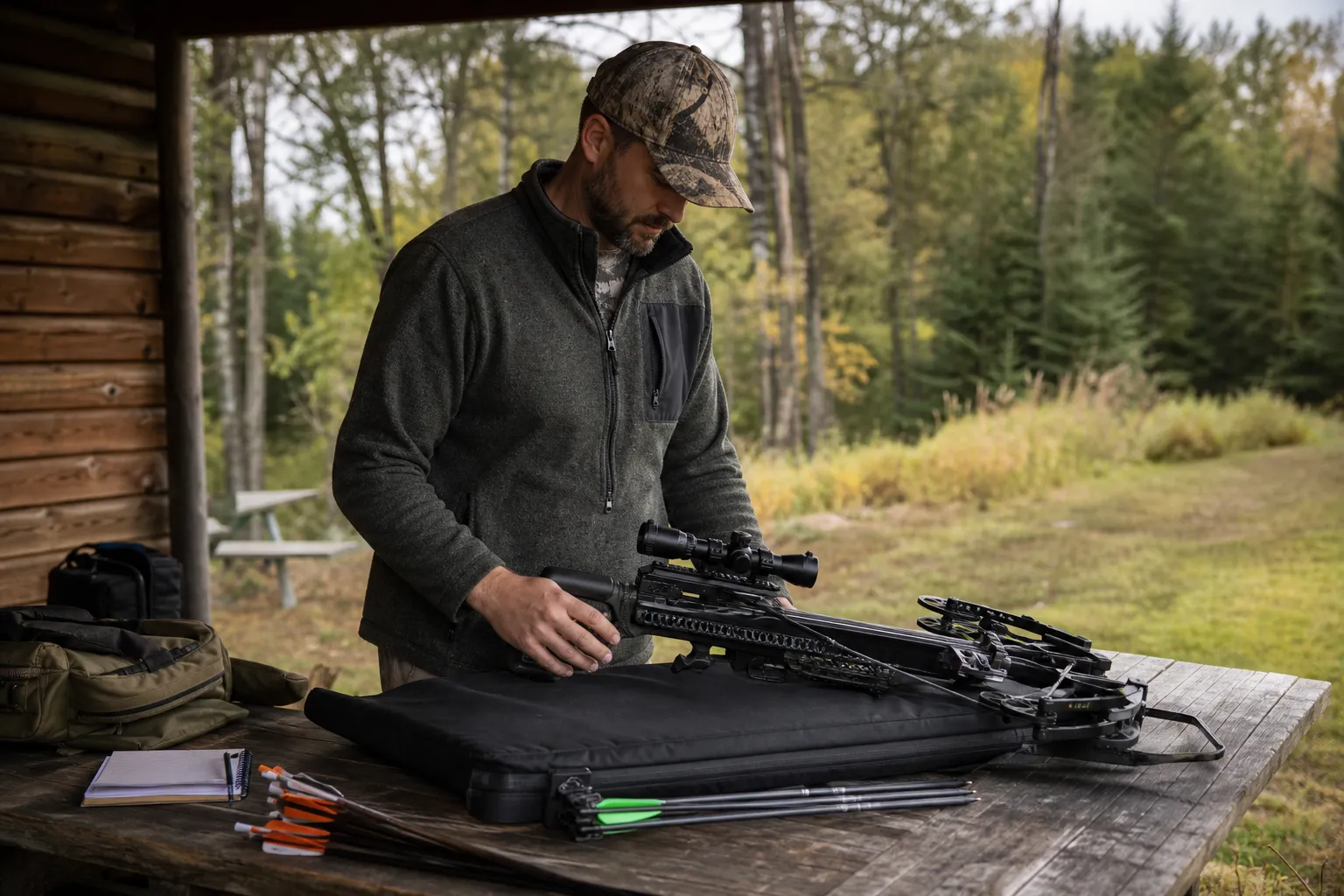
Crossbow draw weight is the force needed to cock the crossbow, but it does not tell the whole performance story by itself. To compare crossbows, look at draw weight, power stroke, arrow weight, advertised FPS and kinetic energy together, then check the owner’s manual for the exact bolts or arrows the maker approves.
What crossbow draw weight means
Barnett defines draw weight as the amount of force, measured in pounds, needed to cock a crossbow. In plain language, it is the resistance you feel when pulling the string back into the cocked position.
That number matters because Alaska Bowhunter Safety Course notes that modern crossbows have heavy draw weights, and that the limbs and strings are under heavy tension. Nebraska Bowhunter Safety Course also says heavier modern draw weights have made cocking more challenging, which is why cocking aids have become more important.
Nebraska Bowhunter Safety Course recommends using a cocking device for safety. It also says cocking devices help keep the string centered and help protect fingers from getting pinched.
Draw weight is not the same thing as arrow speed. A higher draw weight may be part of a faster crossbow design, but the speed number also depends on the crossbow’s power stroke, arrow weight and the way the manufacturer measures the rating.
Power stroke: why the string travel matters
Barnett defines power stroke as the distance the string travels from its resting position to the fully cocked position. That travel distance is one reason two crossbows with different layouts can have different speed ratings even if a buyer is mainly focused on draw weight.
Nebraska Hunter Safety Course states that crossbows have a shorter power stroke than conventional compound bows. It also states that, to produce the same arrow speeds as a conventional compound bow, a crossbow must have more than twice the draw weight of a compound bow and must have much heavier limbs.
That is the key point for new users comparing a crossbow and compound bow: the numbers are not directly interchangeable. A crossbow stores and releases energy in a different format, with a shorter string travel distance, so draw weight does not compare one for one with the draw weight of a vertical bow.
Excalibur’s 2026 quick reference guide shows how manufacturers often list performance as a group of connected specifications. Its table includes cocking effort, draw length, velocity, arrow model and length, and minimum arrow weight. One example in that guide lists the Excalibur Hybrid X at 435 FPS with an 11.3 inch draw length and a 400 grain minimum arrow weight.
FPS: what the advertised speed number means
Barnett defines FPS as feet per second, the unit used to state crossbow shooting speed. A crossbow advertised at a given FPS is being described by arrow speed, not by draw weight alone.
The important caution is that advertised FPS depends on how the test is done. Barnett’s 2023 universal owner’s manual states that the crossbow industry does not have a universal set of standards for calculating advertised arrow speeds. The same manual says manufacturers use various arrow weights to calculate speeds, with listed weights ranging from 380 grains to 400 grains.
That means one company’s speed rating may not be measured with the exact same arrow weight as another company’s rating. It also means a speed number is most useful when you know the arrow weight used to produce it.
An advertised FPS number is best read with the arrow weight used to produce it.
Arrow weight and finished arrow weight
Gold Tip defines total arrow weight as the complete finished arrow, including the shaft, nock, insert, point and fletching. For a crossbow user, that means the number is not just the bare shaft.
This matters because crossbow manuals set minimum arrow requirements. Nebraska Hunter Safety Course says a crossbow arrow, also called a bolt, must meet the specific arrow size requirements for that crossbow, and that minimum arrow size, weight and length are given in the owner’s manual.
The words bolt and arrow are often used together in crossbow education materials. For a closer look at the safety and parts differences, see crossbow bolts vs arrows. For the basic parts included in a finished arrow, see parts of an arrow.
Arrow stiffness also matters. Barnett’s 2023 universal owner’s manual warns users not to use improperly spined, improperly weighted or improperly sized arrows. In that manual, arrows under 380 grains are listed as improperly weighted. For general background on stiffness terminology, see arrow spine charts.
Kinetic energy: how the number is calculated
Kinetic energy is commonly shown as a calculated value based on total arrow weight and speed. Gold Tip gives the formula as:
KE = (arrow weight × speed²) ÷ 450,240
Gold Tip also says a chronograph reading is the most accurate speed input for calculating a setup’s kinetic energy.
Because speed is squared in that formula, a change in measured FPS can change the calculated energy number. Because arrow weight is also part of the formula, a heavier arrow can produce a different kinetic energy value even at the same speed.
Barnett’s arrow speed appendix shows this clearly. At 400 FPS, Barnett lists 135 foot pounds with a 380 grain arrow and 142 foot pounds with a 400 grain arrow.
The takeaway is simple: do not compare kinetic energy claims unless you also know the arrow weight and speed used for the calculation.
Why speed ratings are not the whole story
Nebraska Hunter Safety Course describes the crossbow as a short range hunting tool that shoots shorter arrows. That framing is useful for new buyers because a crossbow is not just a speed number on a box.
A speed rating can help you compare one setup to another, but it should not be treated as the only specification that matters. Manufacturer materials show that power stroke, cocking effort, draw length, arrow model, arrow length and minimum arrow weight are connected parts of the same system.
For example, Excalibur’s quick reference guide does not list velocity in isolation. It places velocity alongside cocking effort, draw length, arrow model and length, and minimum arrow weight. Barnett states that there is no universal industry standard for advertised arrow speeds.
For a new user, that means the best comparison is not simply “which one has the highest FPS?” A better question is: “Which crossbow, with which approved arrow, produces this rating?”
Safety: use only manufacturer approved arrows
Alaska Bowhunter Safety Course says it is extremely important to read and understand the owner’s manual before assembling or using a crossbow. That advice belongs at the start of any discussion about draw weight, speed and arrows.
Barnett defines a dry fire as releasing a cocked crossbow string without a properly weighted arrow installed, and calls it extremely dangerous. Barnett also says this can seriously damage the crossbow.
Excalibur’s 2026 owner’s manual states that all models have a 350 grain minimum total arrow weight. That is a different manufacturer requirement, which is exactly why users should not assume one crossbow’s minimum arrow weight applies to another.
Nocks are also a safety issue. Barnett’s manual says attempting to fire a crossbow with incorrect arrow nocks, non regulation nocks or damaged nocks will result in a dry fire.
Barnett’s manual also requires arrows designed for crossbows that are the appropriate weight and length. It warns against using compound, vertical bow or recurve bow arrows in a Barnett crossbow.
A simple way to compare crossbow specs
When you are comparing two crossbows, read the numbers in this order:
- Draw weight: how much force is needed to cock the crossbow, as Barnett defines it.
- Power stroke or draw length: how far the string travels from rest to the cocked position, or the manufacturer’s listed draw length.
- Advertised FPS: the arrow speed in feet per second, remembering Barnett’s warning that there is no universal industry standard for advertised speeds.
- Test arrow weight: the arrow weight used for the rating, if the manufacturer lists it.
- Kinetic energy: the calculated value from arrow weight and speed.
- Minimum approved arrow: the owner’s manual requirement for weight, length, size, nock type and crossbow compatibility.
This approach keeps the numbers connected. It also keeps safety in the same conversation as performance.
Bottom line
Crossbow draw weight tells you how much force is needed to cock the bow. Power stroke tells you how far the string travels. FPS tells you the measured arrow speed. Kinetic energy is calculated from arrow weight and speed.
None of those numbers should be read alone. Barnett says the industry does not use a universal standard for advertised arrow speeds. Manufacturer manuals also make clear that arrow weight, length, spine, nock type and damage inspection are safety concerns, not just tuning details.
Before using a crossbow, check the current owner’s manual for that exact model. Before hunting, confirm current equipment and season rules with the appropriate wildlife agency for the place you plan to hunt.
Frequently asked questions
What does crossbow draw weight mean?
Barnett defines draw weight as the force, measured in pounds, needed to cock the crossbow.
Does a higher draw weight always mean a faster crossbow?
Not by itself. Speed also depends on power stroke, arrow weight and the manufacturer’s testing method. Barnett states that the industry does not have a universal standard for advertised arrow speeds.
What is power stroke on a crossbow?
Barnett defines power stroke as the distance the string travels from its resting position to the fully cocked position.
Why can the same crossbow have different FPS numbers?
FPS ratings depend on the arrow weight and testing method used, so a rating is most useful when the test arrow weight is known.
How is crossbow kinetic energy calculated?
Gold Tip gives the formula as KE = (arrow weight × speed²) ÷ 450,240, using arrow weight in grains and speed in FPS.
Why should I use only manufacturer approved crossbow arrows?
Manufacturer manuals treat arrow weight, length, spine and nock type as safety requirements. Barnett warns that incorrect or damaged nocks can result in a dry fire.
Sources
- Glossary, Barnett OutdoorsOfficial source. Accessed November 20, 2026.
- Crossbow Owner’s Manual, Barnett OutdoorsOfficial source. Accessed November 20, 2026.
- What You Learned, Nebraska Hunter Safety Course, Hunter Ed. Accessed November 20, 2026.
- The Need for Cocking Aids, Nebraska Bowhunter Safety Course, Bowhunter Ed. Accessed November 20, 2026.
- Before You Begin, Alaska Bowhunter Safety Course, Bowhunter Ed. Accessed November 20, 2026.
- Kinetic Energy Calculator, Gold Tip ArrowsOfficial source. Accessed November 20, 2026.
- Owner’s Manual, TenPoint Crossbow TechnologiesOfficial source. Accessed November 20, 2026.
- TX Ultra 26.5, TenPoint Crossbow TechnologiesOfficial source. Accessed November 20, 2026.
- Owner’s Manual, Excalibur CrossbowOfficial source. Accessed November 20, 2026.
- 2026 Quick Reference Guide, Excalibur CrossbowOfficial source. Accessed November 20, 2026.