Longbow vs Recurve Bow: Shape, Performance and Traditional Use
Longbows and recurves are best separated by limb shape and string contact. Recurve geometry can store more energy for a given draw weight and draw length, while longbows keep the simpler traditional shape and have limited string contact.
By RaiS. Reviewed by RaiS. Published . 8 min read.
Research and drafting were assisted by AI. RaiS checked the facts against the sources below and approved this page.
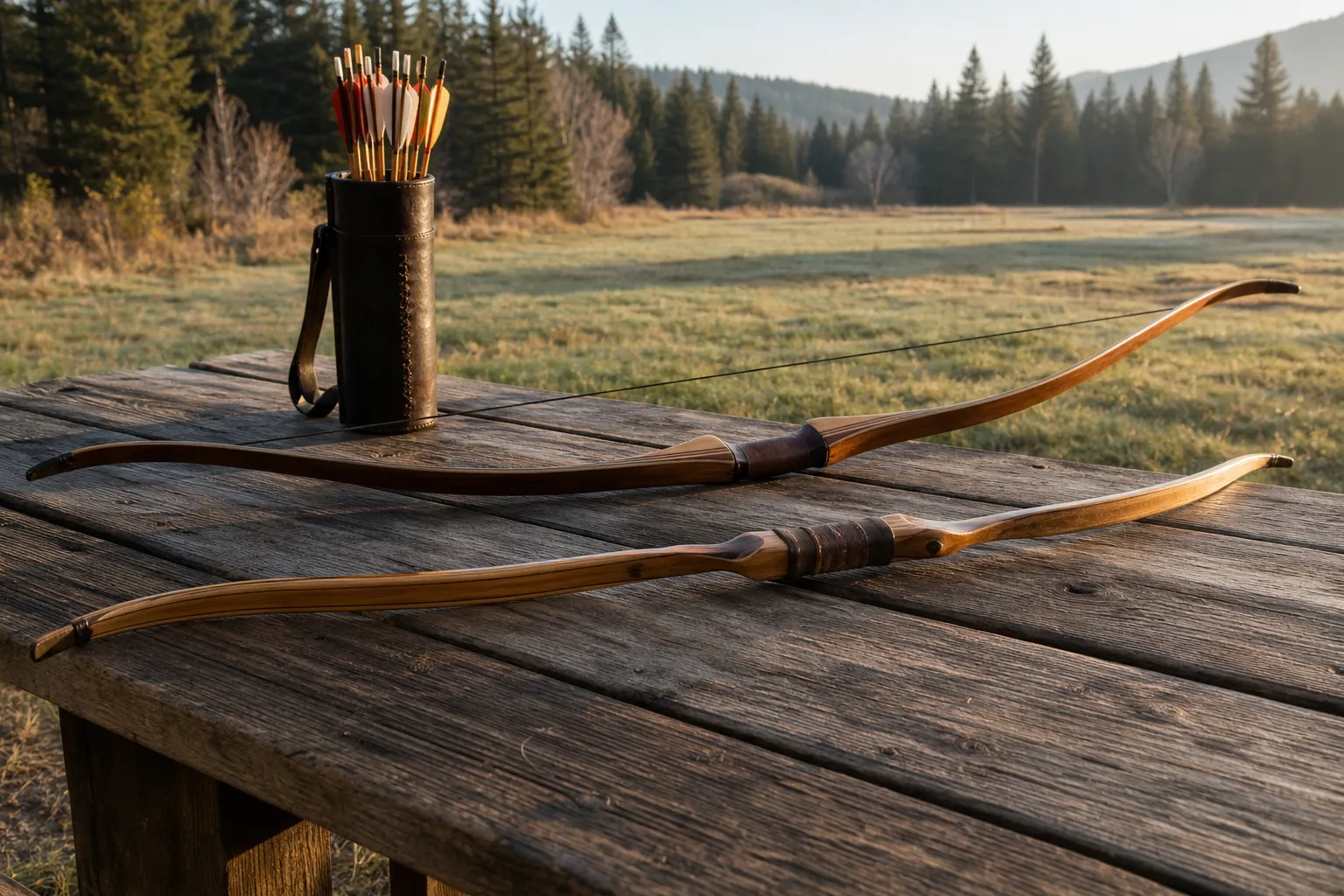
A longbow and a recurve bow are easiest to tell apart by limb shape and string contact. Archery Canada describes a recurve as having curved tips at the ends of the limbs, while it describes a longbow as straight when unstrung and slightly C-shaped when strung. World Archery’s longbow rule gives an even clearer practical test for its longbow division: when braced, the string must touch no part of the bow except the string nocks.
For a beginner, that shape difference explains most of the comparison. A Berkeley archery technical paper says recurve geometry can store more energy for the same draw weight and draw length. A longbow keeps a simpler limb shape and has less string contact with the limb faces.
Quick comparison
| Feature | Longbow | Recurve bow |
|---|---|---|
| Basic limb shape | Archery Canada describes a longbow as straight when unstrung and slightly C-shaped when strung. | Archery Canada describes a recurve as having curved tips at the ends of the limbs. World Archery says the tips curve back away from the archer. |
| String contact | World Archery’s 2026 Book 4 longbow rule says the braced string touches only the string nocks. Traditional Bowhunter Magazine gives the same working distinction: the string does not touch the limb faces. | Traditional Bowhunter Magazine describes a recurve as having string contact beyond the nocks. |
| Energy storage | The Berkeley paper compares non-recurved longbow geometry with recurve geometry at the same draw length and draw weight. | The Berkeley paper says recurve geometry stores significantly more energy than a longbow for the same draw length and draw weight. |
| Typical speed | Speed depends on materials, draw length, arrow weight and bow design. | Field & Stream reports recurves as typically 10 to 20 fps faster than a similar longbow, while cautioning that there are no hard rules. |
| Noise | Field & Stream attributes a common quieter-longbow comparison partly to less string slap against the limbs. | Recurves have more string contact around the curved limb tips, so the common noise comparison is often explained through string slap. |
| Portability | World Archery’s 2026 Book 4 rules allow a longbow to be a two-piece takedown made from any material or combination of materials. Bear Archery also lists take-down longbow limbs with tool-less takedown capability. | World Archery says recurve limbs often detach for transport or storage. Traditional Bowhunter Magazine lists take-down travel convenience and shorter overall length among common recurve advantages. |
| Historical association | World Archery associates yew longbows with medieval England. The Mary Rose museum documents Tudor-period longbows recovered from the ship. | World Archery contrasts shorter composite bows used by mounted Asian warriors with English yew longbows. |
Limb shape: the first difference to learn
Archery Canada recognizes recurve, compound and longbow as three bow types in its basic equipment guide. In that same guide, the visible distinction is simple: a recurve has a curved tip at each end of the limbs, while a longbow is completely straight when unstrung and becomes slightly C-shaped when strung.
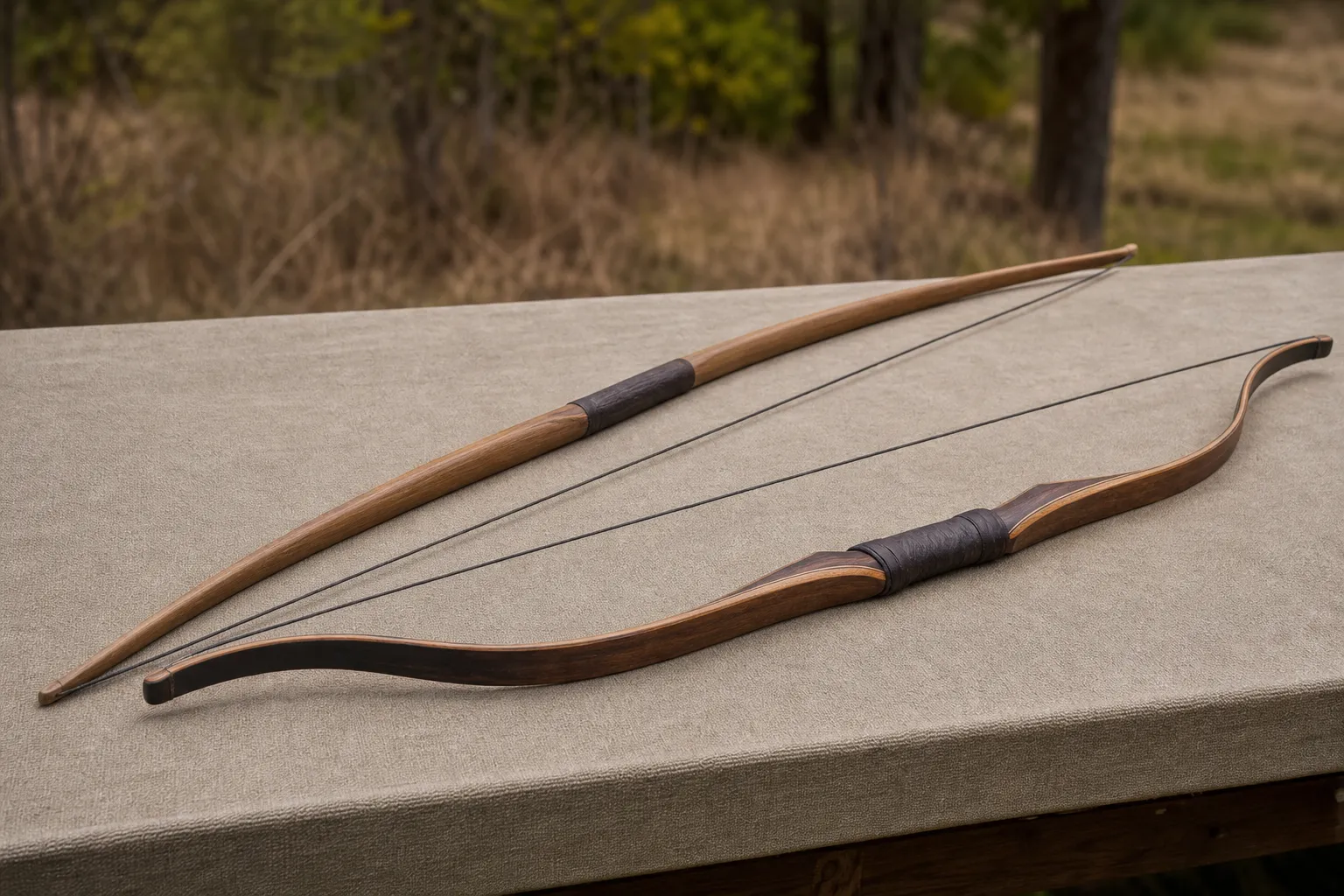
World Archery explains the recurve name the same way, from limb tips that curve back away from the archer. If you are new to traditional bows, this is the easiest visual clue. On a recurve bow, the limb tips turn away from the archer when the bow is strung. On a longbow, the overall profile is simpler and straighter.
String contact is the cleaner technical distinction. World Archery’s 2026 Book 4 longbow rule requires the braced bowstring to touch no part of the bow except the string nocks. Traditional Bowhunter Magazine gives a similar working distinction for everyday discussion: a longbow string does not touch the limb faces, while a recurve string contacts the bow beyond the nocks.
That matters because casual labels and competition labels do not always mean the same thing. World Archery’s 2026 Book 4 longbow division, for example, sets rules for length, construction and accessories. Those rules are not just a dictionary definition. They are equipment rules for a competition class.
Draw feel and stored energy
A Berkeley archery technical paper makes a narrow comparison: for the same draw length and draw weight, recurve geometry stores significantly more energy than a longbow.
That does not mean every recurve feels better to every archer. Draw feel depends on the bow’s design, the archer’s draw length and the way the bow is set up. The safe beginner takeaway is narrower: the recurved limb shape is an energy-storage design feature, not just a visual style.
The Connecticut manual also says the recurve is slightly easier to hold and aim at full draw than the longbow. Recurves are often discussed as using their geometry to improve energy storage without simply making the bow longer.
The Berkeley paper adds a useful engineering contrast. It says a non-recurved longbow shape is inherently stable at all draw lengths in its model, while a recurve can gain improved energy content without needing to be longer. That helps explain why recurves are often shorter for a given use and still efficient.
For beginners, draw length is part of this comparison. A bow’s behavior is tied to how far it is drawn, so a person comparing bow types should understand how to measure draw length before reading too much into speed or feel claims.
Speed: recurves are usually faster, but not by rule
Field & Stream reports recurves as typically 10 to 20 fps quicker than a similar longbow, while cautioning that there are no hard rules.
That caution is important. Materials, draw length, arrow weight and bow design all affect speed. A recurve shape can store more energy, but speed comparisons are only meaningful when the bows and arrows being compared are similar.
This is why the best educational comparison is not “recurve fast, longbow slow.” A more accurate version is: recurve geometry usually gives a speed advantage for similar bows, while longbows trade some of that energy-storage advantage for a simpler limb shape and a different shooting character.
Arrow setup also belongs in the conversation. If a beginner changes arrow weight or stiffness while comparing bows, the result can change. For the arrow side of the topic, see arrow spine charts and the parts of an arrow.
Noise and string slap
Field & Stream attributes the quieter-longbow comparison partly to less string slap against the limbs.
This follows from the string-contact difference. Under World Archery’s longbow rule, the braced string touches only the string nocks. In the traditional working distinction described by Traditional Bowhunter Magazine, a recurve has string contact beyond the nocks.
Noise still depends on the individual bow and setup. The comparison is about the common tendency and the reason usually given, not a guarantee that every longbow will be quieter than every recurve.
Portability and takedown designs
World Archery says recurve limbs often detach for transport or storage. Traditional Bowhunter Magazine also lists shorter overall length, easier maneuvering and take-down travel convenience as common recurve advantages.
The Berkeley paper explains one reason portability comes up in the recurve discussion: a recurve can gain improved energy content without needing to be longer. In simple terms, the recurved limb shape helps a bow store energy in a shorter package than a comparable straight-limbed design.
Longbows are not always one-piece bows, however. World Archery’s 2026 Book 4 rules allow a longbow to be a two-piece take-down made from any material or material combination. Bear Archery’s take-down longbow limbs are also described by the manufacturer as fitting the Fred Bear Takedown latch system and maintaining tool-less takedown capability.
Bear Archery’s Fred Bear Take Down page also lists riser and limb combinations that make bows from 56 inches to 64 inches AMO. That manufacturer example shows why “recurve equals takedown” and “longbow equals one piece” are too simple. Takedown recurves are common, but modern takedown longbows also exist.
Historical and traditional use
World Archery’s history page contrasts shorter composite bows used by mounted Asian warriors with yew longbows associated with medieval England. That broad historical split is useful, but it should not be turned into a rule that every curved traditional bow is one culture’s design or every longbow is English.

For the English longbow tradition, the Mary Rose museum gives unusually concrete evidence. The museum says its longbows and arrows are the only precisely dated archery assemblage surviving from any historical period. Its collection includes 172 longbows and more than 2,000 complete arrows recovered from the ship.
The Mary Rose museum says all of the recovered longbows are single-piece yew bows using heartwood and sapwood. It gives the recovered longbows a length range of 1,839 mm to 2,113 mm. Those figures show that the historical military longbow was not just a modern recreational category. It was a large yew weapon represented by a major Tudor-period archaeological collection.
Modern “traditional” divisions can mean something more specific than the everyday word traditional. USA Archery says its traditional bow divisions represent National Archery Association target-shooting equipment from the late 19th and early 20th centuries. USA Archery also cautions that these divisions do not necessarily mean instinctive or non-sighted equipment.
USA Archery’s Traditional Recurve division has its own historical reference point. USA Archery says it is intended to let wooden recurve shooters compare scores with target archers of the 1950s and 1960s. That is different from saying that all traditional recurve shooting is unsighted, instinctive or ancient.
Which one is “better” for a beginner?
The answer is not a ranking. The longbow and recurve solve the same basic problem with different shapes.
Choose the comparison point first:
- If you are studying form and classic simplicity, the longbow’s straight unstrung shape and limited string contact are the key ideas.
- If you are studying stored energy, shorter bow length and common takedown portability, the recurve’s curved limb tips are the key ideas.
- If you are studying history, the English yew longbow and the shorter composite bows described by World Archery belong to different traditions.
- If you are studying competition, read the current equipment rules rather than relying on casual labels.
For practical learning, the fundamentals of stance, grip and anchor point matter with either design. Those basics are covered separately in how to draw a bow.
Bottom line
A longbow is the simpler, straighter design, and in World Archery’s longbow rule the braced string touches only the string nocks. A recurve has limb tips that curve away from the archer, and recurve geometry can store more energy for the same draw weight and draw length.
That energy-storage advantage explains why recurves are typically described as faster and more compact. Longbows remain important for their simpler shape, traditional shooting feel and historical connection to yew military bows in England.
Before relying on a label for an event, check the current rules from the organizing body, such as World Archery or USA Archery. If the bow will be used for hunting, check the current equipment rules from the state, provincial or territorial wildlife agency where you plan to hunt.
Frequently asked questions
What is the main difference between a longbow and a recurve bow?
The main difference is limb shape and string contact. Archery Canada describes a recurve as having curved limb tips, while it describes a longbow as straight when unstrung. World Archery’s longbow rule says the braced string touches only the string nocks.
Is a recurve faster than a longbow?
Usually, a similar recurve is faster, but it is not a hard rule. Field & Stream reports recurves as typically 10 to 20 fps quicker than a similar longbow, while noting that there are no hard rules. Materials, draw length, arrow weight and bow design all matter.
Why can a recurve store more energy?
A Berkeley archery technical paper says recurve geometry stores significantly more energy than a longbow for the same draw length and draw weight.
Are longbows quieter than recurves?
They can be, depending on setup. Field & Stream attributes the common comparison partly to less string slap against the limbs.
Are all recurves takedown bows?
No. World Archery says recurve limbs often detach for transport or storage, but that does not mean every recurve is a takedown. Longbows can also be takedown designs, since World Archery’s 2026 Book 4 rules allow a two-piece takedown longbow and Bear Archery lists take-down longbow limbs.
Does “traditional” mean no sights or instinctive shooting?
Not always. USA Archery says its traditional divisions represent older target-shooting equipment traditions and cautions that they do not necessarily imply instinctive or non-sighted equipment.
Sources
- Basic Archery Equipment, Archery CanadaOfficial source. Accessed November 7, 2026.
- Recurve, World ArcheryOfficial source. Accessed November 7, 2026.
- Book 4: Field and 3D Archery, 2026-01-27 Version, World ArcheryOfficial source. Accessed November 7, 2026.
- About Traditional Target Archery, USA ArcheryOfficial source. Accessed November 7, 2026.
- Archery and Longbows on the Mary Rose, Mary Rose TrustOfficial source. Accessed November 7, 2026.
- History, World ArcheryOfficial source. Accessed November 7, 2026.
- Islamic Arms and Armor in The Metropolitan Museum of Art, The Metropolitan Museum of ArtOfficial source. Accessed November 7, 2026.
- Hunter Safety Manual, Chapter 7, Connecticut Department of Energy and Environmental ProtectionOfficial source. Accessed November 7, 2026.
- Fundamentals of the Design of Olympic Recurve Bows, University of California, Berkeley Archery. Accessed November 7, 2026.
- Fred Bear Take Down, Bear ArcheryOfficial source. Accessed November 7, 2026.
- Take Down Longbow Limbs, Bear ArcheryOfficial source. Accessed November 7, 2026.
- Longbow or Recurve?, Traditional Bowhunter Magazine. Accessed November 7, 2026.
- Recurve vs. Longbow: Here’s What You Need to Consider, Field & Stream. Accessed November 7, 2026.