Over-Under vs Side-by-Side Shotguns: What Is the Difference?
Over-under shotguns stack two barrels vertically, while side-by-side shotguns place two barrels horizontally. Both are usually break-action doubles, but their sight picture, traditions, and common clay or field uses differ.
By RaiS. Reviewed by RaiS. Published . 7 min read.
Research and drafting were assisted by AI. RaiS checked the facts against the sources below and approved this page.
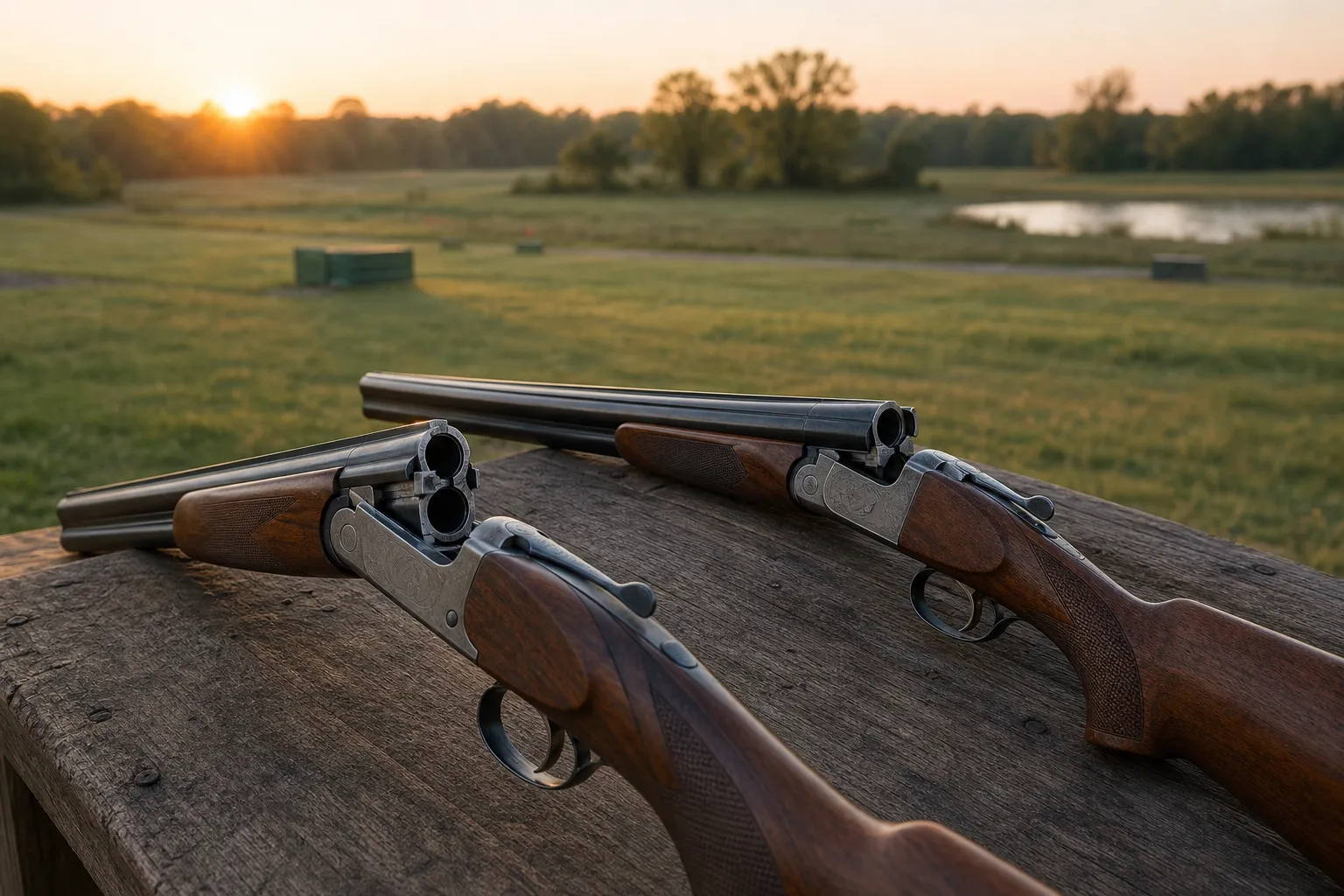
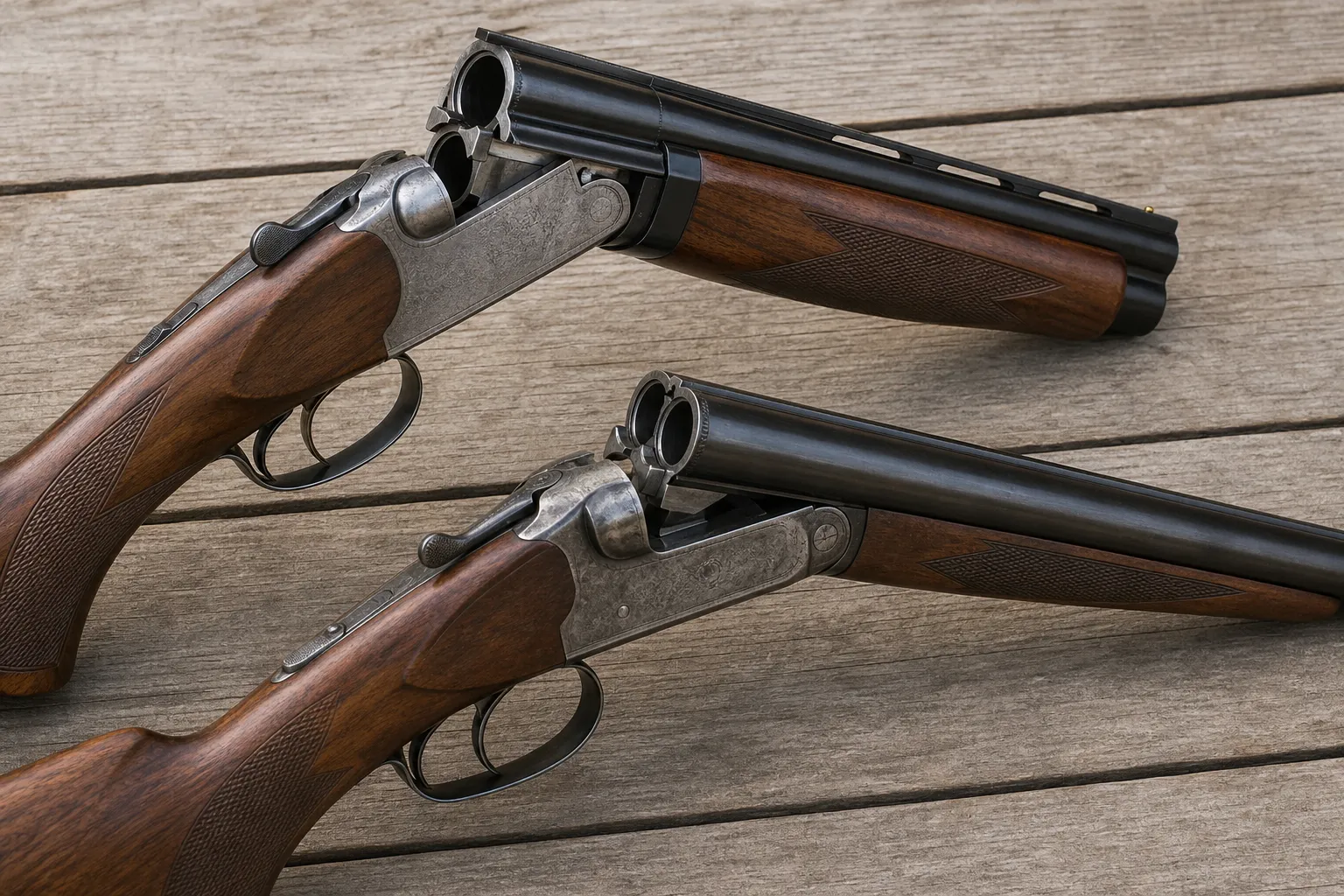
An over-under shotgun has two barrels stacked one above the other. A side-by-side shotgun has two barrels positioned next to each other. Both are classic double-barrel, break-action shotguns, and both usually give the shooter two shots before the gun must be opened and reloaded.
That simple layout difference affects what the shooter sees over the barrels, how barrel selection is arranged, how the gun is described in clay-target and hunting contexts, and how makers discuss balance and recoil. It does not, by itself, decide which shotgun is better. Fit, gauge, choke, point of impact, range rules, and the individual gun’s design all matter.
The core layout difference
The National Shooting Sports Foundation describes a shotgun, for this discussion, as a shoulder-fired smoothbore gun intended to fire a shell loaded with multiple pellet projectiles. In the traditional double-gun category, both over-under and side-by-side shotguns are usually break-action designs. NSSF explains that a break-action gun hinges open at the receiver and stock.
For a broader overview of action types, see Types of Shotguns: Pump, Semi-Auto, Break-Action and More.
TriStar’s double-barrel shotgun manual gives the cleanest layout distinction: over-under barrels are stacked one on top of the other, while side-by-side barrels are positioned beside each other. Browning describes the Citori over-under the same way, as a two-barreled shotgun with the barrels aligned one over the other.
| Feature | Over-under shotgun | Side-by-side shotgun |
|---|---|---|
| Barrel arrangement | Two barrels stacked vertically | Two barrels placed horizontally |
| Action family | Usually a break-action double | Usually a break-action double |
| Shots before reloading | Two barrels allow two shots | Two barrels allow two shots |
| Barrel naming | Often upper and lower barrel | Often right and left barrel |
| Commonly described use | NSSF says over-unders are more popular in skeet, trap, and sporting clays | NSSF says side-by-sides are seen on classic hunting shotguns |
NSSF notes a key advantage and limit of break-action shotguns: they are simple to load and unload, with no extra operating mechanism during firing, but the shooter has only one or two shots before reloading. For a double gun, that usually means two shots.
Sight picture and aiming reference
The main visual difference is easy to understand: an over-under stacks the barrels vertically, while a side-by-side spreads them horizontally. Browning’s Citori overview says John M. Browning believed stacked barrels and a single sighting plane were superior to the side-by-side models popular in his day.
That does not mean every shooter will see or shoot every over-under the same way. Browning’s Citori manual ties shotgun fit and sight picture to how the shooter’s dominant eye aligns with the rib. The same manual says a correctly adjusted gun has the shooter looking directly down the center of the rib with the front and middle beads aligned.
Browning also describes point of impact as a design and setup issue. Its Citori overview says a flat 50/50 point of impact is preferred when target presentations can come from any direction, while a 70/30 point of impact is more suited to trap because a higher point of impact lets the shooter keep a rising target visible when the trigger is pulled.
For a new shooter, the practical takeaway is modest: barrel layout affects the view over the gun, but the actual sight picture depends on the shotgun’s fit, rib, point of impact, and the shooter’s eye alignment. It is not just an over-under versus side-by-side question.
Triggers, barrel selection, and chokes
Both layouts can use different trigger systems depending on the model. TriStar’s manual lists three double-barrel trigger arrangements: double, single, and single selective. It explains that double triggers assign one barrel to each trigger, a single trigger fires the barrels in a set order, and a single-selective trigger lets the shooter choose which barrel fires first.
Beretta’s side-by-side manual shows how this can work on a side-by-side gun. For the selective single-trigger version described in that manual, the selector chooses the right or left barrel first. For the double-trigger version in that manual, the front trigger fires the right barrel and the back trigger fires the left barrel.
Browning’s Citori manual describes its over-under as having a single selective trigger, with only one barrel fired for each pull of the trigger. That supports the same general point: trigger and barrel-selection details are design features, not fixed rules for every double gun.
The two-barrel layout also allows different choke choices in each barrel when the gun is built for that. NSSF notes a practical reason over-unders are useful in sporting clays: the shooter can fire two quick shots and put a different choke tube in each barrel to optimize one barrel for close targets and the other for far targets.
For more background on constriction and pattern effects, see Shotgun Chokes Explained. For pellet distribution at the target, see How to Pattern a Shotgun: Paper Targets, Chokes and Pellet Distribution.
Typical uses: field guns and clay-target guns
NSSF describes side-by-side shotguns as styles seen on classic hunting shotguns.
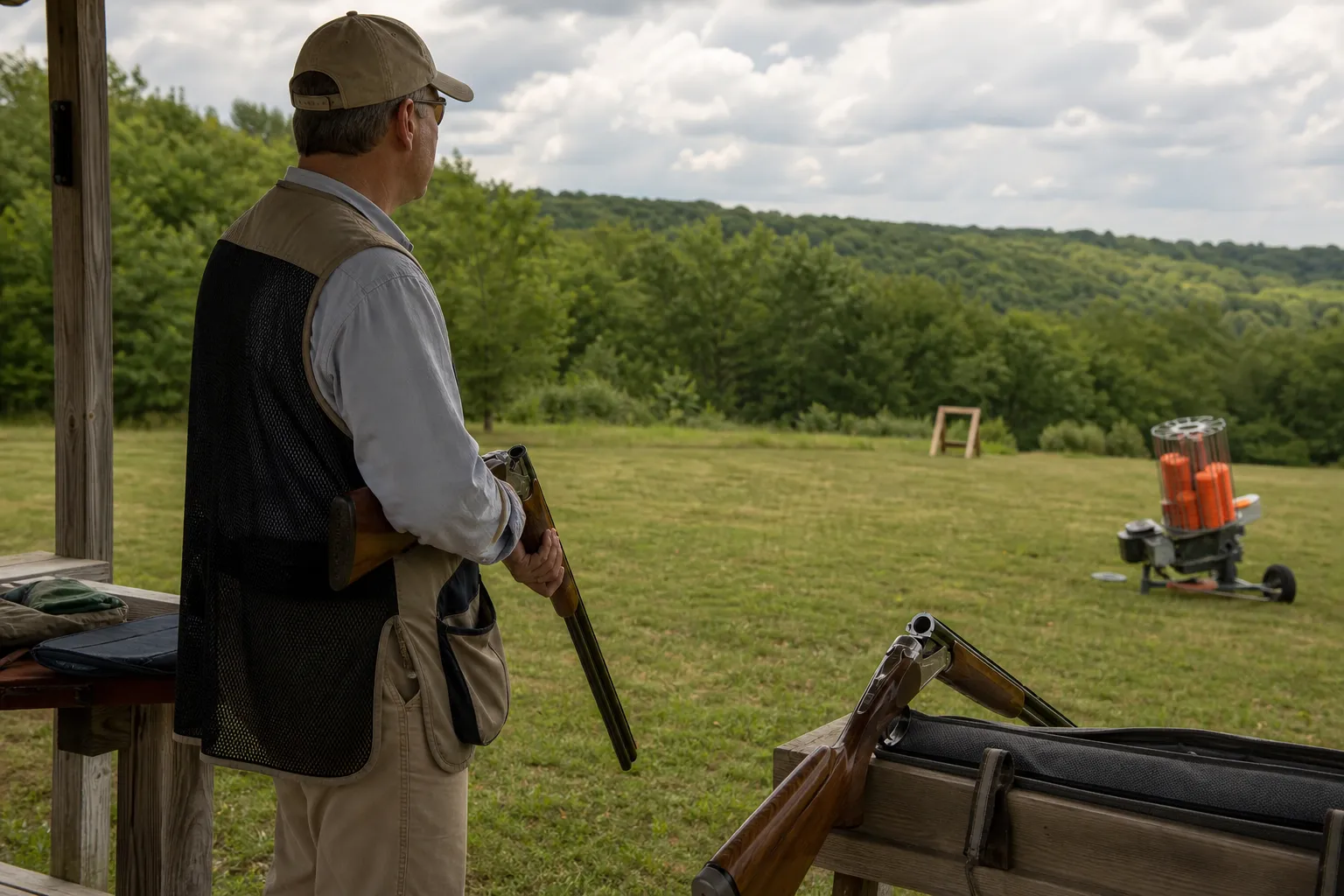
NSSF describes over-unders as more popular in clay shooting sports such as skeet, trap, and sporting clays. That is a statement about common use, not a rule that only over-unders belong on clay fields.
The 2026 National Skeet Shooting Association rule book says skeet guns must be capable of firing two shots because a regulation 25-shot round includes four sets of doubles. The same rule book says the gun may be a double barrel, pump gun, or automatic, depending on the shooter’s preference. It also treats over-under and side-by-side doubles as break-open guns for safety handling when not at the station, stating that such guns are to be broken open and empty.
For a comparison of clay games, see Trap vs Skeet vs Sporting Clays: What’s Different?.
Balance and recoil feel
Balance and recoil feel are often discussed by shooters, but the reliable facts are model-specific. A double gun’s layout is only one part of the design. Receiver height, stock shape, barrel weight, rib, and fit all influence how a shotgun feels, and the published manufacturer descriptions are mainly for specific over-under models.
Browning’s Cynergy overview says that model’s reduced receiver height brings the forward hand closer to the bore line to improve pointability and balance. Browning also says that having the barrels more in line with the shoulder on the Cynergy improves recoil control and limits muzzle jump for more accurate follow-up shots.
Those examples should not be stretched into a universal claim that every over-under recoils or balances a certain way, or that every side-by-side does the opposite. The safer comparison is this: Browning’s over-under descriptions emphasize sighting plane, pointability, and recoil control on specific designs, while NSSF and Purdey describe side-by-sides in terms of classic hunting and game-gun identity.
Historical context
The side-by-side has deep roots in fine sporting guns. Purdey describes its side-by-side as one of the oldest styles of guns it produces and as a classic game gun. Purdey says its side-by-side action was perfected in the 1880s and has more than 140 years of production behind it.
Purdey also states that its side-by-side is appreciated for elegant engineering that allows faster loading. That is a maker’s description of its own side-by-side design, and it fits the broader picture of the side-by-side as a traditional game-gun form.
The over-under has its own important modern history. Browning’s historical archive says the B-25 Superposed was the first over-under shotgun design to successfully appeal to a worldwide shooting market. Browning also says the Citori joined its shotgun line in 1971 as the fifth generation of the Superposed.
So the historical contrast is not old versus new in a simple sense. It is better understood as two long-established double-gun layouts with different design traditions: the side-by-side as a classic game-gun form, and the over-under as a major modern double layout with a strong presence in clay-target shooting.
Which difference matters most for a new shooter?
Start with the layout. If the barrels are stacked vertically, it is an over-under. If they are arranged horizontally, it is a side-by-side.
Then look at use and setup. NSSF describes over-unders as more common in skeet, trap, and sporting clays, while side-by-sides are seen on classic hunting shotguns. But clay rules do not require an over-under in all cases, and the 2026 NSSA rule book specifically allows a double barrel, pump gun, or automatic for skeet depending on shooter preference.
Finally, look at the individual shotgun. Trigger type, barrel selection, choke setup, point of impact, fit, and balance features are model details. Two guns with the same barrel layout can still feel and shoot differently.
Always read the manufacturer’s manual for the exact shotgun, follow the range or club rule book, and confirm current clay-target or hunting requirements with the governing organization or wildlife agency before using any shotgun in a formal event or in the field. Basic handling rules apply to both layouts, and break-open doubles should be kept open and empty where the applicable range rules require it. For a safety refresher, see The Basic Rules of Firearm Safety.
Frequently asked questions
What is the main difference between an over-under and a side-by-side shotgun?
The barrel arrangement. TriStar’s manual describes over-under barrels as stacked one on top of the other, while side-by-side barrels are positioned beside each other.
Are both over-under and side-by-side shotguns break-action guns?
Traditional versions usually are. NSSF describes break actions as guns whose barrel or barrels hinge open from the receiver and stock, and says double-barrel break actions may be oriented side by side or over and under.
Why are over-unders common in clay-target sports?
NSSF says over-under designs are more popular in skeet, trap, and sporting clays. It also notes that a double can fire two quick shots and use different choke tubes in each barrel for closer or farther targets.
Does skeet require an over-under shotgun?
No. The 2026 NSSA rule book says a skeet gun may be a double barrel, pump gun, or automatic, depending on the shooter’s preference, and it must be capable of firing two shots because regulation rounds include doubles.
Can side-by-side shotguns have barrel selectors or double triggers?
Yes, depending on the design. Beretta’s side-by-side manual documents selective single-trigger selection for right and left barrels, and also documents a double-trigger setup where the front trigger fires the right barrel and the back trigger fires the left barrel.
Is recoil always lower with an over-under than a side-by-side?
The supported facts here are model-specific, not universal. Browning says the Cynergy over-under’s low-profile design and barrel alignment improve recoil control and limit muzzle jump, but that should not be applied to every shotgun of either layout.
Sources
- Equipment, Meet the Shotgun, National Sporting Clays Association, National Skeet Shooting Association, republishing National Shooting Sports Foundation materialOfficial source. Accessed October 30, 2026.
- 2026 NSSA Rule Book, National Skeet Shooting AssociationOfficial source. Accessed October 30, 2026.
- Browning Citori Over and Under Shotgun Owner's Manual, BrowningOfficial source. Accessed October 30, 2026.
- Citori Over and Under Shotgun Overview, BrowningOfficial source. Accessed October 30, 2026.
- Cynergy Over and Under Shotgun Overview, BrowningOfficial source. Accessed October 30, 2026.
- Citori History, Browning Historical Archive, BrowningOfficial source. Accessed October 30, 2026.
- TriStar Setter and Upland Hunter Instruction Manual, TriStar ArmsOfficial source. Accessed October 30, 2026.
- Beretta Side-by-Side Shotgun User Manual, BerettaOfficial source. Accessed October 30, 2026.
- 694, Over and Under Shotguns, BerettaOfficial source. Accessed October 30, 2026.
- Beretta Firearm Families, BerettaOfficial source. Accessed October 30, 2026.
- The Sidelock Side-by-Side, James Purdey & SonsOfficial source. Accessed October 30, 2026.
- The Great Double-Barrel Debate: Side-By-Side vs. Over/Under Shotguns, NRA Family. Accessed October 30, 2026.