Derringers Explained: Design, History and Modern Meaning
A derringer is a small handgun category, usually built around one or two short barrels. The name is associated with Henry Deringer Jr.’s Philadelphia pocket pistols.
By RaiS. Reviewed by RaiS. Published . 6 min read.
Research and drafting were assisted by AI. RaiS checked the facts against the sources below and approved this page.
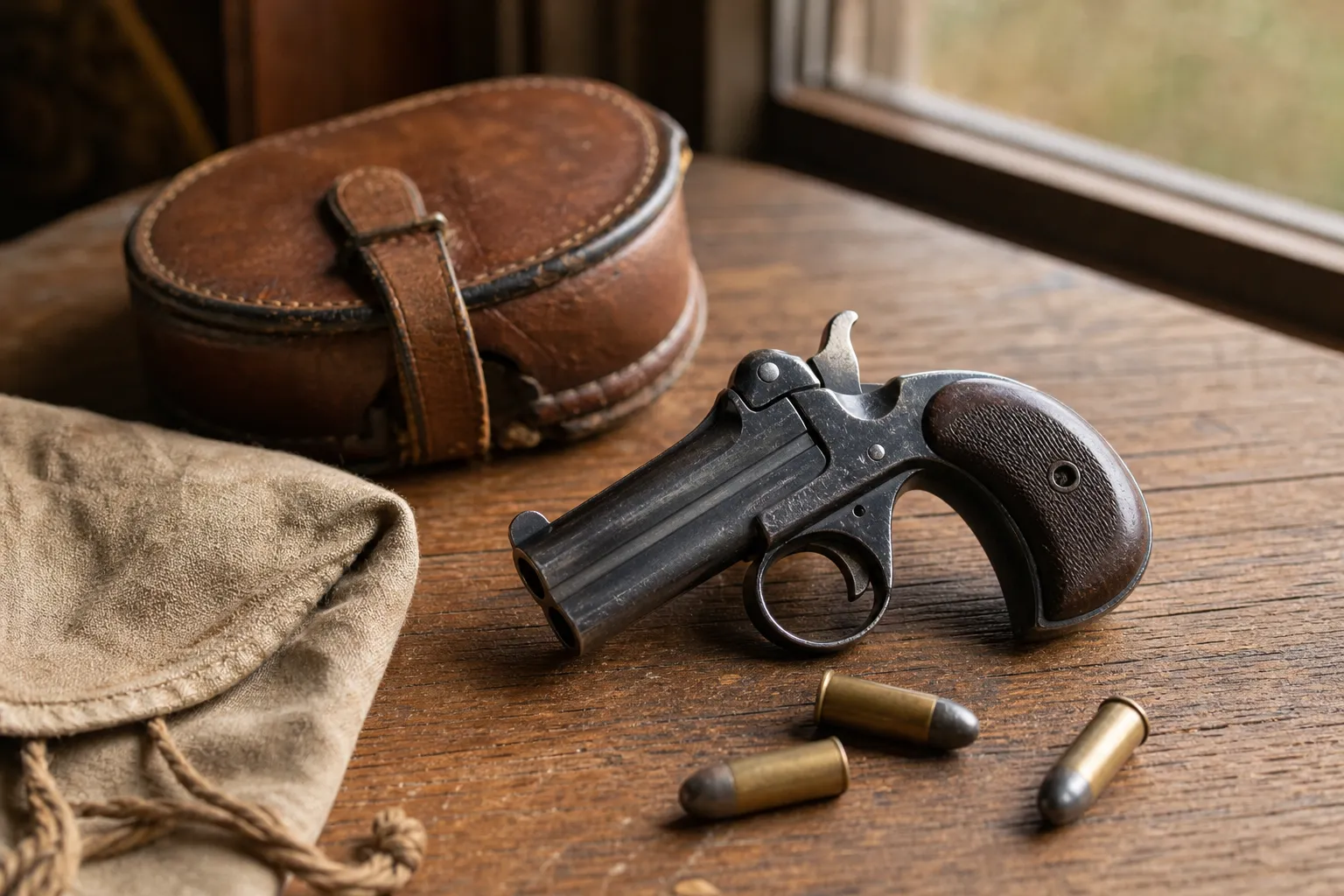
A derringer is a small handgun, usually with one or two short barrels, according to the NRA Museums glossary. It is a handgun category, not the same thing as a semi-automatic pistol or a revolver. The name is associated with Henry Deringer Jr. of Philadelphia.
What a derringer is
The simplest definition is the one used by NRA Museums: a derringer is usually a small pistol with one or two short barrels. That definition covers early single-shot percussion pocket pistols as well as later two-shot cartridge pistols.
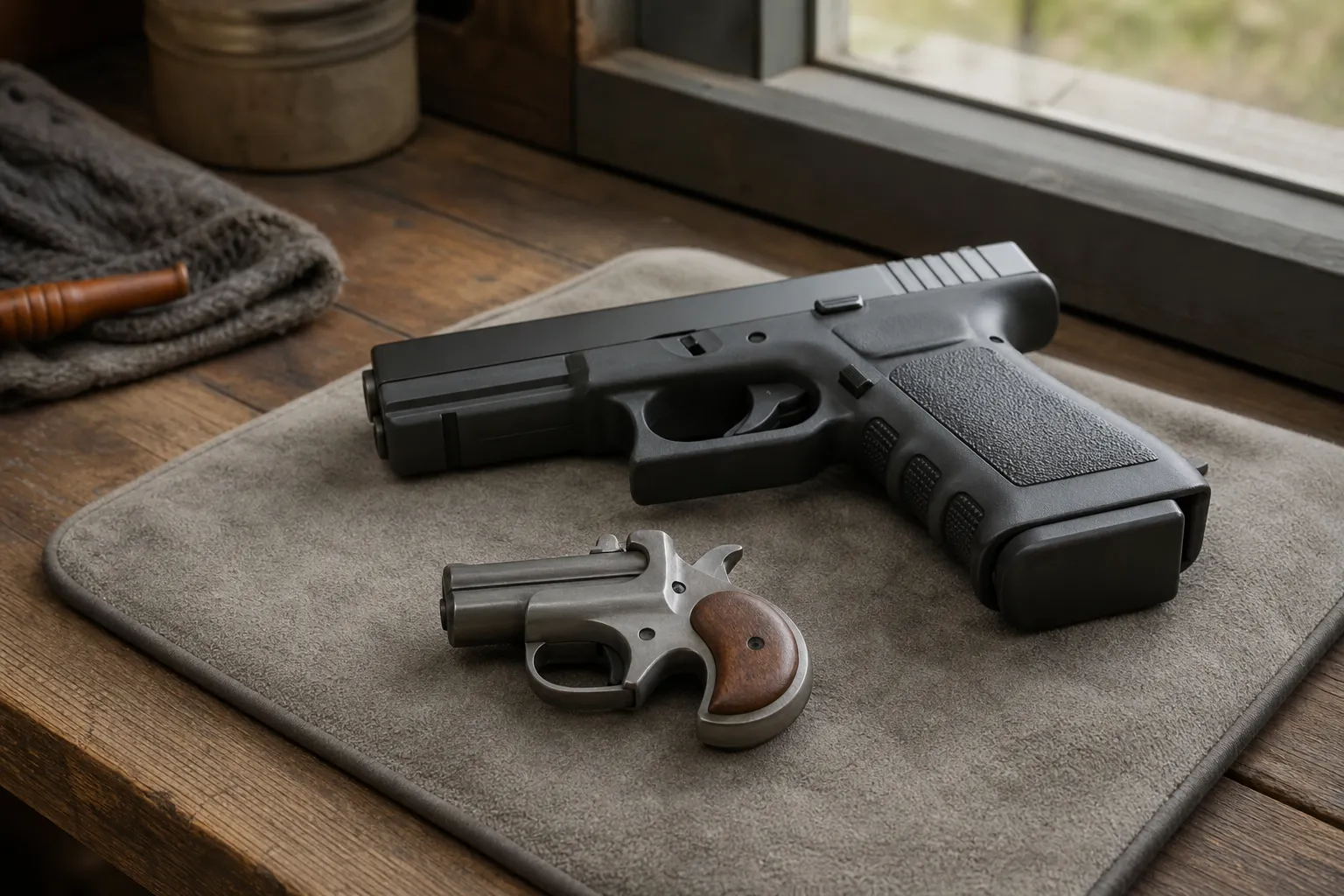
A derringer is best understood by its layout, not by a repeating mechanism. A revolver uses a rotating cylinder, and a semi-automatic pistol uses a self-loading action. A derringer, as the term is commonly used in firearms history and manufacturer manuals, is usually much simpler: one barrel or two barrels, short overall size, and manual reloading after a very small number of shots.
Several basic terms help explain the category:
| Term | Meaning in this context |
|---|---|
| Single-shot | NRA Museums defines a single-shot action as one that stores or loads only one cartridge and is manually operated. |
| Double-barreled | NRA Museums defines a double-barreled gun as having two barrels joined side by side or one over the other. |
| Over-under | NRA Museums uses “superposed” for an over-under barrel configuration. |
| Break-open | NRA Museums defines a break-open action as barrels pivoting on a hinge pin to allow access to the chamber or chambers. |
| Single action | NRA Museums defines single action as a design that requires the hammer to be manually cocked for each shot. |
Those terms explain why many derringers look unlike larger service pistols. The design is usually compact and mechanically simple, but the tradeoff is limited ammunition capacity and manual handling between reloads.
Where the name came from
Henry Deringer, not “Derringer,” was the Philadelphia gunmaker behind the original name.
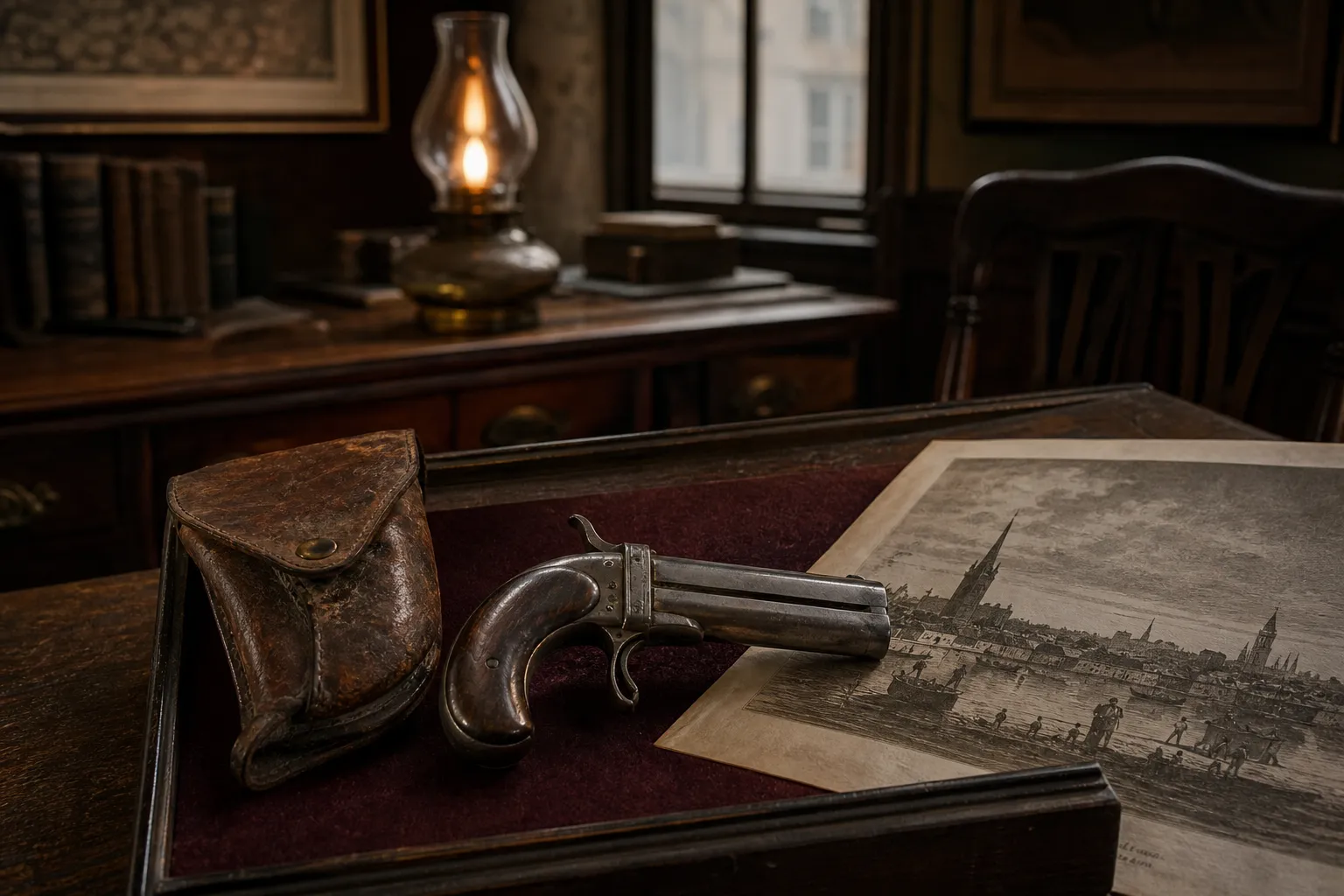
In modern usage, “Deringer” can refer specifically to Henry Deringer and his Philadelphia pistols, while “derringer” is the broader category name most readers see today.
Common derringer layouts
Derringers are most often discussed in three broad layouts: single-shot pocket pistols, two-shot double-barrel pistols, and modern over-under derringer-style pistols. These layouts share the small size implied by the name, but they differ mechanically.
Single-shot percussion pocket pistols
Museum examples show how compact these arms could be. The Autry Museum identifies one Philadelphia Deringer in its collection as a circa 1850 Henry Deringer Jr. percussion pistol in .41 caliber. The same museum lists that pistol’s dimensions as 5 3/4 inches by 4 inches by 1 1/4 inches.
The Autry Museum describes that example as having a steel barrel, brass and steel inlay, engraved decoration, and a one-piece hardwood grip.
Mechanically, the important point is that single-shot examples offered one shot. The NRA Museums definition of a single-shot action fits that concept: it stores or loads only one cartridge and is manually operated.
Two-shot double-barrel pistols
The best-known historical two-shot derringer pattern is the Remington Double Derringer. NRA Museums says the Remington Double Derringer appeared in 1866, was available only in .41 caliber rimfire, and remained in production longer than any other Remington handgun. NRA Museums estimates that more than 150,000 were manufactured between 1866 and 1935.
The phrase “over-under” matters here because the NRA Museums glossary defines a double-barreled gun as one with two barrels joined either side by side or one over the other.
That Remington pattern helped shape the modern public image of a derringer: two short barrels stacked vertically, with a compact frame and very limited capacity. Because the Remington example used .41 rimfire, it also sits in the broader history of rimfire ammunition, though cartridge design itself is a separate topic.
Modern over-under derringer-style pistols
Modern manufacturer manuals still use the term. The Bond Arms manual identifies its covered firearms as double-barrel handgun derringers. It describes a crossbolt safety that blocks the hammer from reaching the firing pins, while also warning that a safety does not replace safe handling.
The same Bond Arms manual states that its derringer is a short-range handgun with an effective range from 1 to 21 feet. It also notes that the top and bottom barrels can have different points of impact because the barrels sit at different distances from the shooting hand. The manual gives the trigger pull as about 7 pounds and says compact derringers require the user to operate the gun in a specific manner.
The Bond Arms manual is useful because it describes the modern mechanical meaning of the category without turning it into a recommendation. It shows that the derringer idea still exists, but with important limits in range, capacity, and handling.
Historical context and cultural meaning
The Philadelphia Deringer became historically important because it was small and strongly associated with the pocket pistol idea. Museum catalogues from the Autry Museum show surviving percussion examples and their basic features.
One unavoidable historical reference is the assassination of President Abraham Lincoln. The National Park Service states that John Wilkes Booth used a .44 Derringer pistol in the assassination on April 14, 1865. The National Park Service also describes Booth’s pistol as single-shot and notes that he carried a dagger because he knew the pistol could fail or be insufficient.
That history should be treated plainly, not glamorized. It is part of why the word is familiar, but it also illustrates a key mechanical limit: a single-shot pistol gives the user only one shot before reloading.
The later Remington Double Derringer gave the term another lasting shape. NRA Museums says it appeared in 1866 and was made in .41 rimfire for 69 years, with more than 150,000 estimated examples manufactured between 1866 and 1935. That long production run helps explain why many people picture a two-barrel over-under pistol when they hear “derringer.”
Mechanical limits
The main mechanical limit is capacity. Many derringers offer one or two shots before manual reloading. That is very different from a revolver cylinder or a semi-automatic pistol magazine. For background on magazine-fed pistols, see our guide to pistol magazines.
Short barrels and compact frames also affect how these pistols are described by manufacturers. Bond Arms calls its derringer a short-range handgun and gives an effective range from 1 to 21 feet. The same manual says top and bottom barrels can have different points of impact because they sit at different distances from the shooting hand.
Trigger and handling can also be different from larger handguns. Bond Arms gives its trigger pull as approximately 7 pounds and says small compact derringers require the user to operate the gun in a specific manner. NRA Museums defines single action as a design that requires the hammer to be manually cocked for each shot. For the broader terminology, see single action vs double action.
These limits are the reason derringers should not be discussed as if they are simply miniature versions of larger handguns. Their small size comes with constraints in capacity, sighting, point of impact, and handling.
Safety, ammunition, storage, and lawful ownership basics
For a broader safety refresher, see the basic rules of firearm safety and our guide to gun locks.
Manufacturer ammunition warnings are also important. The Bond Arms manual says to use only the ammunition type and caliber marked on the barrel and not to alter the barrel, chamber, or caliber. That is especially relevant for derringer-style pistols because the same broad category can include very different historical and modern chamberings.
Federal, state, provincial, local, transport, storage, and carry rules can differ. Readers should confirm current requirements with ATF and the relevant state or provincial authority before acquiring, transporting, storing, or carrying any handgun.
Frequently asked questions
What is a derringer?
NRA Museums defines a derringer as a small pistol, usually with one or two short barrels. It is a handgun category, not a revolver or semi-automatic pistol design.
What is an over-under derringer?
An over-under derringer has two barrels stacked one above the other. NRA Museums defines a double-barreled gun as having two barrels joined side by side or one over the other, and identifies “superposed” as an over-under configuration.
What are the main limitations of derringers?
Many derringers offer only one or two shots before manual reloading. Bond Arms also describes its derringer as a short-range handgun and notes that stacked barrels can have different points of impact.
What should owners check before using or storing one?
Owners should follow the manufacturer manual for handling, ammunition, and storage, and confirm current federal, state, provincial, and local rules.
Sources
- NRA Museums Glossary, NRA Museums. Accessed November 20, 2026.
- Deringer, American Firearms and Their Makers: A Research Guide, Library of Congress. Accessed November 20, 2026.
- Philadelphia Deringer, Autry Museum of the American West. Accessed November 20, 2026.
- Deringer Percussion Pistol, National Museum of American History, Smithsonian Institution. Accessed November 20, 2026.
- Deringer Pistol, National Museum of American History, Smithsonian Institution. Accessed November 20, 2026.
- Model 1813 Maryland Contract Pistol, Smithsonian Institution Collections Search Center. Accessed November 20, 2026.
- FAQ: The Assassination, National Park Service, Ford’s Theatre National Historic SiteOfficial source. Accessed November 20, 2026.
- FAQ: The Assassin, National Park Service, Ford’s Theatre National Historic SiteOfficial source. Accessed November 20, 2026.
- Remington Double Derringer, NRA Museums. Accessed November 20, 2026.
- Firearms Curios or Relics List, Bureau of Alcohol, Tobacco, Firearms and ExplosivesOfficial source. Accessed November 20, 2026.
- Double-Barrel Handgun Derringers Safety and Instruction Manual, Bond ArmsOfficial source. Accessed November 20, 2026.
- DoubleTap Pistol Instruction Manual, DoubleTap Defense LLCOfficial source. Accessed November 20, 2026.
- Safety and Security for Firearm Owners, Bureau of Alcohol, Tobacco, Firearms and ExplosivesOfficial source. Accessed November 20, 2026.
- Minimum Age for Gun Sales and Transfers, Bureau of Alcohol, Tobacco, Firearms and ExplosivesOfficial source. Accessed November 20, 2026.