Shotgun Forcing Cones Explained
A shotgun forcing cone is the tapered transition from the larger chamber to the smaller bore. It matters in discussions of chamber dimensions, shot column handling, pattern quality, recoil claims and shell length safety.
By RaiS. Reviewed by RaiS. Published . 7 min read.
Research and drafting were assisted by AI. RaiS checked the facts against the sources below and approved this page.
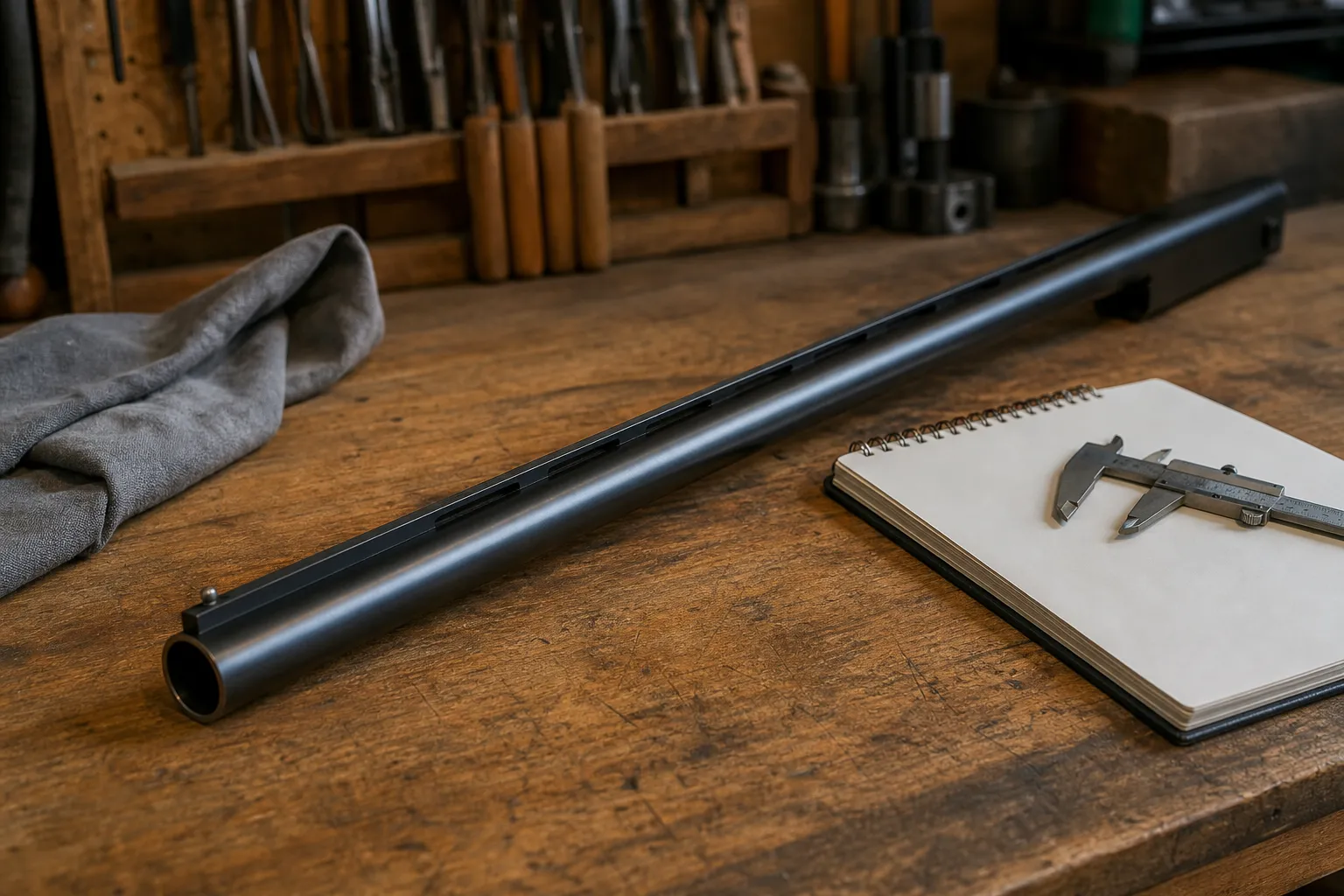
A shotgun forcing cone is the tapered transition just forward of the chamber, where the larger chamber diameter narrows to the bore diameter. The NRA Museum glossary defines it as the forward part of a shotgun chamber where chamber diameter is reduced to bore diameter.
Where the forcing cone sits in a shotgun barrel
American Rifleman describes the inside of a shotgun barrel as five areas: chamber, chamber to bore forcing cone, cylinder bore, choke forcing cone and choke. In that sequence, the forcing cone discussed here is the chamber to bore transition, not the muzzle choke.
The chamber has to be larger than the bore because it holds the shotshell hull, so a tapered transition is needed between chamber and bore.
Browning defines the forcing cone as the tapered transition between chamber and bore that constricts the shot column. SKB describes it as the transition immediately forward of the chamber. The NRA Museum glossary adds that the forcing cone aids the passage of shot into the barrel.
That location also explains why forcing cones come up in discussions of shotgun shell length, shotgun gauges and barrel design. It is the place where the fired shell’s contents leave the chamber area and enter the smaller bore.
How SAAMI and C.I.P. describe shotgun chambers
SAAMI Z299.2 is the U.S. voluntary industry standard for commercial shotshell pressure, velocity and dimensional characteristics.
American Rifleman summarizes the SAAMI geometry by saying SAAMI specifies a five degree taper that yields a forcing cone of approximately 3/4 inch in length.
C.I.P. also publishes technical data for smoothbore shotgun cartridges. C.I.P. says its TDCC tables are approved by C.I.P. and contain data used to establish technical standards for proof of small arms. C.I.P.’s Cal. 12 TDCC sheet lists minimum chamber dimensions, bore related dimensions and chamber lengths for 12/70, 12/76 and 12/89.
The important reader takeaway is that forcing cone geometry is part of chamber and bore specification, but there is not one marketing term or one advertised cone length used by every maker. Browning and SKB describe their own forcing cone designs in their technical materials, and other makers may use their own barrel profile terminology.
Forcing cone versus choke
A chamber forcing cone should not be confused with a choke. SAAMI defines a shotgun choke as an interior constriction at or near the muzzle end of a shotgun barrel bore for controlling shot dispersion. That is different from the chamber to bore forcing cone, which sits just forward of the chamber.
A barrel can therefore have more than one tapered or constricted area. American Rifleman separates the chamber to bore forcing cone from the choke forcing cone and choke.
This distinction matters when reading pattern discussions. A forcing cone is part of how the shot column enters the bore. A shotgun choke is the muzzle end constriction used to influence shot dispersion.
What people mean by a lengthened forcing cone
SKB defines a lengthened forcing cone as an increased distance of the transition length. In plain terms, the taper from chamber diameter to bore diameter is made more gradual over a longer distance.
Browning uses the name Vector Pro for one of its forcing cone designs. Browning says its longer Vector Pro forcing cone creates a more gradual taper that reduces stress on the shot column as it moves into the bore, reducing pellet deformation. Browning also lists fewer deformed pellets, more uniform patterns and denser center cores as advantages of that design.
Those are manufacturer descriptions of specific barrel designs. They are useful for understanding the design claim, but they should not be read as proof that every longer cone will produce the same result in every shotgun, load and choke combination.
Shot columns, pellets and pattern claims
The common claim is that a longer, more gradual cone is gentler on the wad and shot column as they move from the chamber into the bore. Browning states this claim directly for Vector Pro, saying the more gradual taper reduces shot column stress and pellet deformation.
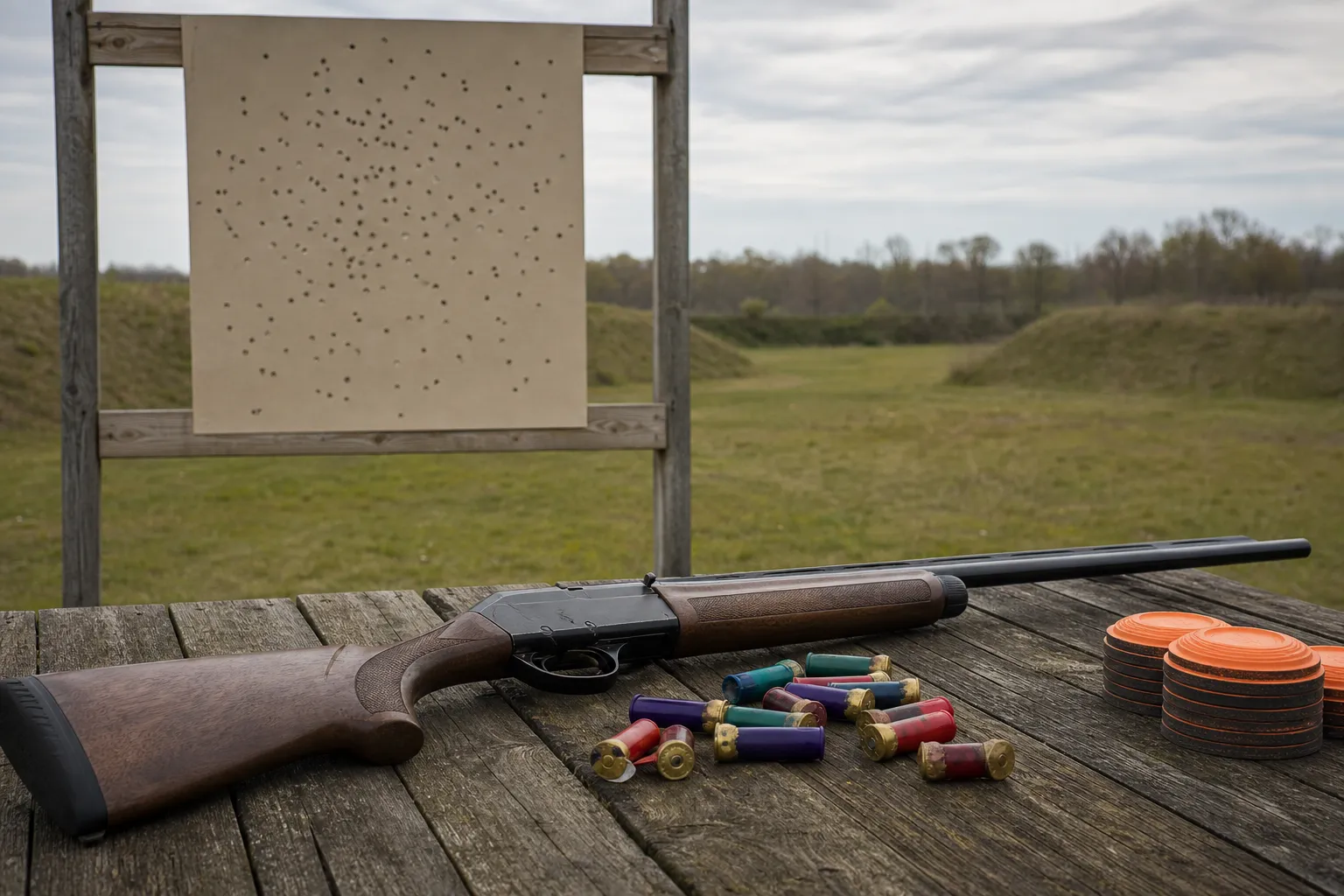
Pattern performance is not controlled by forcing cone length alone. Browning describes forcing cone design as one part of a broader barrel performance package that can also include chamber design, bore diameter and choke tube system design. The National Skeet Shooting Association and National Sporting Clays Association article says shell speed, wad, shot composition, and shell and chamber length can affect optimal bore and forcing cone dimensions.
American Rifleman reports a more cautious patterning observation: lengthening a forcing cone may improve the evenness of pellet distribution more than it increases the total percentage of pellets inside the traditional 30 inch circle at 40 yards.
For readers, that means forcing cone claims belong in the same conversation as load, wad, shot material, bore geometry and choke. Patterning on paper is still the practical way to see how a particular shotgun, shell and choke combination distributes pellets. For that process, see our guide to patterning a shotgun. For pellet size background, see birdshot sizes and buckshot sizes.
Recoil claims: free recoil versus felt recoil
Forcing cones are often mentioned in recoil discussions, but recoil needs careful wording. SAAMI’s recoil technical sheet distinguishes free recoil from felt or perceived recoil. SAAMI says felt recoil can vary with the rate of force application, recoil pads or damping devices, and action type.
SAAMI’s free recoil formula uses ejecta weight and velocity, propellant gas weight and velocity, and firearm weight. For shotguns, SAAMI says ejecta includes the shot charge or slug and wad column. Forcing cone length is not listed as a direct variable in that free recoil formula.
That does not mean shooters cannot perceive a difference between guns or loads. It means that a claim about reduced recoil from a lengthened forcing cone should be treated as a manufacturer or industry claim unless it is supported by instrumented testing for the exact gun and load being discussed. SKB claims a lengthened forcing cone improves downrange performance by reducing pellet deformation and felt recoil, but SAAMI’s free recoil formula does not make forcing cone length a direct input.
Chamber length and gauge safety
Forcing cones are also involved in important shotshell safety warnings. SAAMI says using shorter shells in longer chambers may be acceptable, but the reverse is not true. SAAMI explains that a longer shell in a shorter chamber can produce higher than expected pressure because the shell mouth can open into the forcing cone and create a constriction.
SAAMI also warns that different shotshell gauges are never interchangeable. SAAMI gives the example of a 20 gauge shell lodging in the forcing cone of a 12 gauge barrel. Winchester’s Select shotgun manual gives the same type of warning: it tells users to use only shells of the correct gauge and length, and explains that a 20 gauge shell in a 12 gauge gun can stop at the end of the 12 gauge chamber, an area Winchester calls the forcing cone.
The practical point is simple: use only the gauge and shell length marked for the shotgun. If a gun, barrel or ammunition marking is unclear, stop and confirm with the firearm manufacturer or a qualified professional before firing.
What to look for in specifications
When a shotgun specification mentions the forcing cone, look for what is actually being claimed. Some specifications simply identify the barrel design. Others use a brand name for a longer cone or a broader barrel design. Browning’s Vector Pro is one example of manufacturer specific terminology.
Read forcing cone claims alongside the rest of the barrel specification. Browning’s own technical material presents forcing cone design as one element among chamber, bore diameter and choke tube system design. SAAMI’s choke definition also reminds readers that choke is a separate muzzle end feature for controlling shot dispersion.
For hunting or clay sports, the most useful question is not whether a forcing cone is described as long, short or progressive in isolation. The useful question is how the complete shotgun, shell and choke combination patterns with the load you intend to use.
Bottom line
A shotgun forcing cone is the tapered chamber to bore transition. It helps the shot and wad move from the larger chamber into the smaller bore, and it is part of the internal barrel geometry covered in shotgun chamber standards.
Longer or more gradual forcing cones are commonly marketed as reducing shot column stress, pellet deformation, pattern irregularity and sometimes felt recoil. Those claims should be read as design claims unless there is specific testing for the gun and load in question. Pattern results also depend on the shell, wad, shot material, bore dimensions and choke.
Always check the gauge and chamber length marked on the firearm and use only matching ammunition. Confirm current safety guidance and specifications with the firearm manufacturer, SAAMI, C.I.P. where applicable, or the relevant official manual before using unfamiliar ammunition or a shotgun with unclear markings.
Frequently asked questions
What is a shotgun forcing cone?
The NRA Museum glossary defines it as the forward part of a shotgun chamber where chamber diameter is reduced to bore diameter.
Is the forcing cone the same as the choke?
No. The chamber forcing cone is just forward of the chamber. SAAMI defines a choke as an interior constriction at or near the muzzle end of a shotgun barrel bore for controlling shot dispersion.
Does a longer forcing cone improve patterns?
Manufacturers such as Browning claim longer, more gradual forcing cones can reduce pellet deformation and improve pattern uniformity. American Rifleman reports that lengthening a forcing cone may improve evenness of pellet distribution more than total pellet count in a 30 inch circle at 40 yards.
Does a lengthened forcing cone reduce recoil?
SKB claims a lengthened forcing cone can reduce felt recoil. SAAMI’s free recoil formula, however, uses ejecta weight and velocity, propellant gas weight and velocity, and firearm weight, not forcing cone length as a direct variable.
Why does forcing cone safety matter with shell length and gauge?
SAAMI says a longer shell in a shorter chamber can open into the forcing cone and create a constriction, causing higher than expected pressure. SAAMI also warns that different gauges are never interchangeable and gives the example of a 20 gauge shell lodging in the forcing cone of a 12 gauge barrel.
Sources
- SAAMI Z299.2, 2019, Voluntary Industry Performance Standards for Pressure and Velocity of Shotshell Ammunition, Sporting Arms and Ammunition Manufacturers’ InstituteOfficial source. Accessed November 24, 2026.
- TDCC, Tables of Dimensions of Cartridges and Chambers, Commission Internationale Permanente pour l'Epreuve des Armes à Feu PortativesOfficial source. Accessed November 24, 2026.
- C.I.P. TDCC Public, Tab VII Shot Cartridges, Commission Internationale Permanente pour l'Epreuve des Armes à Feu PortativesOfficial source. Accessed November 24, 2026.
- C.I.P. Cal. 12 TDCC, Tab VII, Commission Internationale Permanente pour l'Epreuve des Armes à Feu PortativesOfficial source. Accessed November 24, 2026.
- Glossary, NRA National Firearms Museum. Accessed November 24, 2026.
- Shot pattern of a sporting shotgun, Sports Engineering. Accessed November 24, 2026.
- Understanding Shotgun Barrels: Breech To Muzzle, American Rifleman. Accessed November 24, 2026.
- Vector Pro, Shotgun Barrel Forcing Cones, BrowningOfficial source. Accessed November 24, 2026.
- Total Barrel Dynamics, Shotguns, BrowningOfficial source. Accessed November 24, 2026.
- What is a Lengthened Forcing Cone?, SKB ShotgunsOfficial source. Accessed November 24, 2026.
- Explore Steelium Barrel Technology, BerettaOfficial source. Accessed November 24, 2026.
- Gun Recoil, Technical, Free Recoil Energy, Sporting Arms and Ammunition Manufacturers’ InstituteOfficial source. Accessed November 24, 2026.
- Generally Accepted Firearms and Ammunition Interchangeability, Sporting Arms and Ammunition Manufacturers’ InstituteOfficial source. Accessed November 24, 2026.
- Select Shotgun Owner’s Manual, Winchester Repeating ArmsOfficial source. Accessed November 24, 2026.
- Forcing Cones, National Skeet Shooting Association and National Sporting Clays Association. Accessed November 24, 2026.
- SAAMI FAQs, Sporting Arms and Ammunition Manufacturers’ InstituteOfficial source. Accessed November 24, 2026.
- SAAMI Standards, SAAMI. Accessed November 25, 2026.